


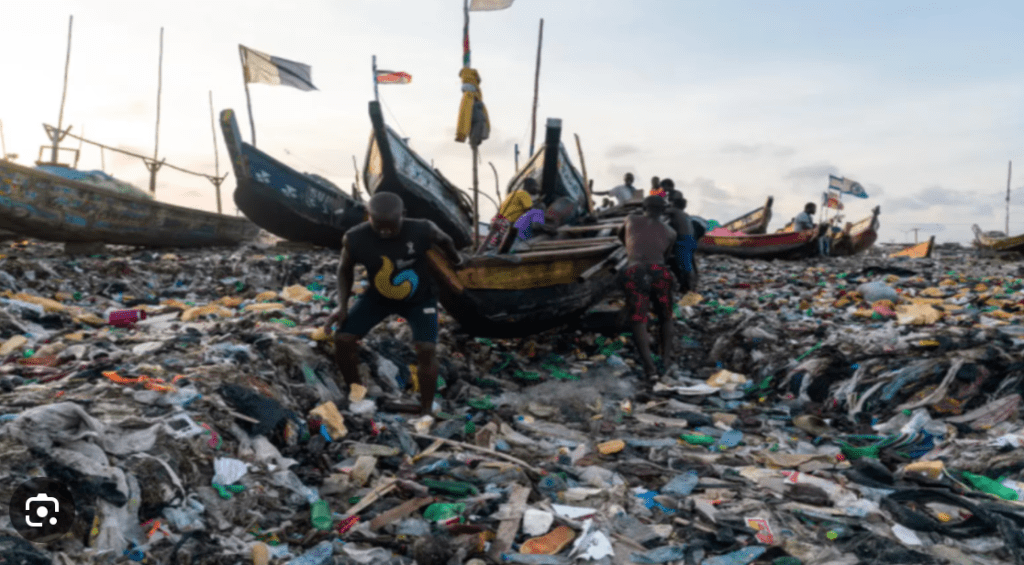
If you don’t know about the world wide problem of clothes on the Ghanian beaches, and have a moment, stop right here and just look up “clothes in the ocean off Ghana” and choose images. What you will see is not an exaggeration. It’s real and it’s disturbing.
The clothes we give away to thrift or place in bins have the best of intentions coming from us. There are people who benefit and get their clothes from these places. But there are not enough people in the world who have clothing needs in comparison to the waste.

Back in 2017 my husband and I traveled to Africa for a few weeks on an overland Safari. Twice we passed through the town of Maun in Botswana. It was the only town with the smallest sign of stores and street vendors that we saw in the entire country. Do you know what they were mostly selling? Clothes. Clothes from first world countries that we buy and donate. Racks and racks upon streets and streets of our old clothes.
You would be hard pressed to meet anyone who hasn’t heard about the horrors of the clothing business and sweat shops. Even though it’s been about 20-30 years since I first heard about it, the problem only seems to be getting worse. More and more shops pop up with more and more humans ‘earning’ starvation level wages, being denied bathroom breaks and sick leave. What’s worse? Knowing this hasn’t helped me to remember to stop with the buying. I did start shopping consignment a few years ago, but it’s so tempting to keep buying cheap inexpensive items online when I need something and it shows up right at my door less than a day later.
But it doesn’t make it right.
Despite my own attempts to streamline and keep a capsule closet, somehow every few months I have an overstuffed closet and find myself purging my clothes, shoes and jewelry, keeping only “what sparks joy”. I attempt the “sparks joy” mantra when I am online and needing for example, a simple pair of black leggings. Do you know how difficult it would be to find a pair of black leggings in a thrift or consignment shop? That also means I need to leave my couch and spend what little precious time I have off in a store with racks of clothes packed so tight that it hurts my fingers to even push the hangers aside.
So instead I jump on Amazon and put “small black leggings” in the search bar. My intention is for it to end there – just to choose a single pair and get off. But there are so many options I find myself spending entirely too much time clicking on multiple images that are not capris, have fringe, a flap on the waste, some ridiculous pattern… Minutes and minutes tick by. I find one that is perfect, I think! But not my size, they are not black, they don’t carry black. I click and click and I’m in a hole of despair. Then finally I’ll find a pair in a 3 pack. Do I choose the pack of three black or the ones that have black, white and red? I could use a red pair I tell myself, to match the tunic I bought and haven’t worn yet because my last pair of cheap (black none-the-less) leggings have a hole in a seam. Even though black would match, red would match better. And then right next to that 3 pack is another with grey, navy and army green. Those would all match great too! Yay I think. Now that I have spent more time than it would take to drive to a store to find leggings, I finally find a pair. I just bought 6 pairs and I believe I am done.
They seem to arrive 5 minutes later and one of two things will happen. I will either unpack them and put them away, or try them on because they look funny, or see-through or too tight. If I keep them the likelihood of me using them is low – I will more than likely grab the simple black pair over and over until they crumble to trash in a few months and completely forget about these other colors. When I purge my overflowing closet again in a few months I will donate them because I don’t use them. They don’t spark joy.
OR I will try them on and hate them. Then I will find myself having to drive to Kohl’s to return them. Kohls will give me a 5% off coupon at which time I will pass leggings on my way to the far end of the store and I will buy a pair on the spot without trying them on because I am in a rush to get somewhere. The same saga will unfold and those leggings I returned are not going back on a shelf – they are being donated or thrown away (look this up too, it’s true).
This is all from me, with good intentions. Who attempts to only shop fair trade or consignment. And I’m in the hole with the rest of the world. A cog in a horrific wheel of human waste, destroying the planet.
This isn’t just a problem with leggings for me. Or clothes. In the past 6 months I cannot even tell you how many coffee frothers I have been through. I will not even look at Temu. When I search “American Made” or “Fair Trade” – it’s almost as if search engines are broken. All I get are ads, sponsors and the absolute inability to tell where or how anything is made.
A paragraph from my enraged husband: Now we have a new online shopping service, Temu, that has taken “fast fashion”, the concept of cheap clothes production destined to be worn and thrown out quickly, to a new level. Temu specializes in selling high volume, low quality clothes and other junk from China. They offer incredibly low prices through a combination of Chinese government subsidies, purchasing clothes from Chinese factories that exploit their workers, (look up the factory policy of 996) and avoiding US import taxes by shipping in small quantities. China makes no secret about its goal of dominating global production of goods, and they do so through anti-competitive practices that leave US made and other non-Chinese producers at a disadvantage. Shop like a billionaire = shop and contribute to mountains of garbage on African beaches, and poor Chinese workers with no time for anything other than work and sleep AND forcing companies from other countries out of business.
I don’t know how to stop the madness, but look at Ghana. It starts with awareness at least. How about “shop like an informed billionaire”.
An article just published today on the NY Times: https://www.nytimes.com/2024/09/14/business/economy/tariffs-amazon-walmart-china-shein.html?smid=nytcore-ios-share&referringSource=articleShare&sgrp=c-cb&ngrp=mnp&pvid=1B1BD8B6-958A-4F1A-91C1-25CBD779178E


 esterinaanderson.com