When Daren and I first got here to Italy five months ago, and Daren got the blogging bug (I’ve been blogging for over 10 years), we reframed my WordPress site around our Italy experience and created three areas on that page: My Experience/Posts, Daren’s Experience/Posts, and Our Travelogue.
If you haven’t seen it because you get the blog in your email, it’s EsterinaAnderson.com.
At first we did post separate things, but for a long time now we’ve pretty much only used the joint Travelogue section.
Why am I saying all this? Because this post is from me (Esterina) and belongs completely under the Esterina’s Posts button. This isn’t one of the posts we both edited together, so I don’t want to rope him into this.
We came to Italy to take a break from life and see how other people live.
When we first started tossing around the idea we are now living, the main goal was to step away after retirement, work on my citizenship, and see what happened. And that break is happening.
Our mornings are slow to start. Yoga, then coffee and the New York Times games together. Then often some exercise and computer work. We talk—a lot. Most of the day. We talk during meals, during errands, and on our many long car rides as we travel. This was the goal. To connect, ponder, and explore.
The conversation has shifted and changed since we got here. Initially we thought we might want to do NGO work, maybe in Africa or the EU. Citizenship certainly would open more doors for us to do those things. We also initially considered really ramping up and expanding our small consulting company. Those talks have now evolved into different conversations.
We talk about deep and spiritual things. We talk about how we want to spend the rest of our lives, who we want to be, and how much, if any, work we want to do for profit. We are doing a lot of reading for fun, but also a lot of reading about Life Part II and spirituality. The books we both read, whether novels or not, we talk about often for hours—how the characters behave, who or what they remind us of, and things the other person might not have considered. We talk about experiences we’ve had, both together and separately, and what we’d do differently now. We talk about the similarities and differences between the U.S. and Italy, what we like about each, and what we don’t like about each. We fuss over Koji. We talk about how we want to show up for the people we love.
These conversations have become really important and might just be a keystone of how, in years to come (assuming I’m lucky enough to have years to live), I look back on this time here.
I know from our blogs it probably looks like all fun, games, traveling, and bliss. But there is another side to what we’re doing. It’s not as glamorous, it’s hard to explain, and it has nothing to do with frescoes, churches, or sightseeing. It’s what happens in between, while we are shopping and going to the comune and to the veterinarian.
While I love traveling, the glitz and writing about it have fallen to the back burner for me. We’re mostly going to tourist cities, and for the most part they are very similar. Walled cities with souvenir shops, gelato, and churches. These places are indisputably beautiful, but they’re honestly starting to feel like a lot of the same. Luckily, our next few planned trips are a little more off the beaten path, and the places that aren’t will be with friends who are coming to visit.
In case I haven’t said it before (if you’ve talked to me, you’ve heard it!), I am really tired of Italian food, and it’s almost all we can get while traveling. Daren keeps writing that we eat different things whenever we go to cities, but we don’t go to cities very often. We used to eat Indian food at least once a week, and I think we’ve had it four times since we’ve been here. We can cook different things at home, but even that’s limited. The grocery stores are very large, but not as diverse as I expected.
I’m also really struggling with the cadence of life. The riposo is a bit of whiplash for me. From a non-Italian or non-Spanish perspective, it initially sounds cozy, romantic, relaxing, and family-oriented. Riposo (like a Spanish siesta) is the afternoon break when many businesses close for a few hours. It wasn’t created to inconvenience anyone. It grew out of a culture that values a long midday meal with family, stepping away during the hottest part of the day, and then returning to work later into the evening. It’s a rhythm that made a lot of sense long before air conditioning, supermarkets, and 24-hour convenience became normal in the U.S. and other European countries. But I’m finding it a little depressing. The streets are empty. Stores look like they’ve been closed since the Dark Ages, with metal gates over the doors. The piazzas empty out. It feels like a deserted ghost town.
The riposo and lack of air conditioning go hand in hand. The buildings are made of heavy stone with small windows, so many places are naturally dark. The shutters stay closed to keep the heat out, which means even less natural light. I’m used to bright, open, airy spaces with lots of sunshine, so this doesn’t fit with my natural circadian rhythm, and I find it difficult. I know what I need to do, and I do it. But I haven’t gotten used to it, and I’m struggling a bit.
I’ve been feeling a little off. We were up until 2:00 in the morning Friday night at the opera, and I slept terribly that night. Then I slept poorly again last night because I was overtired. After a mid-afternoon nap, I had a nice break to reflect on how I’d like to say this (which I am doing now).
When I woke up, I just lay there and thought about nothing… in the heat, with the sound of a fan blowing. It reminded me of when I was a kid in Brooklyn and later on Long Island, before we had air conditioning, or when we would only turn it on for a little while during the day. There was nothing to do and nowhere to go. The days felt so long. It felt free. Someone else took care of dinner and the bills. The day would be ahead of me. I’d wake up, lie in bed, and just think about nothing in particular while I listened to the fan blowing.
Today was like that. I need this in my life. Everyone should be fortunate enough to take a (what Daren is calling) sabbatical in their mid-life at some point.
I wanted time to reflect, to think, to decide what to keep and what to let go of—in what I think, what I own, what I do, and what I want to do. While riposo isn’t my cup of tea, it is helping me not “go, go, go” all day and instead take an afternoon break.
Retirement adjustment is a real thing. I knew it wouldn’t be some kind of amazing transition. I wasn’t sure what to expect and this is all part of it.
I’m not sure exactly what I’m trying to say, except that there is much more going on here than what shows up in our Travelogue. While this kind of sounds like a Seinfeld show (in that it’s about nothing), there is so much more than the eye can see in the nothing. There’s been a lot of soul-searching, a lot of downtime, and a lot of adjusting to a different way of life. Some parts of it I think I’ll carry home with me. Other parts I’ll happily leave behind. I don’t think the grass is greener anywhere else, but I do think it’s worth seeing that there are other ways to do things, even in two first world kind of similar countries. I feel blessed to have this experience even though most days do not look like the blogs you read! And I have to say I’m gladder than you would think that the actual experience is not exactly as it may seem in our posts. The nothingness is really where the treasure is for me. And that is something I will always carry with me no matter where I am standing in the world.
After yet another terrifying, then exhilarating experience yesterday, I believe it’s finally time I tell you what this whole Italy thing has been like from my point of view.
First of all — this is Koji.
Most of you probably know me already, but if not, my mommy and daddy are Esterina and Daren. Mommy is helping me write this because, despite my many talents, typing is apparently beyond my skill set.
It all started with the crate.
I hadn’t seen a crate since I was a tiny puppy. Back then I actually liked it. One day it disappeared, which I assumed meant I had proven myself trustworthy enough not to destroy the house while nobody was home.
Then suddenly, eleven years later, a giant crate appeared in the living room.
This one was sturdier. More serious.
Naturally, I climbed right in because I remembered the assignment. Also, every time I went inside, treats appeared. Sometimes daddy closed the door and left me in there for a while. Honestly? Not bad. Cozy enough. The crate sat next to my dog bed for weeks, so eventually I stopped questioning it.
Then one day the house became chaos.
Suitcases. Humans moving quickly. Doors opening and closing. Stress smells.
And then somehow the crate came too.
I knew we were going on an adventure because suitcases always mean somebody disappears for a while. The trick is figuring out whether I’m included. I watch carefully for clues:
Is my food being packed?
Is my travel bed involved?
Has someone picked up my leash?
The leash is the final confirmation. Once the leash appears, I allow myself to emotionally commit.
That day, I knew I was coming.
But something felt… suspiciously large-scale.
We all got into a huge car with a driver. Me, mommy, daddy, bags, and somehow the crate too. I sat between them while the world rushed by outside the windows.
Then we arrived somewhere unlike anywhere I had ever smelled before.
Let me tell you something about airports: Outstanding smells. Absolutely incredible.
Thousands of humans. Thousands of shoes. Old crumbs. Fear. Coffee. Perfume. Mild panic. One abandoned french fry.
A sensory masterpiece.
At one point, some men took my crate away while mommy and daddy walked beside me telling me I was a good boy in the tone humans use when they are pretending not to worry.
That’s when I realized: Something weird was about to happen.
Eventually they guided me into the crate and suddenly we were separating.
I squeaked a little. Not dramatically. Just enough to register concern.
Then came many loud noises, strange movements, rolling, lifting, waiting, more rolling, more noises, and an extremely long period of time where absolutely nothing made sense.
At some point the whole world tilted upward. Later downward. Then loud again.
Frankly, I decided the best strategy was acceptance.
Eventually the crate started moving again and suddenly — THERE THEY WERE.
Mommy and daddy.
I cannot adequately explain the relief.
I exploded out of that crate emotionally and physically although I tried to remain composed.
They tried to get me to eat and drink and use the potty, but I was simply too overwhelmed to focus on bodily functions.
Then we got into another car — this one just for us — and after a long ride we arrived somewhere quieter.
There were two ladies there. And another dog.
His name was Rhum.
We sniffed each other thoroughly and professionally. He informed me I was welcome to drink from his water bowl, which I appreciated because suddenly I realized I was incredibly thirsty.
That was the moment I understood: We were staying here.
Soon I was introduced to what appears to be my new life.
Honestly? I like it very much.
There are hills everywhere, which is admittedly a little tough on my hips, but the tradeoff is excellent smells.
I have now smelled:
olive groves
vineyards
medieval streets
beach air
outdoor markets
approximately twelve thousand years of accumulated Italian dog pee
Daddy likes to say I am smelling “medieval urine.”
I don’t fully understand what medieval means, but I respect the depth of the scent.
The most shocking part of Italy is this: I AM ALLOWED EVERYWHERE.
Stores. Restaurants. Outdoor cafés. Little shops with meats and cheeses hanging everywhere like some kind of fever dream.
The humans speak in different words now, although honestly I never understood English either, so this has not been a difficult transition for me.
People here love dogs.
Sometimes they bring me water. Sometimes treats. Sometimes they bend down and call me “bravo cane,” which apparently means I am an excellent citizen.
I already knew this.
One of my favorite things is going to restaurants with mommy and daddy. They sit for very long periods of time while I rest under the table like a furry security detail.
The only issue is other dogs.
When another dog walks by, I do feel it is important to announce myself loudly so everyone remains aware of the situation.
This has not always been appreciated.
Still, overall I believe my public behavior has been excellent.
We also visit many piazzas, which seem to be giant outdoor human gathering zones filled with conversations, footsteps, pigeons, espresso, and confusion.
They are exhausting.
I often collapse directly in the middle of traffic flow to recover.
Duomo in FlorenceDipping paw for first time in the MedMarketsAn actual china shop!GelatoMore gelato (dog specific!)What dog heaven is like
Yesterday, however, was the strangest experience yet.
We arrived somewhere with an alarming number of stairs.
An unreasonable number. A hostile number.
I was already emotionally preparing myself for the climb when I noticed something horrifying:
The stairs were moving.
I immediately lay down on the ground because clearly this was a terrible idea.
But mommy and daddy reassured me with pets and encouraging voices, which usually means they are about to force me into personal growth.
Daddy gently dragged me onto the moving stairs.
At first I trembled.
Then suddenly I realized something incredible:
THE STAIRS WERE DOING THE WALKING FOR ME.
Honestly? Revolutionary.
By the second escalator I was uncertain but cooperative.
By the third one I trotted right on like an experienced commuter.
I have changed as a dog.
Mommy later told people this story and her friend Sarah — Chester’s mom — apparently said, “You can teach an old dog new things.”
I was very proud to hear that.
Anyway, I thought it was time I explained what this whole Italy experience has been like from my perspective.
I want to pause for a moment and say how incredibly lucky we are to be able to bring Koji along on this adventure. And honestly, he’s pretty lucky too.
Koji is a rescue dog from a high-kill shelter in Tennessee. On Friday, May 15th, he turned 12 years old. As a larger dog, we’re starting to see signs of age creeping in a bit, but he is still unbelievably happy, curious, loving, and as healthy as we could hope for.
Because Daren, Koji, and I were fortunate enough to find one another — thanks to my son Tom, who originally petitioned for us to adopt him — I’ve been thinking a lot lately about giving back to other dogs and to the organizations that make stories like this possible.
That bumper sticker that says “Who rescued who?” really is true.
I recently created a small section on my website (Digital Downloads)where I’m sharing collections of digital iPhone wallpapers. Some are favorite older photos from the U.S., and others will be small collections inspired by our time here in Italy.
They’re simple instant downloads that cost just a few dollars, and all proceeds will be donated to the Cosgrove Animal Shelter in Branford, Connecticut.
If you’d like to support the joy, comfort, companionship, and second chances that rescue animals give so freely, feel free to download a photo you love.
We’ve just returned from a two-week swing through southern Italy and have plenty of reflections to share. Our itinerary included some of the country’s most iconic destinations—Sorrento and the Amalfi Coast—as well as lesser-known areas in Calabria, including Tropea and the region around Crotone.
We knew there was a North/South divide in Italy before this trip—but only because we had started looking into it when we were planning our move. Before that, it really wasn’t something we understood or thought much about, despite having been here, watching movies about Italy, and knowing plenty of people with Italian roots. What we didn’t realize is that it’s not exactly something people talk about openly here.
It seems to fall into that category of topics that carry some weight. Not necessarily hidden, but not casually discussed either. And that makes sense, given how much history—and reality—is tied up in it. At the same time, if we didn’t really understand it until recently, we’re guessing a lot of our family and friends don’t either. So we’re going to share what we’re learning!
Part of the reason this divide isn’t widely understood—especially from an American perspective—is because, from the outside, Italy is presented as one cohesive, romantic place. And if you’re just visiting, that’s how it feels. Most trips hit the same highlights—Rome, Florence, Venice, the Amalfi Coast. They’re all beautiful, welcoming, and very used to tourists. It ends up feeling like one seamless experience rather than a collection of very different regions. The deeper differences—economic, cultural, even linguistic—aren’t obvious on a short trip.
Then there’s the version of “Italian culture” many of us grew up with in the U.S., which was largely shaped by Southern Italian immigrants. Over time, that became its own blended identity—food, language, energy, traditions—and it’s easy to assume that’s what all of Italy feels like.
But it’s not that simple. The divide here isn’t dramatic or immediately visible. You can be in both the north and the south and still see stunning towns, have incredible food, and enjoy everyday Italian life. The differences show up more subtly—in how things function, in opportunities, in infrastructure, and in the pace and tone of daily life.
A lot of this traces back to history that most of us were never really taught. Italy only became a unified country in 1861. Before that, it was a collection of separate regions, and they didn’t all develop in the same way. The north industrialized more quickly, while the south faced longer-term economic challenges.
We also tend to generalize countries a bit. We’re used to thinking in big terms. But Italy is incredibly regional—it’s almost like visiting very different parts of the U.S. and calling it all the same experience.
Before we made the move to Italy, we watched a documentary on Italian immigration patterns. It wasn’t until then that we realized that almost all the Italians we knew in the U.S. just happened to have roots from the Naples area, Sicily, and Calabria. It always felt like a coincidence—one of those things you hardly notice so never question. But it’s not a coincidence at all.
We learned the earliest large waves of Italian emigration began in the late 1800s—roughly the 1870s through the early 1900s. At that time, many of the immigrants leaving Italy were from the northern regions, like Piedmont, Veneto, and Lombardy. Many went to South America, particularly Argentina and Brazil, where there was a strong demand for labor and a culture that, in many ways, felt more familiar. But over time the trend changed.
Northern Italy started to industrialize and become more economically stable, while the southern regions—areas like Campania (Naples), Calabria, and Sicily—faced deeper, more systemic poverty and fewer opportunities.
By the late 1800s into the early 1900s, it was southern Italians who began leaving in large numbers. Many still went to South America—again to places like Argentina, Brazil, and Uruguay—but by then those regions were becoming saturated with immigrants. Again the migration patterns changed.
This is when large numbers of Italians began immigrating to North America, particularly between about 1880 and 1920. They came to cities like New York, Boston, Philadelphia, and Chicago, settling into tight-knit communities that many of us still recognize today.
However, unlike earlier migrations, they weren’t always welcomed. Southern Italians, in particular, faced significant discrimination and had to work incredibly hard, often in difficult conditions, to build a life here. Over time, though, they did what immigrants always do—built communities, held onto their traditions, adapted where they needed to, and slowly became part of the fabric of the country.
And so, somewhere along the way, that became the version of “Italian” that many of us grew up with. The food, the energy, the family dynamics—the pizza, the pasta, the loud kitchens and big tables. It’s such a strong and beautiful culture. But it’s also just one part of a much bigger, more complex story.
When you step back and look at Italy overall, you can start to see how all of this may have shaped the divide that still exists today. Entire generations left the south in search of opportunity, while the north continued to industrialize and build wealth. Over time, that created two very different realities within the same country—something that doesn’t just disappear, even after more than a century.
This divide is rooted in history, geography, and economics. Exploring it could easily fill its own blog post, but it’s worth noting that southern Italy is generally less affluent, less developed, and less urbanized than the north, with distinct cultural differences.
What it may lack in infrastructure, however, it more than makes up for—with dramatic scenery, stunning coastlines, rugged mountains, exceptional food, and deep historical roots… most of which we’re only just beginning to explore.
So enough on this history lesson & let us tell you about our trip!
Southern Italy
Sorrento and the Amalfi Coast
Our trip began in Sorrento, often considered the gateway to the Amalfi Coast. Perched on a peninsula just south of Naples, Sorrento sits in the shadow of Mount Vesuvius, whose looming presence feels especially ominous if you’re familiar with the story of Pompeii.
Reaching Sorrento involves driving through Naples and then through a series of long tunnels cut through the mountains. Our first impression wasn’t especially favorable: heavy traffic, tight roads, and a seemingly endless swarm of scooters operating by their own unwritten rules. They zipped past us on both sides—even crossing into oncoming traffic on narrow two-lane roads—creating a constant, buzzing chaos that made the drive more stressful than scenic.
After one night in a disappointing rental, we relocated to a comfortable hotel just outside of town. Over the next few days, our impressions improved. We found spots to take in the stunning clifftop views over the Bay of Naples and toward the island of Ischia, enjoyed a few excellent meals, and spent time relaxing by the pool.
Sorrento itself is undeniably touristy. Even in mid-April, the streets were crowded with tour groups, and the narrow shopping lanes were often packed.
One unmistakable theme of the region is lemons. They are everywhere—growing in groves tucked into backyards and terraced along steep hillsides. Many trees are covered with wooden frames and green netting to protect them from the elements. In town, lemon motifs appear on everything from clothing to ceramics to linens. And Esterina just had to buy a pair of lemon pants that she is wearing every few days now.
We took two successive day trips to the Amalfi coast starting with Positano, the first major town on the Amalfi Coast when traveling west to east. The drive alone was unforgettable: narrow, winding roads climbing over mountains before descending toward the sea, with breathtaking views at every turn.
Positano itself is a nearly vertical town cascading down toward the water. It’s undeniably beautiful, though heavily touristed. Still, it charmed us. We had one of the best meals of the trip there—gnocchi and fresh local fish—while Koji rested contentedly under the table. Linen clothing is practically a uniform in the Amalfi towns, and I (Daren) couldn’t resist adding a few pieces to my summer wardrobe.
The beaches here are dark and rocky, shaped by the region’s volcanic origins. Even in April, people were sunbathing and swimming. Koji braved a quick dip; we, lacking swimsuits, did not.
On a second day we came back to see the town of Amalfi itself. While undeniably picturesque from a distance, we found the town smaller, more crowded, and less appealing than Positano. Its narrow spaces felt more congested and shaded, and the density of tourists diminished its charm. In contrast, the journey along the coast—with its dramatic cliffs and buildings perched impossibly above the sea—was the true highlight.
On the way back, we stopped in Maiori, just a few miles away but worlds apart in atmosphere. With a long beach, a relaxed promenade, and far fewer tourists, it felt more authentic. After a leisurely seafood lunch, we spent an hour simply lying on the beach, listening to the waves.
Overall, we left the Amalfi region with mixed feelings. The scenery is undeniably spectacular, but even in shoulder season, the crowds, traffic, and overtourism detract from the experience. It’s hard to imagine what peak summer must be like.
A highlight of our trip was a guided visit to Pompeii which sits between Naples and Sorrento and was easily reached by a ½ hour ride on the regional commuter rail line. With an archaeologist as our guide, the ancient city came vividly to life. Though roofs have largely collapsed under volcanic debris, the layout of streets, buildings, and public spaces remains remarkably intact. We were especially fascinated by the bathhouses, with their distinct hot, warm, and cold rooms, as well as the preserved mosaics and roadways. Our guide’s insights into language—particularly the connection between Latin and modern languages—added an extra layer of interest.
Calabria: Tropea and Beyond
After five days in Sorrento, we headed south to Calabria. The drive itself was a highlight, passing through rolling farmland, green hills, and fields dotted with wildflowers. As we moved farther south, the landscape became more rugged and developed.
Our destination was Tropea, often called the “jewel of Calabria.” Perched atop cliffs overlooking a striking white sand beach, it’s easy to see why. There, we met Esterina’s brother Frank and his girlfriend Mary, who joined us after spending several days in Rome.
Tropea is small but charming, with lots of nice restaurants and a relaxed pace. While still a tourist destination, it felt far more local, with relatively few international visitors. It was beautiful, but a bit rough around the edges. We spent our time enjoying seafood, relaxing on the beach, staying active, and learning about the region’s famous red onions—renowned across Italy for their sweetness and featured prominently in local cuisine.
Family in Crotone
Our final stop was with family in and around Rocca di Neto, near Crotone. As on previous visits, we were welcomed warmly and treated to incredible food and conversation. It was also our best opportunity yet to practice Italian, as few family members speak English.
This visit held special significance: Esterina and Frank brought their father’s remains to be placed in the family mausoleum alongside previous generations.
We spent a day exploring Crotone’s old town and its quiet seaside promenade before gathering for one last family dinner. Crotone, like Tropea, was a mix of historic charm and grittiness. The next morning, we began the long drive back north to Tuscany.
Final Reflections Each place we visited had something to offer—and something that didn’t quite land. Sorrento and the Amalfi Coast are undeniably stunning, but also incredibly crowded. Tropea’s beaches are beautiful, but the town itself felt a bit worn, with visible garbage and public spaces that seem overlooked.
But what stayed with us most was the time we spent with family. It was a simple reminder that keeps coming back to us—where you are matters, but who you’re with matters more. And in the end, that’s the part we’ll remember.
Thanks for taking the time to read. We’d love to hear your thoughts!
Please feel free to leave a comment or subscribe for future updates.
Long before our move to Italy, we had planned a trip to Rocca di Neto for April of 2026. I turned 50 in February and wanted to go to Italy to see where my father grew up and connect with my relatives. At the time, I was even hoping my father would be able to come too.
My father hadn’t been back to Italy in about 20 years. For his 70th birthday, my brother Mario and I helped him renew his green card so he could get his passport and travel again. This April would have been the perfect time.
Running in the background of all of this since 2018 was my effort to obtain Italian citizenship.
I had worked with a lawyer for a few years who suggested that the fastest path might be to move to Italy temporarily and apply from here. At the time, that didn’t feel realistic. We had kids still in school and jobs that wouldn’t allow for that kind of move. Who has the luxury of just packing up and heading to Italy “for a while”?
So I gathered all the paperwork and began the process through the Italian consulate in the United States. Because we live in Connecticut, that meant going through the New York City consulate. The wait time for an appointment there is several years long. After years of gathering and translating the correct documents, I added my name to the list in June of 2022 and still haven’t received an appointment.
Then last year, everything shifted in ways we couldn’t imagine.
I unexpectedly retired. Not long after, my father passed away in August. The months surrounding that were a whirlwind of family chaos and change. Daren was still working full time, but we started talking about what we really wanted next.
We both wanted to keep working—but in a way that allowed for more flexibility, less stress, and more control over our time.
And suddenly, moving to Italy for a year didn’t feel unrealistic anymore. It felt right.
After my father passed, the three of us—his children—made the decision that Pops would still go to Rocca in April. We cleared it with the family in Italy, who thought it was a great idea. This week, we carried that plan out.
Before moving to Italy, we had even considered settling in Calabria to be closer to family. We visited the area last October. I had met many of my relatives before in the United States when they visited.
When we arrived last fall, we were welcomed at the small airport in Crotone by my uncle and two aunts. The airport is so small they were practically at the gate. Even though it had been many years since we had seen one another, we all recognized each other right away.
And then came the welcome.
It was like the movies—one long table, full of food, constant conversation, introductions, laughter. We spent a few days with them, fully immersed in it all.
For me, it truly felt like home.
I lost my mom when she was 49, and my dad last summer. For the past 15 years or so, my father didn’t really have a place of his own, so “going home” meant going to newer places that were fine, but didn’t have a deep connection to me.
But in Italy—even having not been there since I was very little—it felt familiar.
My relatives’ homes were decorated the same way my parents decorated. The same types of frames, candy dishes, the same overall feel and aesthetic.
My uncle Joe and his wife even had the same dishes my parents had. My aunt said it was because she and my mom bought them at the same time.
My aunt Sarah’s food tastes just like my mom’s did. It’s uncanny—especially the rabbit sauce. When I told her this, she said it was because her mom (my grandmother, and my mom’s mother-in-law) taught them both how to make it.
We don’t know each other well, but my cousins—especially the men—have the same mannerisms as my father and brothers. The same humor, the same playful energy. They laugh and carry on with the same joy we had when my father was alive.
The language barrier was there, but it was also strangely fun to navigate. We made it work.
When we visited last fall, we seriously considered moving closer to them.
There are real benefits. It’s much easier to practice Italian when people are patient and willing to wait while you find the words or look them up. Learning feels more natural that way.
But Calabria is far south and not close to major international travel routes. With four adult children and family back home, we felt more at ease staying connected and accessible. Being that far away made us feel just a little too vulnerable.
And even though we didn’t move here, we are driving away, having carried out the plan to bring Pops back to his hometown on Rocca.
Thursday we packed into few cars and made the short trip up the road to local town cemetery where the family has a mausoleum. We placed my father’s ashes amongst the other relatives that have passed alongside his parents (my grandparents).
My brother Frankie and his partner Mary were with us this time, and Daren and I took immense joy in seeing how quickly they were welcomed and made to feel at home—that they were with family.
It was special to see the experience we had before through their eyes, and to be back in it ourselves—this time understanding just a little bit more of the rhythm and the sounds around us.
Calabria feels like home. Not because I had been there before—but because so much of it already lived in me. The way people gather, the way meals are shared, the way homes are filled with the same small details I grew up with.
It made me realize that home isn’t always a place you return to. Sometimes it’s something that travels quietly through generations—carried in traditions, in mannerisms, in the way people connect with each other.
Being with people I barely know, in a place I had never lived, somehow—and truly—feels like home. It All Clicks.
Thanks for taking the time to read. I’d love to hear your thoughts!
Please feel free to leave a comment or subscribe for future updates.
Happy Easter – Buona Pasqua (in Italian, if you couldn’t deduce that ☺)
We are in Italy and alone. I feel like I should feel sad or lonely, but I don’t. And that in itself has me reflecting, because Easter hasn’t felt like much of a holiday to me for a long time.
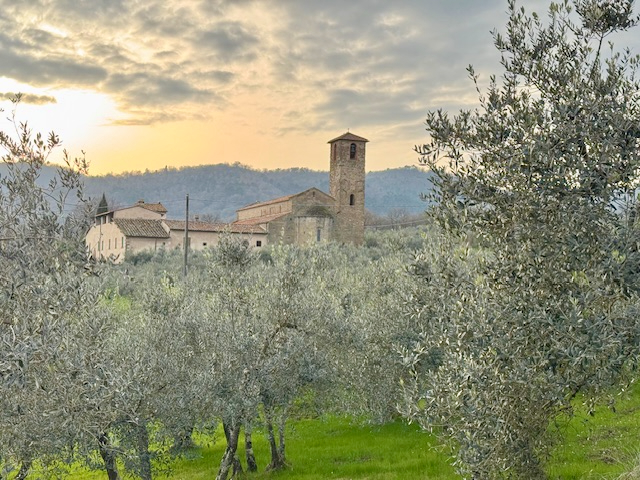
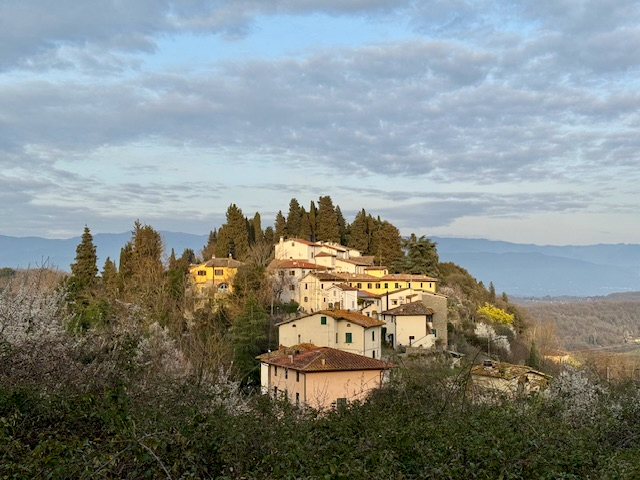
And yet here I am, in the hills of Tuscany on Easter morning.
When I was a kid, I went to Catholic school—St. Brendan’s in Brooklyn, New York. I loved Holy Week, beginning with Palm Sunday all the way through Easter and the vacation week that followed.
It wasn’t because of Jesus, exactly, or even religion. I loved the tradition, the pomp, the feeling that spring was on its way, the dressing up.
Being in Catholic school made it all feel special. The church was right next to the school, and for religion class we were often inside—looking around, practicing music, getting familiar with it. I knew what it looked like during Mass and in between. I loved how, in preparation for Easter, everything got cleaned and polished. The priests, who lived in the rectory on the block and were always kind and involved, would bring out their special robes. I had a crush on one of the younger priests—Father Michael.
Starting on Palm Sunday, the church was all dolled up. There were special Masses all week that were different and, to me, kind of fun—even if the topic was somber. For the short time I was in the youth choir, there were lots of practices and lots of reasons to go to church and hang out with my friends. By Wednesday of Holy Week we had a half day, and then were off for the next week and a half. As a kid, that felt magical.
Easter itself was always a little anticlimactic. The build-up was over. But there were egg hunts around the apartment, Easter baskets, and those gigantic Italian chocolate eggs my dad always found for my brothers and me—each with a toy inside. The toy was never anything special, but as a kid, any toy lit up my heart.
When we moved from Brooklyn to Long Island in middle school, Easter and Holy Week were never quite the same. I went to public school and didn’t spend time around church anymore. We still went to Mass on Easter, but we became the kind of Catholics who mostly showed up on Christmas and Easter. Going to church now required a car instead of a three-block walk, and we didn’t know anyone there.
Still, Easter was fun. We colored eggs, got baskets, received those chocolate eggs from my dad, gathered with extended family, and had a special meal that included rabbit—yes, rabbit, like the Easter bunny.
Years went by. I grew up and had children young. Until then, I hadn’t really experienced Easter without kids involved—either being one or having them. It was always about eggs, bread, a great meal, and extended family. Holy Week still carried that feeling of something special, even though I was no longer part of church festivities and rarely attended them.
And even though I no longer got those giant, mostly hollow chocolate eggs, my father always made sure my kids and their cousins did. I’m not even sure if the toy was still inside—my kids might know. What I do remember is trying to get the egg home intact and usually finding it cracked from the car ride. It always felt like too much chocolate, so I’d break it into smaller pieces, freeze it, and use it later for cookies or some other dessert in the spring.
It wasn’t until I got divorced and the family split up that Easter really started to lose its shape. Different traditions. Not always having the kids. The standard divorce agreement doesn’t even count Easter as a holiday.
And as I got older, I started to notice that Easter isn’t really considered a holiday at all. It falls on a Sunday, so there’s no time off from work. Even people who work that day don’t get special pay like they do on actual holidays. In the United States, Easter comes with plenty of fun—egg hunts, baskets, the Easter bunny—but the day itself doesn’t carry the same weight. It feels more like Mother’s Day or Father’s Day.
Over time, it started to feel less special. Holy Week stopped registering, the kids never really loved it, and somewhere along the way it became just another Sunday—one where I might text people, but didn’t make plans or go to church. Not because I didn’t want to, exactly, but because I’d feel like a total hypocrite showing up.
My father, who passed away last August, always loved Easter. Being here now, in his mother country, I can see it from his perspective. It feels like a bigger deal here—no Easter bunny, no egg hunts—but the bakeries are full, and those giant hollow eggs he always brought us are everywhere.
I can’t help but look at them and tear up a bit. He wasn’t always my favorite person, but once he was just a young boy excited about chocolate and toys like the rest of us. That’s what he passed on.
Those eggs feel different to me now.
And yet this morning, I sit far from family in the hills of Tuscany. An Italian sauce simmers on the stove. I hear birds outside. Soon we’ll pack up lunch and head down to the pool to celebrate Pasqua with other expats who also have no family here.
Today—between the sauce simmering, the quiet hills, and sharing pranzo with others who are also far from home—I feel something I haven’t felt in a long time.
Not the old version of Easter. But something just as real.
When I went for a morning run today along the path that follows the water from Santa Margherita to Portofino in Liguria, I felt so alive. So happy. So free.
My body was thanking me for running. The sun felt amazing on the few parts of my skin that were bare. I felt the thread of life all around me and deeply connected to my surroundings.
I’ve often felt this way while running or walking. Most often, it happened at home—in my neighborhood or during the lunch break walks I took nearly every working day since 2003. During those walks, I’d pass people and smile—sometimes say hello or good morning. If I was too out of breath, I’d just smile. If the other person noticed, there was almost always a small, lovely connection. Just human to human. A brief moment.
Smiling begets smiling. I always think of the line: “A candle loses nothing by lighting another candle.”
Today, on this particular run—alone in a new place, but along the same path Daren and I walked yesterday—I felt that same connection for the first time here in Italy. And for the first time, it felt normal to run by people and say, ciao, buongiorno, scusi, grazie, permesso…
People smiled. People greeted me back. Some were lost in their own thoughts and didn’t notice. It was no different from my lifelong experience at home in the United States.
This simple, beautiful act got me thinking: we are all the same. Everywhere. Humans are the same.
But a day or two earlier, I don’t think I would have had this experience. I would have been looking down at my phone, trying to figure out the route. I thought at first it was just that—being in an unfamiliar place.
But it’s more than that. Just a couple of weeks ago, I didn’t have enough words under my belt to greet strangers or make a passing comment, like “what a beautiful day.” Not that I’m any expert now—but having even a few phrases that I know I’m saying correctly creates connection.
And then, somewhere along the run, The Doors’ People Are Strange started playing in my head—and that sent me down another path of thought.
People really are strange when you are the stranger.
I am new to this land. Definitely a stranger. A foreigner. The one who doesn’t quite fit. So, of course, people feel strange. But as I get more comfortable—as I learn the paths—people become less strange. And I start to see how similar we all are, how people respond to me the same way whether I’m running here in Italy or on the familiar roads outside my home.
My mind then made a further leap—to all the things friends and family back home have told us or asked us, based on their assumptions about Italy and Europe in general.
I have to say… a lot of it just isn’t true.
Our lives, our stores, our people, our systems—love, power, corruption, generosity—you name it… they are far more similar than different.
There are three assumptions I’ve heard over and over again—one of which even showed up in my husband’s blog this week. There are more, but for brevity, I’ll stick with these:
The food is better
People are more put together and always well dressed
The roads are strange and driving is more difficult
These are often shared as facts—based on a single trip or experience.
So what’s actually true?
Food: Some food is better. But I’ve also had some really bad meals here, to be honest—especially outside of tourist areas.
Grocery store food? Hit or miss. I’ve bought the same items from Lidl or Coop and had completely different experiences—likely depending on delivery or the crop. Tomatoes and lettuce have ranged from absolutely incredible to completely tasteless.
Well-dressed people: On past trips to Italy, I noticed how put together everyone seemed. But now that I’m living here, I see plenty of pajama pants, yoga pants, joggers, sneakers, messy buns, and chipped nail polish. Sound familiar?
Driving: The roads are smaller, yes—but so are the cars. It actually feels pretty similar. The signs are slightly different, but very understandable if you’ve driven in the U.S. And the drivers? Same story. Tailgaters, slow drivers, unexpected moves… different place, same cast of characters.
So why do we think it’s all so different—and better?
Because most of us experience Italy as tourists.
And in tourist areas, the food is better. People are more dressed up. Everything is curated.
Think about major U.S. destinations—New York, D.C., Las Vegas, Orlando, New Orleans, Chicago, Miami, Seattle, San Diego, San Francisco. When I’ve visited those places, I’ve had the same experience: great food, well-dressed people, chaotic driving that feels totally different.
But what’s actually different in those moments?
Me.
And what’s the same?
They’re all tourist destinations.
Tourist destinations are designed to impress—better food, cleaner streets, people dressed for work or presentation.
Step outside those areas—whether in Italy or back home—and it’s the same story. Food is hit or miss. Roads are wider and quieter. And people are out living their lives in whatever is comfortable… sometimes not exactly stylish.
So back to my run. I realized that when I feel comfortable—when I know what to say—I connect more easily with people, and in turn feel more connected to that thread of life around me.
People aren’t all that different. They respond in much the same ways, no matter where I am.
And when I take that a step further, I see how this extends beyond just brief interactions. It challenges the assumptions we carry about entire cultures—about how friendly people are, how they live, what they value. Even the things we romanticize most—the beauty, the clothing, the food.
It’s not that these things aren’t special. It’s just that they’re not as different as we imagine—and maybe neither are we.
It’s 9:03 at night. My body is exhausted. It’s 3pm back home.
Home… home is here for now. In Italy. It still feels too new to remember that without a little whiplash.
My mind is tired too—but wired. Jet lag has that strange rhythm where I can feel like I might fall asleep standing up, and then suddenly I’m wide awake again, almost normal. Until I get a good night or two of real sleep, I imagine I’ll feel a little disembodied—like I’m participating in my life, but it belongs to someone else.
But we are here. We are here. We did it! No other day ever will be the first day. It’s surreal. I’m too tired to be excited. Except for being tired, it feels oddly very normal. We are sitting on the sofa. There is no TV yet. Daren is reading. We are thinking about opening a laptop or iPad to watch something, but who are we kidding? We are exhausted.
Traveling Overseas with a Dog
The thing everyone wants to know about is Koji (the dog) and how we got him here. This was hands down the most worrisome part of the trip. It was such a great unknown. We had some idea of what would happen, but not really. And holy worry about how he’d feel and behave. If only he could understand human language, we could have warned him what was going to happen.
For anyone who hasn’t flown a dog in cargo before (I didn’t know anyone who has), let me say a little more about what happened.
We left from JFK. For Italy, the only direct flight that would take a dog was ITA, and because of his crate size (large – for a 70 lb dog) they couldn’t guarantee him on a flight until 72 hours before. Obviously that wasn’t going to work for us, so we had to fly non-direct through Frankfurt.
Koji had never been to an airport. We were concerned he’d be out of his mind with being overwhelmed, barking and sniffing like a lunatic. But weirdly he was normal. He just walked around next to us like he’d been doing this his whole life. There were a few barks when one of us had to stand in a different line – more or less to notify us that our group was broken up. But once we acknowledged that the human at his side knows where the other human is and has eyes on them, he was ok.
Once at JFK we had to check in at a special excess baggage area. Our other bags were checked at that time almost normally, but Koji’s check-in was different. We were to bring an airline-approved crate, large enough for him to stand and turn around. We did a lot of paperwork ahead of time, including a health exam 10 days prior to flying that needed to be perfectly timed to get his shipping information back from the USDA. We showed up with everything needed.
They didn’t take him right away. We were allowed to walk him around and bring him out to a pet relief area. They helped us time his departure from us perfectly so we had time to get through security with him having the least amount of time in the crate.
Koji hadn’t been in a crate in almost 12 years. To prepare for this, we brought the crate near his dog bed in the house several weeks ago. We made it seem normal and like a safe place. We had him sit in there for short periods at first, then with the door closed, then longer periods with the door closed. By the time we got to the airport yesterday, with all the excitement of the ride and the stimulation of the airport, he was sniffing his crate as if he wanted to go in there and shut out all the outside stimulation.
Finally the time came where we walked with him over to TSA. He dutifully went in and was loaded on a cart. He squeaked a little, didn’t bark, and we reassured him with positivity that this was ok, it wasn’t against our wishes. And we left.
That was hard, but we did it!
I’d love to say we didn’t worry about it or didn’t talk about him very much, but that would be untrue. I will say, though, that I thought about it and fretted about it a smidge less than I imagined I would.
Once in Rome we weren’t sure how to collect him either. No one really told us. I am scratching my head in hindsight about why we didn’t ask, but it also turned out not to be that big of a deal.
We followed the signs to the excess baggage, but when we saw it we didn’t think it possible that our dog would come out of there. I stayed near the area and the carousel while Daren went to ask about it. Meanwhile I searched the internet about how to do this. Daren came back to confirm what I also found out – that we were in the right place and Koji would be coming out there.
We were both informed that he’d likely be delivered about 30 minutes after the bags came out. So I went to get us some coffee and croissants. I was only gone a few minutes, but when I got back – there was Koji in his crate!
Side note – it was mandatory to zip-tie the crate. Daren wondered how we’d get the zip ties off if we couldn’t carry scissors with us in our carry-ons. I assured him that the airline would be aware of this and bring out something to cut the zip ties.
Also, a side note – which was quite funny: we had to tape his food and water to the top of the crate. So we were running around with zip ties and duct tape – like kidnappers or something. But no scissors.
Well I was wrong and Daren was right to question this. The porter (a non-English-speaking Italian porter, that is) came out and was surprised to see zip ties. No scissors in sight anywhere. I came back while Koji was practically levitating in his crate with excitement, and the porter was using a key to slowly saw away at the zip tie.
We finally got him out. I’m not sure what I was expecting, but I’d be remiss not to say that I was surprised Koji was just himself. Very thirsty, but more or less his normal goofy self.
We collected our bags and proceeded to the car rental area. Koji trotted alongside me and the trolley cart like he’d been doing this his whole life. He even seemed to know where to go. I’m sure that was his nose picking up on the trail that many humans have traveled before us from baggage to the rentals, but it was weirdly and quickly business as usual for him.
On the way to the airport in the van transport, smiling! Trotting around the outside of the airport like it’s something he does on the regularChillaxing on the floor of JFK in front of his crate Made it to the other side! Just out of the crate. “Helping” daddy get the bags on the trolleySitting out on the porch with us – just like at home! Resting after the longest day of his dog life
DAY 2
We are just finding our way about.
Yesterday we hit up the stores to stock up on food and essentials. Our landlord and realtor highly suggested a shopping area that has a “Media World,” which is a Best Buy equivalent, and a really large grocery store. It’s kind of like a Walmart, but with more food and fewer non-food items. Not at Walmart prices though.
We were seriously there almost 3 hours. It was truly epic trying to find things in another language. I mean a lot of stuff is the same, like fruits and veggies, but things with labels in cans and boxes are not. I was undertaking the process of finding baking supplies. Some things I just couldn’t find and gave up and ordered on Amazon. Baking soda and baking powder were among the few.
We got back home and unloaded all the loot. That, plus making dinner and walking the dog, wiped us out for the rest of the day. We did squeeze in a short hike down the street where our landlord suggested.
Today was a true feat and success. We ventured out to get new Italian phone numbers and purchase a washer and dryer. Back to the Media World store we went, with some memorized words in Italian on our tongues, to do both – yes both. There is apparently a wireless service in this Media World.
We level-set our expectations based on the day before, anticipating that we would be in the store for a very long time.
We were quickly sidetracked. When we pulled into the parking lot Daren got a notification that our boxes from the States had been attempted for delivery, but the driver turned around because we didn’t answer the door. We’d only left like 10 minutes before! Of course that’s when they came.
We looked into the Send My Bags service we used and for some forsaken reason it said that if we weren’t home, to leave it with a neighbor, but the “neighbor” was a Tabaccheria. Huh?
A Tabaccheria, by the way, is a small corner type of 7/11-ish store with more cigarettes and lotto tickets than food, but the same idea.
We ended up sitting in the car on a live chat trying to figure out how we could pick up our boxes at a local DHL. We were so bummed to miss this delivery. We finally got it sorted and saw that we’d be able to pick up our boxes the next day.
Satisfied, we put on our armor and trudged back into Media World to attempt to communicate in a foreign language.
Amazingly – we walked out about an hour later with a washer and dryer on order, arriving by delivery with installation next week – AND new SIM cards and phone numbers.
Trying to figure out words and understand them is exhausting but also exhilarating. We were so excited that we’d accomplished this that we took ourselves out for lunch. We went to the piazza in town to one of the only places that was open. It was the kind of place my father would have loved and I would have hated, but the food was good! And quite inexpensive. However, we spent the whole meal messing around with our phones trying to figure out how to keep and use our American phone numbers and use the Italian data plan. With some Google and ChatGPT we were able to configure it all without too much fanfare.
At the end of lunch I checked my email and saw that 11 Amazon packages had arrived. Yikes! Then weirdly Daren got an email that our boxes from the U.S. were indeed delivered to a Tabaccheria. At the moment this Tabaccheria was closed and there were these boxes at home.
Side note: We are learning that almost all places close around 1pm and re-open around 3:30–4. They are serious about a lunch break! Wow. I can’t even fathom it. Most places open at 9 and then close at 7. It’s a 10-hour day, but with a really long break in between. I’m not sure how I feel about this yet.
We went back home to tend to these boxes. I was imagining how cramped we were probably making the walk past our apartment, and it turns out I wasn’t wrong!
Next we were off to the Tabaccheria to get our boxes from home, and entered the address in the GPS. This all seemed so crazy and we thought there was a slim chance our boxes would be there, especially considering how we asked them to be sent to DHL. We pulled into this tiny side street and waited a few minutes in the car until they re-opened at 3:30. We walked in with the Italian word for boxes just looked up and on our tongues, and behold… all 5 of our boxes were there! It was so exciting.
We grabbed them, came back home, and unpacked and unpacked. I assembled a coat rack. Daren messed around with installing a new TV our landlord dropped off. And exhausted… we had leftovers for dinner.
Daren went for his first run while I think I napped. He took these amazing photos.
Day 4
Just like at home I’m already returning stuff from Amazon. We hit up a Farmers Market. I finally found ginger. We stopped at a new grocery store and found cottage cheese! We were so happy. It was otherwise an uneventful day. I finally had most of the ingredients and implements to make our favorite things. We went home to open more boxes. I went to work making chocolate chip cookies, my favorite oatmeal nearly zero-point Weight Watchers cookies, compote, and my beloved ginger tea.
Day 5
First trip to Florence. Ever. It was a dual-purpose trip. One, to drop off our rental car and pick up our car subscription that we’d be using for the year. And the other reason was to declare my presence in Italy with the state police (Questura).
Mentally preparing to get yelled at by the Questura
The street navigation was the most annoying thing. At the moment Daren is furiously typing about it. I’ll let him elaborate.
The Questura, for what I needed to do, was quite a simple process, but a very long wait. My citizenship lawyer warned me about this so I was prepared. Everyone jokes here about Italian bureaucracy, but in all honesty it’s not that different from U.S. bureaucracy. I needed to do many things to prepare for this trip and to apply for Italian citizenship, and one of them was to get paperwork from the Department of Social Security. I speak the language, knew what I needed, and felt obviously confident enough to communicate this, but I also was prepared in the U.S. to get yelled at by a cranky federal employee (and I wasn’t wrong, I was talked to like I was a complete idiot) – both times I had to go down.
Side note: Why just me at the Questura, dnd why did we have to go? Well Daren got Irish citizenship a few years ago and can be in the EU without fanfare. And I can too for now with the 90-day pass American citizens have. But I will be applying for Italian citizenship as soon as a final piece of paper arrives. If we had flown directly into Italy and I came through the EU borders through Italy I wouldn’t have had to make this Questura stop. But because we had Koji and flown in through Germany, Italy didn’t know I was there so I had to let them know.
While at the Questura with my ticket to wait in line, Daren and Koji went to return the rental car. The area at the Questura was immigration. Here in Italy I am an immigrant. There were people from all over the world and walks of life and ages speaking all kinds of different languages. The main language the employees speak, of course, is Italian with very little English. Like in the U.S., the staff feel like if you will be in Italy you should try speaking Italian (who can blame them?). It was overwhelming and humbling to be there amongst all these other people trying to keep their paperwork in order.
I heard 3 women about my age speaking English with one another, each with different foreign accents. They were talking about how to cleanse from the negative energy of the Questura and the city. This was a conversation right up my alley! I went over to them and said I couldn’t help but overhear their exchange. They welcomed me, we exchanged names and countries of origin, and talked non-stop for the next hour or so. They all lived in Florence and were there for different reasons. All of them love yoga, one was even a yoga teacher. She and I exchanged contact information through WhatsApp. That was lovely. I don’t know if I’ll ever see them again, but it was nice to just speak English and meet new people.
This trip Beat Me Up. I was ready to call it a day by noon when I was done at the Questura but we pushed through it. We had lunch at an Indian place that allowed Koji to come inside – yes INSIDE! They gave him water (which he was very grateful for) and we enjoyed our first Indian meal (so good!).
We walked around a bit worried about how Koji would behave in a city. He is a well-traveled dog. He boated with us and visited our kids in college with us. He’s been up and down the East Coast and even to Canada, but he has spent very little time in cities. He surprised us by trotting alongside us like he’s been doing this his whole life! So we made our way from the car rental at the train station to the Duomo. Neither Daren nor I were wearing comfortable shoes. And the dog was kind of beat so we stopped there. But we felt victorious for making it to a monument, getting a car, and checking off this annoying task I had to do at the Questura.
Coffee and other things we are getting used to
Everyone knows that Europeans, Italians in particular, love strong black coffee. Small cups. When my father (from Italy) used to come to my house and see the cups of coffee we drank he would be annoyed. Every single time he had something to say about it. (Weirdly I remember my mother loving coffee just as much and making the same normal-size American cups and him not saying a word about it… but that is besides the point.) I know this intellectually. I’ve seen it. The rest stops have coffee counters with miniature cups. They look like something a child would play with in a tea set. The natives order their coffee, scoot to this counter, and drink this mini cup in record time and move on. I’m not sure what the purpose is except to caffeinate.
When our rental came with an American coffee maker I was quite happy. Daren does like the small strong black coffee and kind of said something to the effect of when in Rome, but I insisted that for me we keep this American coffee maker. The first day we were here we went to the only open grocery store (Lidl – yes, the same chain as in the U.S.) and bought a small super vacuum-packed bag of coffee, which was the only kind of coffee sold. We were jet-lagged, came back to our new home, and made coffee. It was delicious. The cups provided at the rental were quite small, and even though the coffee maker said 10 cups, it was about a cup and a half each.
To make a long story short…. After purchasing, then returning, mini coffee scoops…. And then buying a nice (I LOVE it) American coffee maker…. 10 cups in these European models do not mean what 10 cups in American models mean. There is no other size coffee scoop than the one we bought (and returned, thinking we bought too small a size). It is what it is. Even “American” coffee here is smaller. So we will either adjust to having about ½ the amount of coffee we enjoy in the morning or make 2 pots. Either way it was a week-long learning curve.
That is just one of the many silly things that tripped us up.
• How to navigate through a toll booth • Opening plastic tops from bottles • The necessity of weighing produce and putting a sticker on it to purchase it • Driving in downtown cities with secret zones where you need a pass (Daren will say more about) • 2 size plugs, the smaller type not being the converter size sold at airports and other places outside the EU zone
Daren’s take on Driving in Italy
Of all the adjustments an American needs to make while settling into life in Italy, I suspect that none are more challenging than learning how to handle a car and navigate in this new country. At first pass things seem very similar to home: cars drive on the right. Stop signs and traffic lights look the same, and cities are connected by an efficient system of highways with rest stops, overhead signs, construction alerts, and traffic updates. True, there are a lot more traffic circle and fewer traffic lights, but these are easy to handle and actually make driving smoother and more efficient. But after just a few days of driving, this comforting sense of similarity soon dissipates and the real differences become apparent. First, the roads: they are narrow, winding, and hilly. Even the highways, while extensive and well-marked, are much narrower with minimal shoulders and lots of curves and hills. While one gets used to this rather quickly, it requires a higher level of vigilance, especially since highway speeds tend to be faster than in the US, often 130km/hr (80 mph).
Getting gas is another learning experience. Where is the gas cap? How does it open? In our first vehicle the front door needed to be open to expose and open the cap. How do you activate the pump and pay? In one gas station you had to go to a pay station first and tap or insert your card. In others, you pump first and then pay inside. Not so difficult to handle, but just slightly different than our pay-at-the-pump simplicity in the US. And – these differences while nicely marked are in a foreign language so knowing what to do at each one presents a little more of a challenge.
Highway tolls are similar to the US and are easy to manage once you figure out the different lanes. You take a ticket when entering and, when exiting, either insert it into a machine and pay by tapping a credit card, or hand it to an attendant and pay them, depending on which toll booth lane you choose. Like the US, Italy has an “Easy Pass” that allows you to avoid cards and cash. Be careful not to accidentally drive through the “Easy Pass” lane as we did on our first sojourn. In so doing on entering the highway, we had no ticket with which to pay when we exited, requiring us to sneak through the gap in the toll gate! I am sure that the police are looking for us as it was added to a growing list of unintended infractions that we’ve been accumulating.
The other major violations we’ve committed occurred while driving in cities and entering zones where we weren’t allowed. Frustratingly, Apple or Google Maps knows nothing about this and simply maps out the best route to get to your destination, infraction zones be damned! We drove on streets indented only for buses and taxis. We nearly drove onto a tram track. Then we innocently drove on several streets that can only be accessed with “special permission”. These zones are indicated by a digital sign reading “ZTL” for Zona a Traffico Limitato. If it says “ ZTL Attivo”, that means it’s active and you need a special pass to enter. There is a sensor and a traffic camera capturing the identity of each car passing into the Zona. If you don’t have a digital sensor, like and Easy Pass, which you’ve paid for to enable you to pass into these zones, your plate is recorded and fines will be forthcoming. Add to this the fact that city streets are incredibly narrow. Motorcycles and souped up Vespas are flying all around you, trucks are double parking in front of Medieval walls and ancient stone buildings, all while clueless pedestrians (Americans no doubt), are swarming all around with little regard for cross walks.
Then suddenly a road becomes a market and you have to squeeze past food and vegetable stalls, cafes, and throngs of shoppers. Chairs and tables may need to be moved to enable your errant car to pass. And then suddenly a paved road changes to cobblestones and our dental fillings are all jarred out onto the floor mats.
After surviving a drive into Florence to address some bureaucratic residency paperwork and exchange rental cars, we vowed never to drive into an Italian city again, assuming we are not already banned from driving at all by the Italian police. There is a reason why Italy has an excellent system of trains and trams. They are there to help people avoid driving modern vehicles on streets designed for mules, horses, and maybe an occasional oxcart.
For now
This morning it’s Saturday (3/7/26 or as in Italy would be writting 7/3/26), and we finally feel a bit settled. We put together this blog and spent the morning over coffee, writing, and reminiscing about the week we just had. We wanted to capture it all before it’s a distant memory! Onto the next.
We hope you enjoyed reading this. If you’d like to follow us, click the follow button below to get updates when we post. I also hope to update these on Facebook too.
For those of you who don’t know, my father passed away on Wednesday. And for those who don’t know, my relationship with him was far from a beautiful “daddy’s little girl” type of scenario. I loved and hated him. I was afraid of him, yet I felt protected from the outside world by him.
My father was an alcoholic, mean, misogynistic, childish, and a bully. But he was also full of life, energy, and joy. He was strong—crazy healthy despite himself—and had the strongest work ethic of anyone I’d ever met. Just as strong was his play ethic: he worked hard and he played hard.
He lived a full life of ups and downs. He made money fast and spent it even faster. He loved drinking, gambling, and chasing women. He didn’t believe women should work or that education mattered. He believed you should take care of yourself and your family with food, shelter, and clothing in a basic sense. There was always enough, but always with the constant worry that maybe there wouldn’t be, the weight of bills looming.
From him, I learned a lot—what to do, what not to do, who I wanted to be, and how I wanted to show up in the world. This both served me and hurt me. The two main lessons I took from him were how to be productive and how to live fully at the extremes of emotion.
He hated the word “relaxing,” unless everything else that could possibly be done was already done. Before he came home, my brothers and I would scour the house for anything out of place, dirty, or unfinished. Yes, it was unhealthy—but it taught me to scan my environment, make lists, remember details, prioritize, and execute with whatever time I had.
This shaped me: I don’t know how to rest. I’m constantly doing, doing something, or several things at once. I am incredibly productive, and I think I like it that way. It’s a blessing and a burden, because I often don’t realize when I’ve pushed myself too far or taken on too much. My father, in an unhealthy way, taught me this.
Another word to describe him: loud. When the work was done, it was time to play and let loose. He had no qualms about body image, running around shirtless with his big belly. He sang at the top of his lungs, danced like a giant silly human without a care, and enjoyed food like there was no tomorrow. He loved sports—football mostly, the NY Giants in particular, but also soccer and basketball. Watching games with him was full of antics and superstition. The whole neighborhood knew if the Giants were winning or losing.
But with his intensity—whether excitement or anger—came loss of control. Things broke. People and animals got hurt, physically or emotionally.
Some of you who know me now might not realize that “loud” was once how I lived too. I still like to dance, be silly, and LAUGH—only now without the drinking and the overkill of noise.
Ultimately, I didn’t stick around to live like he lived or under his rule of thumb. I got the #$&* out of dodge and started a path of my own in the world.
I’ve learned over the course of the past 31 years that I struggle with boundaries. I was never taught them. I didn’t even know they existed. Particularly with extremes of work, play, and emotions—at first I had none. Everything was to the extreme. I’m now at a point in my life where I realize I can detach from those automatic reactions I was taught, and instead have healthier boundaries around rest, relaxation, and emotional highs and lows.
I am not perfect (who is?) and often struggle with doing too much without realizing it, or failing to recognize when I’m overwhelmed until it shows up as anxiety or panic. A lot of yogic work, mental health work, and a little medication have helped keep me balanced most of the time.
I sit here on my front porch on an August Sunday morning with my coffee and thinking about my dad.
There isn’t much rhyme or reason to this blog—just a moment to reflect on how my father shaped my life and who I am right now because of it. If I stay healthy, it’s not unreasonable to imagine living another lifetime beyond the years I’ve already lived (49). I can’t change the past, but I can absolutely change the future and how I choose to show up and react in it.
One day, those who are in my life when I pass will likely reflect on how I lived, what I taught them—whether it’s how they want to live, or how they want to avoid living. My hope is that whatever I put into the world, people experience it in a way that makes them pause—whether positively or negatively—and reflect on how their own experiences shape their behaviors and ultimately guide their decisions about who they want to be in the world.
And maybe, just maybe, that is the truest way my father continues to live on—through the ways he shaped me, both in what I carry forward and in what I’ve chosen to do differently. In that way, his life reminds me that even the hardest stories can become soil for growth, and that the future is always wide open for choosing a new way to live.
I know if I don’t capture the feelings now, I still might be able to later — but they will never feel as they do now.
Today. My last day of work. That elevator — the sound made me want to cry.
A hot day, not too different from today. 23 years ago.
5th Floor, Building 2 — right outside my door was the elevator bank. Mary Susie Conti — the woman I was replacing — was loading up my head with all that I needed to learn.
I was paying rapt attention, but every so often I sussed out the environment. It felt so different to be in an office in the middle of the day instead of home with my two small children, who were now 45 minutes away in a new daycare. Every time I thought of them, my heart hurt just a bit, and I had to intentionally put it out of my mind.
The feel of the air with the open window (at a time when we were allowed to open windows — now I can’t imagine), the humidity in the office, and the sound of the elevator’s electronic voice blathering all day:
“Fifth Floor Going Down… Fifth Floor Going Up.”
Over the next few days and weeks, I slightly startled the 50 or so times a day I heard that electronic voice announcing the floor it landed on and which direction it was going.
Eventually, it became background noise and I didn’t hear it at all. But when I did tune in, no matter the day or time of year, I was transported back to being 26 years old and learning my new job from Mary Susie Conti.
For the past 8+ years, I haven’t come into the office much. I was on a reasonable accommodation and working from home long before COVID. But I have to say — it always felt like home when I did go in.
I honestly believe one of the reasons I got the job is because of that “home”-like feeling.
When I interviewed for that first job, I went through a series of interviews back to back. Martha Shea was the first person who interviewed me.
Right off the bat, she made it known that if I didn’t pass her muster, the two doctors I would soon interview with would take her consideration into account.
She also made sure to tell me she was prior military and instantly started off by asking about my own military experience.
I was slightly intimidated, but something about her already felt familiar. She was my kind of people — I could tell.
I don’t even know how I wasn’t prepared for the question: “Why do you want to work here?”
I mean — for heaven’s sake — if a person can’t answer that, they shouldn’t get the job!
Martha asked me that question and my truly unprepared, but terribly raw response — when I looked around — was:
“Because it feels like home.”
Martha cracked a genuine smile and asked me why.
I looked around, asking myself the same thing to understand why I had that feeling.
I saw the government-issued 3-month calendar, where you save paper with the months on both sides. The chairs. The carpet. The signage. The halls. The overhead pages. Men with military regalia ambling down the hall. The feeling I always got crossing from a state line onto federal property.
So that is what I said. I first pointed to the calendar on the wall, then the chairs. I mentioned something that was broken in a corner and talked about how it all felt familiar.
I didn’t think about puffing everyone up with “helping veterans,” giving back, stories of grandfathers who fought in wars — or all the other things I subsequently heard over the years when I eventually became the interviewer.
My answer was candid and from the heart.
If my interview were a cartoon, Martha would have started off in a knight’s costume — complete with armor — to intimidate me. Then it would have fallen off, and you would have seen her heart literally melting.
She proudly walked me down the hall to the person who would eventually become my first supervisor at the VA.
With a hand on my shoulder, she introduced me in a way that made it clear she liked me and wanted to take me under her wing.
I already felt protected — and that I was with my people.
Today, I drove into for the last time.
The sunrise down the street from me. A new dawn to a brand new type of day for me.
I saw people parking, taking out their bags and lunches, putting on badges. These people were donned in suits, scrubs, lab coats — and everything in between.
I vividly remembered those early days of parking in that same lot. The uniforms, cars and smells were so unfamiliar at the time. Now they are all second nature. All these years I have been taking the same steps into the same building and heading to the elevators —
“1st Floor, going up.”
Today, I ran into one of my coworkers walking into the building.
We got on the elevator together, and I heard that same electronic voice, unchanged in all these years.
I asked him about his two young girls. He filled me in and then asked how old my children were now.
28 and 26. My youngest is now as old as I was when I first started working there.
I worked there for their entire lives. In some ways, I missed their lives because of that place.
I don’t know who I am without it.
Some people would say I worked there a lifetime (23 years).
Others, who have 40, 45 years in the government, would still consider me a newbie.
It’s all relative. But for me — between the military and the Department of Veterans Affairs — it’s been my whole life.
I had jobs in different buildings and offices. Not too many were close to an elevator bank.
Today, as I left, it was:
“7th Floor, going down.”
It felt like:
“Esterina, now going down and out — into the wider world.”
I sat in the parking lot for a long time. I read the cards I was given, sitting in my car with the air conditioning blasting.
I felt nostalgic — but very excited.
Driving away was the hardest part. No tears, but a large lump in my throat.
A piece of my heart will always be there — in those buildings, carpets, walls, files.
And just like that — “7th Floor Going Down” — one chapter closes, and another begins.
Nothing feels different, but everything feels different.
Chapter 2 is what I am calling this.
I sit across the breakfast table from my husband, but my personal laptop is in place of my work one. There still feels like there are a million things to do. But honestly, not a single one of them really needs to be done.
Was it always like this? Meaning, did anything really ever need to get done?
My heart is beating and I’m racing against the clock—stuff to do… I have to remind myself that there is nothing to actually really do. Today, there will be no sound of bings and chimes to notify me of new emails, Teams messages, or upcoming meetings.
Each of those bings is accompanied (was accompanied—gosh, this will take getting used to) by a spike in alertness and heart rate. At this time of the morning (6:15—YES, Six Flipping Fifteen), my heart rate and anxiety were probably elevated a handful of times.
Whoa, writing that out sounds so unhealthy. It is unhealthy. But I’ve been doing this for years.
Even when I was physically going into the office, I’d wake up around 5 a.m., and just thinking about the day ahead would spike my anxiety. Sometimes in a productive way, but often in a storm of worry about how to plan the day to squeeze the most out of it—for both home and work.
The drive in would be filled with thoughts, worry, plans, more plans. And once I had two kids—then suddenly four—that planning hit a whole new level: kazillion mode.
Things have been quieter in recent years with the kids out of the house and me working remotely. But the anxious habit stuck around. And so did the bings, dings, and mounting pressure of the average workday.
Not that long ago in a land not faraway
I remember back in 2002, my boss gave me access to her email because she found it overwhelming—she got up to 50 emails a day. I was floored. Fifty! I was getting maybe 10, mostly forwarded from her.
Now that number sounds almost quaint. If you get only 50 work emails a day in this era, you’re lucky. Managing email has become its own professional skill.
Most of it? Nonsense. But stressful nonetheless.
I felt like I had to walk into each day in full armor, machete in hand, clearing the overgrown weeds before they even had a chance to stop growing. 90% of emails went straight to Trash. Of those, maybe 10% were actually important—but wading through the digital clutter? A waste. So I created workarounds, tasks, and filters.
OK—seriously, I’ve digressed. But wow. It’s all so absurd.
Getting Anyone’s Attention
You can’t count on someone seeing your email. Depending on how someone organizes their inbox (and I’ve seen some truly wild systems), they may never even notice your message.
Urgent? Tag it with an @? Add the exclamation point? All overused. All part of the noise.
So we escalate: Teams. Work phone. Personal phone. Desk phone. And all of it—every single one of those tools—comes with a sound, a vibration, a ding that makes your chest tighten and your focus scatter.
But Now…
I closed the door. I shut the laptop. I walked away.
That’s why I’m sitting here this morning, coffee in hand, at a different computer.
And now I ask myself: How long will this feeling of impending doom last? (Not actual doom, of course—nothing I ever did was life-or-death. But that tight-chested feeling… it’s real.)
How long until I can simply be present?
I Want to Be Present
I want to be present in my life. I only get one. And I’ve spent 49 years rushing through it.
I’m safe now. I don’t need to stress myself out daily. If I live to be 100, I’m only halfway through. How lucky is that?
I feel so grateful. So blessed. And I don’t want to recreate the stressful life I just stepped away from.
It’s funny—I only found out a week ago that yesterday would be my last day of work. I didn’t dare dream about what’s next, out of fear I’d jinx it.
And now? The urge to plan the “what’s next” is already kicking in. But… I don’t have to figure that out right now, do I?
There’s no rush.
I have the rest of my life—whether that’s a few hours or another 50 years.