When Daren and I first got here to Italy five months ago, and Daren got the blogging bug (I’ve been blogging for over 10 years), we reframed my WordPress site around our Italy experience and created three areas on that page: My Experience/Posts, Daren’s Experience/Posts, and Our Travelogue.
If you haven’t seen it because you get the blog in your email, it’s EsterinaAnderson.com.
At first we did post separate things, but for a long time now we’ve pretty much only used the joint Travelogue section.
Why am I saying all this? Because this post is from me (Esterina) and belongs completely under the Esterina’s Posts button. This isn’t one of the posts we both edited together, so I don’t want to rope him into this.
We came to Italy to take a break from life and see how other people live.
When we first started tossing around the idea we are now living, the main goal was to step away after retirement, work on my citizenship, and see what happened. And that break is happening.
Our mornings are slow to start. Yoga, then coffee and the New York Times games together. Then often some exercise and computer work. We talk—a lot. Most of the day. We talk during meals, during errands, and on our many long car rides as we travel. This was the goal. To connect, ponder, and explore.
The conversation has shifted and changed since we got here. Initially we thought we might want to do NGO work, maybe in Africa or the EU. Citizenship certainly would open more doors for us to do those things. We also initially considered really ramping up and expanding our small consulting company. Those talks have now evolved into different conversations.
We talk about deep and spiritual things. We talk about how we want to spend the rest of our lives, who we want to be, and how much, if any, work we want to do for profit. We are doing a lot of reading for fun, but also a lot of reading about Life Part II and spirituality. The books we both read, whether novels or not, we talk about often for hours—how the characters behave, who or what they remind us of, and things the other person might not have considered. We talk about experiences we’ve had, both together and separately, and what we’d do differently now. We talk about the similarities and differences between the U.S. and Italy, what we like about each, and what we don’t like about each. We fuss over Koji. We talk about how we want to show up for the people we love.
These conversations have become really important and might just be a keystone of how, in years to come (assuming I’m lucky enough to have years to live), I look back on this time here.
I know from our blogs it probably looks like all fun, games, traveling, and bliss. But there is another side to what we’re doing. It’s not as glamorous, it’s hard to explain, and it has nothing to do with frescoes, churches, or sightseeing. It’s what happens in between, while we are shopping and going to the comune and to the veterinarian.
While I love traveling, the glitz and writing about it have fallen to the back burner for me. We’re mostly going to tourist cities, and for the most part they are very similar. Walled cities with souvenir shops, gelato, and churches. These places are indisputably beautiful, but they’re honestly starting to feel like a lot of the same. Luckily, our next few planned trips are a little more off the beaten path, and the places that aren’t will be with friends who are coming to visit.
In case I haven’t said it before (if you’ve talked to me, you’ve heard it!), I am really tired of Italian food, and it’s almost all we can get while traveling. Daren keeps writing that we eat different things whenever we go to cities, but we don’t go to cities very often. We used to eat Indian food at least once a week, and I think we’ve had it four times since we’ve been here. We can cook different things at home, but even that’s limited. The grocery stores are very large, but not as diverse as I expected.
I’m also really struggling with the cadence of life. The riposo is a bit of whiplash for me. From a non-Italian or non-Spanish perspective, it initially sounds cozy, romantic, relaxing, and family-oriented. Riposo (like a Spanish siesta) is the afternoon break when many businesses close for a few hours. It wasn’t created to inconvenience anyone. It grew out of a culture that values a long midday meal with family, stepping away during the hottest part of the day, and then returning to work later into the evening. It’s a rhythm that made a lot of sense long before air conditioning, supermarkets, and 24-hour convenience became normal in the U.S. and other European countries. But I’m finding it a little depressing. The streets are empty. Stores look like they’ve been closed since the Dark Ages, with metal gates over the doors. The piazzas empty out. It feels like a deserted ghost town.
The riposo and lack of air conditioning go hand in hand. The buildings are made of heavy stone with small windows, so many places are naturally dark. The shutters stay closed to keep the heat out, which means even less natural light. I’m used to bright, open, airy spaces with lots of sunshine, so this doesn’t fit with my natural circadian rhythm, and I find it difficult. I know what I need to do, and I do it. But I haven’t gotten used to it, and I’m struggling a bit.
I’ve been feeling a little off. We were up until 2:00 in the morning Friday night at the opera, and I slept terribly that night. Then I slept poorly again last night because I was overtired. After a mid-afternoon nap, I had a nice break to reflect on how I’d like to say this (which I am doing now).
When I woke up, I just lay there and thought about nothing… in the heat, with the sound of a fan blowing. It reminded me of when I was a kid in Brooklyn and later on Long Island, before we had air conditioning, or when we would only turn it on for a little while during the day. There was nothing to do and nowhere to go. The days felt so long. It felt free. Someone else took care of dinner and the bills. The day would be ahead of me. I’d wake up, lie in bed, and just think about nothing in particular while I listened to the fan blowing.
Today was like that. I need this in my life. Everyone should be fortunate enough to take a (what Daren is calling) sabbatical in their mid-life at some point.
I wanted time to reflect, to think, to decide what to keep and what to let go of—in what I think, what I own, what I do, and what I want to do. While riposo isn’t my cup of tea, it is helping me not “go, go, go” all day and instead take an afternoon break.
Retirement adjustment is a real thing. I knew it wouldn’t be some kind of amazing transition. I wasn’t sure what to expect and this is all part of it.
I’m not sure exactly what I’m trying to say, except that there is much more going on here than what shows up in our Travelogue. While this kind of sounds like a Seinfeld show (in that it’s about nothing), there is so much more than the eye can see in the nothing. There’s been a lot of soul-searching, a lot of downtime, and a lot of adjusting to a different way of life. Some parts of it I think I’ll carry home with me. Other parts I’ll happily leave behind. I don’t think the grass is greener anywhere else, but I do think it’s worth seeing that there are other ways to do things, even in two first world kind of similar countries. I feel blessed to have this experience even though most days do not look like the blogs you read! And I have to say I’m gladder than you would think that the actual experience is not exactly as it may seem in our posts. The nothingness is really where the treasure is for me. And that is something I will always carry with me no matter where I am standing in the world.
Long before our move to Italy, we had planned a trip to Rocca di Neto for April of 2026. I turned 50 in February and wanted to go to Italy to see where my father grew up and connect with my relatives. At the time, I was even hoping my father would be able to come too.
My father hadn’t been back to Italy in about 20 years. For his 70th birthday, my brother Mario and I helped him renew his green card so he could get his passport and travel again. This April would have been the perfect time.
Running in the background of all of this since 2018 was my effort to obtain Italian citizenship.
I had worked with a lawyer for a few years who suggested that the fastest path might be to move to Italy temporarily and apply from here. At the time, that didn’t feel realistic. We had kids still in school and jobs that wouldn’t allow for that kind of move. Who has the luxury of just packing up and heading to Italy “for a while”?
So I gathered all the paperwork and began the process through the Italian consulate in the United States. Because we live in Connecticut, that meant going through the New York City consulate. The wait time for an appointment there is several years long. After years of gathering and translating the correct documents, I added my name to the list in June of 2022 and still haven’t received an appointment.
Then last year, everything shifted in ways we couldn’t imagine.
I unexpectedly retired. Not long after, my father passed away in August. The months surrounding that were a whirlwind of family chaos and change. Daren was still working full time, but we started talking about what we really wanted next.
We both wanted to keep working—but in a way that allowed for more flexibility, less stress, and more control over our time.
And suddenly, moving to Italy for a year didn’t feel unrealistic anymore. It felt right.
After my father passed, the three of us—his children—made the decision that Pops would still go to Rocca in April. We cleared it with the family in Italy, who thought it was a great idea. This week, we carried that plan out.
Before moving to Italy, we had even considered settling in Calabria to be closer to family. We visited the area last October. I had met many of my relatives before in the United States when they visited.
When we arrived last fall, we were welcomed at the small airport in Crotone by my uncle and two aunts. The airport is so small they were practically at the gate. Even though it had been many years since we had seen one another, we all recognized each other right away.
And then came the welcome.
It was like the movies—one long table, full of food, constant conversation, introductions, laughter. We spent a few days with them, fully immersed in it all.
For me, it truly felt like home.
I lost my mom when she was 49, and my dad last summer. For the past 15 years or so, my father didn’t really have a place of his own, so “going home” meant going to newer places that were fine, but didn’t have a deep connection to me.
But in Italy—even having not been there since I was very little—it felt familiar.
My relatives’ homes were decorated the same way my parents decorated. The same types of frames, candy dishes, the same overall feel and aesthetic.
My uncle Joe and his wife even had the same dishes my parents had. My aunt said it was because she and my mom bought them at the same time.
My aunt Sarah’s food tastes just like my mom’s did. It’s uncanny—especially the rabbit sauce. When I told her this, she said it was because her mom (my grandmother, and my mom’s mother-in-law) taught them both how to make it.
We don’t know each other well, but my cousins—especially the men—have the same mannerisms as my father and brothers. The same humor, the same playful energy. They laugh and carry on with the same joy we had when my father was alive.
The language barrier was there, but it was also strangely fun to navigate. We made it work.
When we visited last fall, we seriously considered moving closer to them.
There are real benefits. It’s much easier to practice Italian when people are patient and willing to wait while you find the words or look them up. Learning feels more natural that way.
But Calabria is far south and not close to major international travel routes. With four adult children and family back home, we felt more at ease staying connected and accessible. Being that far away made us feel just a little too vulnerable.
And even though we didn’t move here, we are driving away, having carried out the plan to bring Pops back to his hometown on Rocca.
Thursday we packed into few cars and made the short trip up the road to local town cemetery where the family has a mausoleum. We placed my father’s ashes amongst the other relatives that have passed alongside his parents (my grandparents).
My brother Frankie and his partner Mary were with us this time, and Daren and I took immense joy in seeing how quickly they were welcomed and made to feel at home—that they were with family.
It was special to see the experience we had before through their eyes, and to be back in it ourselves—this time understanding just a little bit more of the rhythm and the sounds around us.
Calabria feels like home. Not because I had been there before—but because so much of it already lived in me. The way people gather, the way meals are shared, the way homes are filled with the same small details I grew up with.
It made me realize that home isn’t always a place you return to. Sometimes it’s something that travels quietly through generations—carried in traditions, in mannerisms, in the way people connect with each other.
Being with people I barely know, in a place I had never lived, somehow—and truly—feels like home. It All Clicks.
Thanks for taking the time to read. I’d love to hear your thoughts!
Please feel free to leave a comment or subscribe for future updates.
I can’t believe it, but today marks 7 weeks in Italy. It feels longer than that, but also shorter than that!
There’s something that has been building for a long time, but being here has finally brought it into focus.
When choosing destinations or lodging, we’ve been fooled by photos more times than I can count. Places that look beautiful online—carefully staged, thoughtfully cropped, filtered just right—often don’t match the experience of being there. Once you’re at a location, you can picture where the photographer stood and what was intentionally left out, and even why.
The reviews have been just as confusing. I’ve struggled to understand how so many places end up with five stars when my experience would be nowhere near that. It’s made travel harder than I expected. At least one in every three places has been a real disappointment, and it’s not just accommodations—it’s entire locations. People we know and trust say a place is beautiful, blogs rave about it, and then we arrive and it just doesn’t land the same way.
Daren and I have been traveling together as a couple for 16 years now, since crowd-sourced reviews first became popular. We were early adopters, but over time it’s become clear that something doesn’t quite translate.
Italy has brought this into even sharper focus for me. Before we started looking seriously for a place to live here, my experience of Italy was limited to places like Milan, Venice, Lake Como, and Siena. In my mind, everything was beautiful, everyone spoke English, and the food was always incredible.
Last fall, when we came back to explore more deeply, that image started to shift. Italy isn’t a postcard. It’s where people live. It’s normal in the way any place is normal. There are stores, trash, things that are broken. Some people take care of their surroundings beautifully, others don’t. There are pockets that are stunning, and long stretches that are just average. It felt surprisingly familiar.
We chose Tuscany for practical reasons, mainly access to Florence and Rome if we needed to get home quickly. And it has been wonderful. When we visit places like San Gimignano, Lucca, Portofino, Chianti, or Pienza, they are every bit as beautiful as the photos suggest.
But they are also just one version of reality.
Right now, we’re staying outside of Sorrento, and it’s been a very different experience. Sorrento itself is a step up, but only slightly. Pompeii felt chaotic and overwhelming. Even parts of the Amalfi Coast, which people rave about, felt more worn than I expected.
And yet, I can still take a beautiful photo almost anywhere. I might be able to find the right angle, the right light, the right frame. I can create something that looks magical, even when the broader surroundings aren’t.
Someone commented on Facebook recently that they never thought Italy was beautiful until they saw my pictures, and that really stayed with me.
It made me realize that beauty isn’t just about what’s there—it’s also about what we notice and how we frame it. That’s where crowd-sourcing starts to fall apart. We all have different baselines. Where we live, what we’re used to, and what we value shape how we experience a place.
Back home, we live in a shoreline town with both beautiful and less appealing areas. Our neighborhood happens to be one of the nicer ones, and we take pride in keeping our home clean and comfortable. So when I see a five-star rating, that’s what I’m expecting. But I can see now that not everyone is measuring against the same standard.
Lately, I’ve started taking different kinds of photos. Not just the beautiful ones, but the honest ones too—the train stations, the trash, the lemon groves covered in worn green mesh along the highway. Not to be negative, but to capture a fuller picture of what we’re actually seeing.
TrafficBored ppl on their phones in crowdsConstruction everywhereWhat 9 out of 10 Pasticceria’s really look likeLook close – a baby drinking beer & this “sailor” always at the door here
Where I’ve landed with all of this is pretty simple. The world is beautiful, but not always in the way we expect. It isn’t constant, and it isn’t evenly distributed, but it is there. Sometimes it’s obvious, and sometimes you have to look a little harder for it.
This experience hasn’t made me appreciate Italy any less. If anything, it’s made me appreciate it more. Seeing it as a real place—not just an ideal—has made it feel more honest and more human.
And maybe that’s the point. Not to chase perfect beauty, but to learn how to recognize it wherever you are.
There is beauty everywhere in Italy. But the truth is, there is beauty everywhere when you look for it—even in a flowering weed growing up through the rubble.
Back in 2010, when Daren and I first got together, I remember my brother Mario talking about a theory he had about slowing down life. At the time I was only 34 and thought I was so old, and of course—like all of us—I thought slowing life down sounded important. I won’t go into Mario’s really cool theory here, but it does involve shaking things up and changing your baseline.
Why am I saying this? Because as I sit down this Saturday morning to write about our experience in Italy, I’m floored that it’s only been a week. It feels like so much longer—and that, my friends, is a good thing. It feels like a month has gone by in a week, and at least for this week my life has slowed down.
One truly amazing thing for me that began this week was my sleep. For nearly the past year—ever since I first started thinking early retirement might be possible—I’ve been waking in the middle of the night and struggling for at least an hour or two to fall back asleep. At first it was the possibility that early retirement could happen. Then it was waiting for the VA’s interpretation of early retirement rules. Then the paperwork finally came out. I applied. I was approved. I had two weeks left of work.
Then my father-in-law got into a bike accident. There were issues with one of the kids. My father had his last hospital visit and subsequently passed away. And then we realized that with my retirement, Daren could also retire—and we decided that we wanted to move to Italy so I could pursue Italian citizenship and we could experience at least a year living in another country.
Daren’s retirement. Kid issues. Turning 50. All the excitement, setbacks, and obstacles had me waking up around 2:30 every night.
Until this week.
It’s been at least five nights now that I’ve slept soundly. I cannot tell you how refreshing this is. I feel like a new person.
Slower time—and a good night’s sleep—will do that to you.
So what have we been up to?
Saturday, March 7
We last blogged last Saturday.
That afternoon, after sending the link to our blog out to friends, loved ones, and social media, we went for a hike. Daren had been exploring more on foot than I had, so we took the dog, donned the hiking boots, and set out to walk.
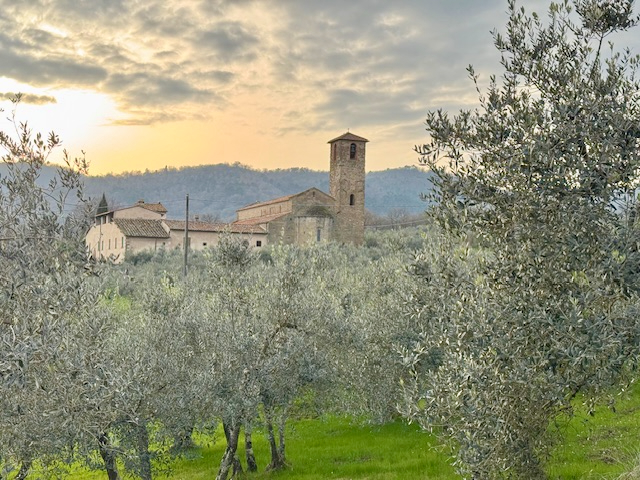
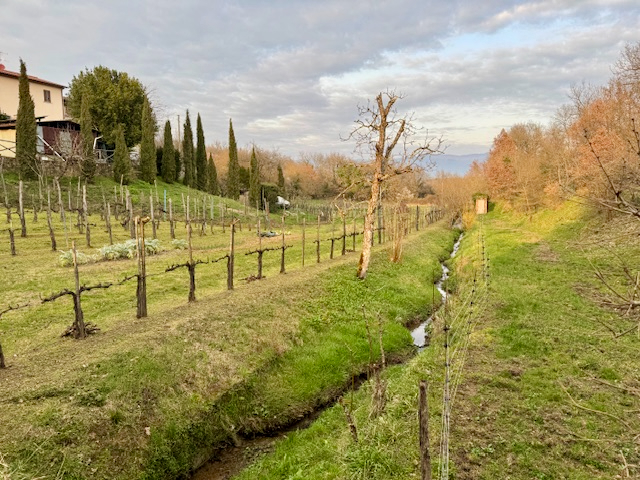
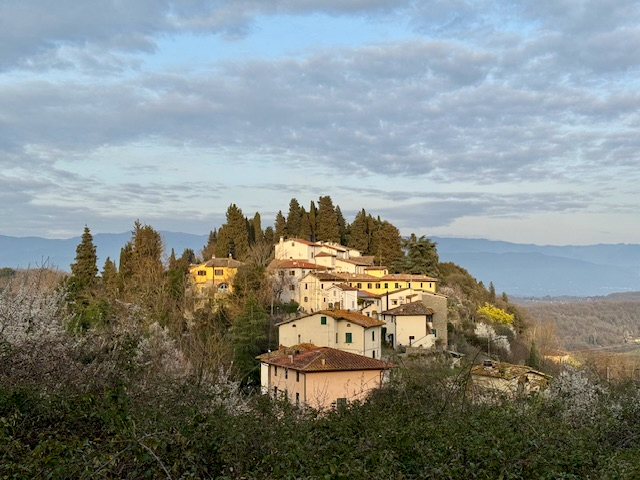
There are multiple hiking trails right off our property—some literally starting on the property and others just down the street. The day was absolutely gorgeous. Spring is blooming here: daffodils, flowering trees, and tons of tiny wildflowers everywhere—on the walls, alongside roads, in the grass. It’s so pretty. Everything feels new to us and new to the season. It almost feels like providence that we arrived just as the season is opening up for a new experience.
Side note: Last week we ended up shopping every single day. While still in the U.S. I made a really good list of what we’d need to purchase upon arrival (a lot more than you’d think). Right before we left I placed a large Amazon order for items we knew we needed immediately—dog food, a dog bed, vitamins—things for which we wouldn’t want to spend much time comparison-shopping.
After that, though, we wanted to shop locally as much as possible.
We both love to cook, and when you start from scratch with spices, ingredients, and kitchen implements—bowls, measuring cups, a hand mixer, rubber spatulas, just to name a few—you end up needing an obscene amount of things. Cooking, health, and baking are important to us, so it was worth the trips and expense, but it definitely took some doing.
Back to Saturday… after hiking and feeling refreshed, we (not surprisingly) needed to shop again. We left the dog at home this time and decided we’d like to go out for gelato for the first time before shopping.
It was about 2 p.m., and we hadn’t really explored our own town yet, so we headed toward the town square. What we’ve been repeatedly surprised by is how everything closes in the middle of the afternoon. This is no joke. Even the gelato shop was closed!
Everything opens again around 3:30 or 4, but there is truly almost nothing open in the middle of the day. There are certain assumptions in the U.S. about how Europeans—and Italians in particular—live. Some of them are absolutely true. This midday closure, at least outside tourist areas, is definitely one of them.
We ended up at a pasticceria instead and had coffee (mini coffees—the norm here) and pastries before heading to the grocery store.
And whoa—the grocery store was a madhouse. A true scene. This must be when all the locals who work during the day do their shopping. There was no parking where we had parked before, but we eventually found an underground parking area we didn’t know existed.
It was chaotic and kind of fun to be in the middle of the bustle of a Saturday early evening in Italy. By this point we’d been in enough stores to know the lay of the land, so we grabbed what we needed without too much fuss and headed home.
From Daren:
That evening we went out to dinner for the first time right up the street at a place that serves pizza just once a week, and by up the street we mean up a very steep hill. We had learned from our landlord that about a quarter of a mile from our home there is a small community hall or meeting room on the second floor above a small store. Apparently, many of the local “nonnas” (grandmothers), come together every Saturday to make and serve pizza in the community room. We were somewhat suspicious and uncertain how this might work. But after parking the lot across the street we found things exactly as described: a large community room filled with local Italian families, a squad of elderly men serving tables, and a large kitchen with a team of elderly women making pizza. There was a menu, a range of drink and pizza options, and after about a 30 minute wait after ordering, two tasty pizzas to eat. We are still sorting out what “pizza” means in Italy. It’s not clear how much regional variation there is, but so far “pizza” has meant something round with cheese, tomatoes and toppings. While this sounds a lot like home, the similarities end with the shape and the components. What has been strikingly different has been the width of the crust. This pizza, and others we’ve had since, are incredibly thin. More like flatbread. And no Italian pizza is ever cut into slices, so you tackle it with a knife and fork and later use your hands after working it down into smaller sections. Whether similar or not, the pizza is delicious. We most enjoyed being surrounded by local Italians talking, laughing, gesticulating, and clearly enjoying a shared meal in their community. Notably, there were very few phones visible. Conversation and camaraderie were preferred over scrolling!
Hiking
Sunday, March 8
Now that the house and shopping basics were set up, we were ready to venture outside of town and see what was around us.
I’ll let the photos speak for themselves.
We went to Greve in Chianti first, and then right down the road to a small hilltop town that was ridiculously picturesque. These two small towns in the heart of Chianti were packed with Tuscan/Medieval charm and we felt like we’d taken a trip back in time as we surveyed the city walls and walked through the central piazza.
March 8 was International Women’s Day, and it’s a much bigger deal here than in the U.S. Mimosa flowers were everywhere. There were free drinks for women and all kinds of celebrations happening wherever we went.
On the way home we (yet again) needed to grab a few things from the grocery store. We stopped at Lidl—the only store open past about 1 p.m. on Sundays. We had gone there the previous week and vowed never to shop there again, but this time we were pleasantly surprised at how easy it was to find things and how inexpensive everything was. It takes some time getting the lay of the land in a new grocery store and a new country!
We will be back. Both to Greve and Lidls that is!
Take a close look at Amazon box on the door, truly up a hill in the middle of no where! haha
Monday, March 9
We had so much fun visiting a new town on Sunday that we decided to do it again. This time the destination was Arezzo, by train.
Again, I’ll let the photos speak for themselves.
I was tired—just beat. I’m not sure if it was the Zyrtec I’m taking for allergies or if I’m finally unwinding now that we’re here and settled, but I was too tired to really enjoy the city. Because of that, I had no interest in exploring the art or churches. Daren enjoyed it very, very much.
I found the city a little “meh.” The lunch we had was terrible. It wasn’t my favorite day or my favorite place—but to be fair, I didn’t really give it a chance either. I was just spent.
And just like that – Womens Day is over…
Tuesday, March 10
We needed to be home Tuesday (blessedly) for our washer and dryer delivery and a conference call related to our new consulting LLC.
I headed out on my first solo run. I jogged and walked (lots of hills!) for 5.6 miles and oh my gosh it was exhilarating. I hadn’t exercised in well over a week and it felt amazing. And the scenery!
I was out for 75 minutes and honestly didn’t want to come back.
When I got home the washer and dryer had arrived—yay! Laundry again.
From past Airbnb experiences in Europe I remembered that laundry machines were not the same as in the U.S., so I was prepared for very low-functioning machines that would take forever, especially since we bought inexpensive models. But we were pleasantly surprised! Nowhere near as large or powerful as what we had back home, but much better than I expected. Daren was worried that without 220 voltage electricity as we have in the US for dryers, we’d never get the clothes dry. But much to our surprise, after about 1.5 hours, we had a fully dry load of laundry.
Overall—a great surprise.
Wednesday, March 11
This was a day of work and figuring out how we want our life here to look.
Since I stopped working last June, I’d developed a routine that loosely mirrored Daren’s workday—exercise, showering, and daily activities earlier in the day while he worked. He worked right up until the day before we left, so now that we’re here and somewhat settled, we needed to build a new kind of day where we’re both home.
At first we kind of assumed we’d each keep doing our same routines. But it quickly became clear that wasn’t really going to work.
So like the two weird geeks we are, we grabbed paper, pens, and a computer and headed to a little café with Wi-Fi to try to level-set our expectations about what a typical day might look like.
I’d love to tell you we figured it all out.
But instead we got very jazzed about traveling and spent most of the time talking about all the places we want to visit while we’re on this side of the pond. We started mapping out what times of year would be best to visit certain places when we suddenly realized the time.
Another conference call was coming up, so we headed home. We need to revisit the conversation about a daily routine and still figure out the travel. No rush, we have time! It’s hard to get used to the concept, I’m sure we will but for now the idea of “no rush” is still incredibly novel.
Thursday, March 12
Another day at home. No meetings. Lots of computer work.
And another long run for me.
I thought the first run might have been the magical one—the “first time back” effect—but this run was even better. I took a slightly different route and tried to dodge some inevitable rain. It wasn’t the sunniest day, but I was completely in the moment and in awe of the scenery.
I took a ton of photos.
Which inspired me to come home and start playing around with editing them. After a warm shower and the need to rest my legs from the hills, that’s exactly what I did.
Daren also went for a run, and in the mid-afternoon we both ended up parked on the couch doing our own things. He read and I edited photos. It felt so nice to just be and to be creative that we abandoned the swordfish we had defrosting on the counter and decided instead to stay right where we were, order a pizza, and watch a movie.
Our first pizza delivery in Italy using “Deliveroo”, a European version of Uber eats delivered by scooter—smooth process and really different, but delicious.
Friday, March 13
And then yesterday—oh my.
We woke up leisurely, had breakfast and coffee, and then packed a day bag, ushered the dog into the back seat of the car, and headed out to San Gimignano.
The day was perfectly sunny and warm—about 15–16°C (in the 60s°F)—and the town was adorable. The walled city was full of tourists, but as I texted my friends back home, there’s a reason some places are touristy.
Lunch was phenomenal—exactly how I remember food in Tuscany from our first trip here ten years ago.
Afterward we stopped at a nature preserve. It honestly wasn’t the prettiest hike and probably not somewhere I’d recommend, but it was exhilarating to be out in nature after the bustle of tourists, a great lunch, and browsing through shops full of seriously beautiful things.
San Gimignano is just over an hour away. The drive there and back was just as beautiful as being there. I drove there and Daren drove back. We took different routes and each got the experience of navigating the hills and simply looking out the window.
The ride home was magical. The sun was setting while spring showers came and went, so the lighting was gorgeous. We played an 80s music mix and sang along, jokingly trying to translate lyrics into Italy, while driving through the hills, just feeling alive.
Dinner was simple—some appetizers with delicious local cheeses we had picked up earlier. Then we collapsed onto the sofa for another movie before heading to bed, truly satisfied and grateful for the experiences we’re lucky enough to be having.
We miss everyone back home. Feel free to comment here. Feel free to text us. Keep in touch please!
It’s 9:03 at night. My body is exhausted. It’s 3pm back home.
Home… home is here for now. In Italy. It still feels too new to remember that without a little whiplash.
My mind is tired too—but wired. Jet lag has that strange rhythm where I can feel like I might fall asleep standing up, and then suddenly I’m wide awake again, almost normal. Until I get a good night or two of real sleep, I imagine I’ll feel a little disembodied—like I’m participating in my life, but it belongs to someone else.
But we are here. We are here. We did it! No other day ever will be the first day. It’s surreal. I’m too tired to be excited. Except for being tired, it feels oddly very normal. We are sitting on the sofa. There is no TV yet. Daren is reading. We are thinking about opening a laptop or iPad to watch something, but who are we kidding? We are exhausted.
Traveling Overseas with a Dog
The thing everyone wants to know about is Koji (the dog) and how we got him here. This was hands down the most worrisome part of the trip. It was such a great unknown. We had some idea of what would happen, but not really. And holy worry about how he’d feel and behave. If only he could understand human language, we could have warned him what was going to happen.
For anyone who hasn’t flown a dog in cargo before (I didn’t know anyone who has), let me say a little more about what happened.
We left from JFK. For Italy, the only direct flight that would take a dog was ITA, and because of his crate size (large – for a 70 lb dog) they couldn’t guarantee him on a flight until 72 hours before. Obviously that wasn’t going to work for us, so we had to fly non-direct through Frankfurt.
Koji had never been to an airport. We were concerned he’d be out of his mind with being overwhelmed, barking and sniffing like a lunatic. But weirdly he was normal. He just walked around next to us like he’d been doing this his whole life. There were a few barks when one of us had to stand in a different line – more or less to notify us that our group was broken up. But once we acknowledged that the human at his side knows where the other human is and has eyes on them, he was ok.
Once at JFK we had to check in at a special excess baggage area. Our other bags were checked at that time almost normally, but Koji’s check-in was different. We were to bring an airline-approved crate, large enough for him to stand and turn around. We did a lot of paperwork ahead of time, including a health exam 10 days prior to flying that needed to be perfectly timed to get his shipping information back from the USDA. We showed up with everything needed.
They didn’t take him right away. We were allowed to walk him around and bring him out to a pet relief area. They helped us time his departure from us perfectly so we had time to get through security with him having the least amount of time in the crate.
Koji hadn’t been in a crate in almost 12 years. To prepare for this, we brought the crate near his dog bed in the house several weeks ago. We made it seem normal and like a safe place. We had him sit in there for short periods at first, then with the door closed, then longer periods with the door closed. By the time we got to the airport yesterday, with all the excitement of the ride and the stimulation of the airport, he was sniffing his crate as if he wanted to go in there and shut out all the outside stimulation.
Finally the time came where we walked with him over to TSA. He dutifully went in and was loaded on a cart. He squeaked a little, didn’t bark, and we reassured him with positivity that this was ok, it wasn’t against our wishes. And we left.
That was hard, but we did it!
I’d love to say we didn’t worry about it or didn’t talk about him very much, but that would be untrue. I will say, though, that I thought about it and fretted about it a smidge less than I imagined I would.
Once in Rome we weren’t sure how to collect him either. No one really told us. I am scratching my head in hindsight about why we didn’t ask, but it also turned out not to be that big of a deal.
We followed the signs to the excess baggage, but when we saw it we didn’t think it possible that our dog would come out of there. I stayed near the area and the carousel while Daren went to ask about it. Meanwhile I searched the internet about how to do this. Daren came back to confirm what I also found out – that we were in the right place and Koji would be coming out there.
We were both informed that he’d likely be delivered about 30 minutes after the bags came out. So I went to get us some coffee and croissants. I was only gone a few minutes, but when I got back – there was Koji in his crate!
Side note – it was mandatory to zip-tie the crate. Daren wondered how we’d get the zip ties off if we couldn’t carry scissors with us in our carry-ons. I assured him that the airline would be aware of this and bring out something to cut the zip ties.
Also, a side note – which was quite funny: we had to tape his food and water to the top of the crate. So we were running around with zip ties and duct tape – like kidnappers or something. But no scissors.
Well I was wrong and Daren was right to question this. The porter (a non-English-speaking Italian porter, that is) came out and was surprised to see zip ties. No scissors in sight anywhere. I came back while Koji was practically levitating in his crate with excitement, and the porter was using a key to slowly saw away at the zip tie.
We finally got him out. I’m not sure what I was expecting, but I’d be remiss not to say that I was surprised Koji was just himself. Very thirsty, but more or less his normal goofy self.
We collected our bags and proceeded to the car rental area. Koji trotted alongside me and the trolley cart like he’d been doing this his whole life. He even seemed to know where to go. I’m sure that was his nose picking up on the trail that many humans have traveled before us from baggage to the rentals, but it was weirdly and quickly business as usual for him.
On the way to the airport in the van transport, smiling! Trotting around the outside of the airport like it’s something he does on the regularChillaxing on the floor of JFK in front of his crate Made it to the other side! Just out of the crate. “Helping” daddy get the bags on the trolleySitting out on the porch with us – just like at home! Resting after the longest day of his dog life
DAY 2
We are just finding our way about.
Yesterday we hit up the stores to stock up on food and essentials. Our landlord and realtor highly suggested a shopping area that has a “Media World,” which is a Best Buy equivalent, and a really large grocery store. It’s kind of like a Walmart, but with more food and fewer non-food items. Not at Walmart prices though.
We were seriously there almost 3 hours. It was truly epic trying to find things in another language. I mean a lot of stuff is the same, like fruits and veggies, but things with labels in cans and boxes are not. I was undertaking the process of finding baking supplies. Some things I just couldn’t find and gave up and ordered on Amazon. Baking soda and baking powder were among the few.
We got back home and unloaded all the loot. That, plus making dinner and walking the dog, wiped us out for the rest of the day. We did squeeze in a short hike down the street where our landlord suggested.
Today was a true feat and success. We ventured out to get new Italian phone numbers and purchase a washer and dryer. Back to the Media World store we went, with some memorized words in Italian on our tongues, to do both – yes both. There is apparently a wireless service in this Media World.
We level-set our expectations based on the day before, anticipating that we would be in the store for a very long time.
We were quickly sidetracked. When we pulled into the parking lot Daren got a notification that our boxes from the States had been attempted for delivery, but the driver turned around because we didn’t answer the door. We’d only left like 10 minutes before! Of course that’s when they came.
We looked into the Send My Bags service we used and for some forsaken reason it said that if we weren’t home, to leave it with a neighbor, but the “neighbor” was a Tabaccheria. Huh?
A Tabaccheria, by the way, is a small corner type of 7/11-ish store with more cigarettes and lotto tickets than food, but the same idea.
We ended up sitting in the car on a live chat trying to figure out how we could pick up our boxes at a local DHL. We were so bummed to miss this delivery. We finally got it sorted and saw that we’d be able to pick up our boxes the next day.
Satisfied, we put on our armor and trudged back into Media World to attempt to communicate in a foreign language.
Amazingly – we walked out about an hour later with a washer and dryer on order, arriving by delivery with installation next week – AND new SIM cards and phone numbers.
Trying to figure out words and understand them is exhausting but also exhilarating. We were so excited that we’d accomplished this that we took ourselves out for lunch. We went to the piazza in town to one of the only places that was open. It was the kind of place my father would have loved and I would have hated, but the food was good! And quite inexpensive. However, we spent the whole meal messing around with our phones trying to figure out how to keep and use our American phone numbers and use the Italian data plan. With some Google and ChatGPT we were able to configure it all without too much fanfare.
At the end of lunch I checked my email and saw that 11 Amazon packages had arrived. Yikes! Then weirdly Daren got an email that our boxes from the U.S. were indeed delivered to a Tabaccheria. At the moment this Tabaccheria was closed and there were these boxes at home.
Side note: We are learning that almost all places close around 1pm and re-open around 3:30–4. They are serious about a lunch break! Wow. I can’t even fathom it. Most places open at 9 and then close at 7. It’s a 10-hour day, but with a really long break in between. I’m not sure how I feel about this yet.
We went back home to tend to these boxes. I was imagining how cramped we were probably making the walk past our apartment, and it turns out I wasn’t wrong!
Next we were off to the Tabaccheria to get our boxes from home, and entered the address in the GPS. This all seemed so crazy and we thought there was a slim chance our boxes would be there, especially considering how we asked them to be sent to DHL. We pulled into this tiny side street and waited a few minutes in the car until they re-opened at 3:30. We walked in with the Italian word for boxes just looked up and on our tongues, and behold… all 5 of our boxes were there! It was so exciting.
We grabbed them, came back home, and unpacked and unpacked. I assembled a coat rack. Daren messed around with installing a new TV our landlord dropped off. And exhausted… we had leftovers for dinner.
Daren went for his first run while I think I napped. He took these amazing photos.
Day 4
Just like at home I’m already returning stuff from Amazon. We hit up a Farmers Market. I finally found ginger. We stopped at a new grocery store and found cottage cheese! We were so happy. It was otherwise an uneventful day. I finally had most of the ingredients and implements to make our favorite things. We went home to open more boxes. I went to work making chocolate chip cookies, my favorite oatmeal nearly zero-point Weight Watchers cookies, compote, and my beloved ginger tea.
Day 5
First trip to Florence. Ever. It was a dual-purpose trip. One, to drop off our rental car and pick up our car subscription that we’d be using for the year. And the other reason was to declare my presence in Italy with the state police (Questura).
Mentally preparing to get yelled at by the Questura
The street navigation was the most annoying thing. At the moment Daren is furiously typing about it. I’ll let him elaborate.
The Questura, for what I needed to do, was quite a simple process, but a very long wait. My citizenship lawyer warned me about this so I was prepared. Everyone jokes here about Italian bureaucracy, but in all honesty it’s not that different from U.S. bureaucracy. I needed to do many things to prepare for this trip and to apply for Italian citizenship, and one of them was to get paperwork from the Department of Social Security. I speak the language, knew what I needed, and felt obviously confident enough to communicate this, but I also was prepared in the U.S. to get yelled at by a cranky federal employee (and I wasn’t wrong, I was talked to like I was a complete idiot) – both times I had to go down.
Side note: Why just me at the Questura, dnd why did we have to go? Well Daren got Irish citizenship a few years ago and can be in the EU without fanfare. And I can too for now with the 90-day pass American citizens have. But I will be applying for Italian citizenship as soon as a final piece of paper arrives. If we had flown directly into Italy and I came through the EU borders through Italy I wouldn’t have had to make this Questura stop. But because we had Koji and flown in through Germany, Italy didn’t know I was there so I had to let them know.
While at the Questura with my ticket to wait in line, Daren and Koji went to return the rental car. The area at the Questura was immigration. Here in Italy I am an immigrant. There were people from all over the world and walks of life and ages speaking all kinds of different languages. The main language the employees speak, of course, is Italian with very little English. Like in the U.S., the staff feel like if you will be in Italy you should try speaking Italian (who can blame them?). It was overwhelming and humbling to be there amongst all these other people trying to keep their paperwork in order.
I heard 3 women about my age speaking English with one another, each with different foreign accents. They were talking about how to cleanse from the negative energy of the Questura and the city. This was a conversation right up my alley! I went over to them and said I couldn’t help but overhear their exchange. They welcomed me, we exchanged names and countries of origin, and talked non-stop for the next hour or so. They all lived in Florence and were there for different reasons. All of them love yoga, one was even a yoga teacher. She and I exchanged contact information through WhatsApp. That was lovely. I don’t know if I’ll ever see them again, but it was nice to just speak English and meet new people.
This trip Beat Me Up. I was ready to call it a day by noon when I was done at the Questura but we pushed through it. We had lunch at an Indian place that allowed Koji to come inside – yes INSIDE! They gave him water (which he was very grateful for) and we enjoyed our first Indian meal (so good!).
We walked around a bit worried about how Koji would behave in a city. He is a well-traveled dog. He boated with us and visited our kids in college with us. He’s been up and down the East Coast and even to Canada, but he has spent very little time in cities. He surprised us by trotting alongside us like he’s been doing this his whole life! So we made our way from the car rental at the train station to the Duomo. Neither Daren nor I were wearing comfortable shoes. And the dog was kind of beat so we stopped there. But we felt victorious for making it to a monument, getting a car, and checking off this annoying task I had to do at the Questura.
Coffee and other things we are getting used to
Everyone knows that Europeans, Italians in particular, love strong black coffee. Small cups. When my father (from Italy) used to come to my house and see the cups of coffee we drank he would be annoyed. Every single time he had something to say about it. (Weirdly I remember my mother loving coffee just as much and making the same normal-size American cups and him not saying a word about it… but that is besides the point.) I know this intellectually. I’ve seen it. The rest stops have coffee counters with miniature cups. They look like something a child would play with in a tea set. The natives order their coffee, scoot to this counter, and drink this mini cup in record time and move on. I’m not sure what the purpose is except to caffeinate.
When our rental came with an American coffee maker I was quite happy. Daren does like the small strong black coffee and kind of said something to the effect of when in Rome, but I insisted that for me we keep this American coffee maker. The first day we were here we went to the only open grocery store (Lidl – yes, the same chain as in the U.S.) and bought a small super vacuum-packed bag of coffee, which was the only kind of coffee sold. We were jet-lagged, came back to our new home, and made coffee. It was delicious. The cups provided at the rental were quite small, and even though the coffee maker said 10 cups, it was about a cup and a half each.
To make a long story short…. After purchasing, then returning, mini coffee scoops…. And then buying a nice (I LOVE it) American coffee maker…. 10 cups in these European models do not mean what 10 cups in American models mean. There is no other size coffee scoop than the one we bought (and returned, thinking we bought too small a size). It is what it is. Even “American” coffee here is smaller. So we will either adjust to having about ½ the amount of coffee we enjoy in the morning or make 2 pots. Either way it was a week-long learning curve.
That is just one of the many silly things that tripped us up.
• How to navigate through a toll booth • Opening plastic tops from bottles • The necessity of weighing produce and putting a sticker on it to purchase it • Driving in downtown cities with secret zones where you need a pass (Daren will say more about) • 2 size plugs, the smaller type not being the converter size sold at airports and other places outside the EU zone
Daren’s take on Driving in Italy
Of all the adjustments an American needs to make while settling into life in Italy, I suspect that none are more challenging than learning how to handle a car and navigate in this new country. At first pass things seem very similar to home: cars drive on the right. Stop signs and traffic lights look the same, and cities are connected by an efficient system of highways with rest stops, overhead signs, construction alerts, and traffic updates. True, there are a lot more traffic circle and fewer traffic lights, but these are easy to handle and actually make driving smoother and more efficient. But after just a few days of driving, this comforting sense of similarity soon dissipates and the real differences become apparent. First, the roads: they are narrow, winding, and hilly. Even the highways, while extensive and well-marked, are much narrower with minimal shoulders and lots of curves and hills. While one gets used to this rather quickly, it requires a higher level of vigilance, especially since highway speeds tend to be faster than in the US, often 130km/hr (80 mph).
Getting gas is another learning experience. Where is the gas cap? How does it open? In our first vehicle the front door needed to be open to expose and open the cap. How do you activate the pump and pay? In one gas station you had to go to a pay station first and tap or insert your card. In others, you pump first and then pay inside. Not so difficult to handle, but just slightly different than our pay-at-the-pump simplicity in the US. And – these differences while nicely marked are in a foreign language so knowing what to do at each one presents a little more of a challenge.
Highway tolls are similar to the US and are easy to manage once you figure out the different lanes. You take a ticket when entering and, when exiting, either insert it into a machine and pay by tapping a credit card, or hand it to an attendant and pay them, depending on which toll booth lane you choose. Like the US, Italy has an “Easy Pass” that allows you to avoid cards and cash. Be careful not to accidentally drive through the “Easy Pass” lane as we did on our first sojourn. In so doing on entering the highway, we had no ticket with which to pay when we exited, requiring us to sneak through the gap in the toll gate! I am sure that the police are looking for us as it was added to a growing list of unintended infractions that we’ve been accumulating.
The other major violations we’ve committed occurred while driving in cities and entering zones where we weren’t allowed. Frustratingly, Apple or Google Maps knows nothing about this and simply maps out the best route to get to your destination, infraction zones be damned! We drove on streets indented only for buses and taxis. We nearly drove onto a tram track. Then we innocently drove on several streets that can only be accessed with “special permission”. These zones are indicated by a digital sign reading “ZTL” for Zona a Traffico Limitato. If it says “ ZTL Attivo”, that means it’s active and you need a special pass to enter. There is a sensor and a traffic camera capturing the identity of each car passing into the Zona. If you don’t have a digital sensor, like and Easy Pass, which you’ve paid for to enable you to pass into these zones, your plate is recorded and fines will be forthcoming. Add to this the fact that city streets are incredibly narrow. Motorcycles and souped up Vespas are flying all around you, trucks are double parking in front of Medieval walls and ancient stone buildings, all while clueless pedestrians (Americans no doubt), are swarming all around with little regard for cross walks.
Then suddenly a road becomes a market and you have to squeeze past food and vegetable stalls, cafes, and throngs of shoppers. Chairs and tables may need to be moved to enable your errant car to pass. And then suddenly a paved road changes to cobblestones and our dental fillings are all jarred out onto the floor mats.
After surviving a drive into Florence to address some bureaucratic residency paperwork and exchange rental cars, we vowed never to drive into an Italian city again, assuming we are not already banned from driving at all by the Italian police. There is a reason why Italy has an excellent system of trains and trams. They are there to help people avoid driving modern vehicles on streets designed for mules, horses, and maybe an occasional oxcart.
For now
This morning it’s Saturday (3/7/26 or as in Italy would be writting 7/3/26), and we finally feel a bit settled. We put together this blog and spent the morning over coffee, writing, and reminiscing about the week we just had. We wanted to capture it all before it’s a distant memory! Onto the next.
We hope you enjoyed reading this. If you’d like to follow us, click the follow button below to get updates when we post. I also hope to update these on Facebook too.
For those of you who don’t know, my father passed away on Wednesday. And for those who don’t know, my relationship with him was far from a beautiful “daddy’s little girl” type of scenario. I loved and hated him. I was afraid of him, yet I felt protected from the outside world by him.
My father was an alcoholic, mean, misogynistic, childish, and a bully. But he was also full of life, energy, and joy. He was strong—crazy healthy despite himself—and had the strongest work ethic of anyone I’d ever met. Just as strong was his play ethic: he worked hard and he played hard.
He lived a full life of ups and downs. He made money fast and spent it even faster. He loved drinking, gambling, and chasing women. He didn’t believe women should work or that education mattered. He believed you should take care of yourself and your family with food, shelter, and clothing in a basic sense. There was always enough, but always with the constant worry that maybe there wouldn’t be, the weight of bills looming.
From him, I learned a lot—what to do, what not to do, who I wanted to be, and how I wanted to show up in the world. This both served me and hurt me. The two main lessons I took from him were how to be productive and how to live fully at the extremes of emotion.
He hated the word “relaxing,” unless everything else that could possibly be done was already done. Before he came home, my brothers and I would scour the house for anything out of place, dirty, or unfinished. Yes, it was unhealthy—but it taught me to scan my environment, make lists, remember details, prioritize, and execute with whatever time I had.
This shaped me: I don’t know how to rest. I’m constantly doing, doing something, or several things at once. I am incredibly productive, and I think I like it that way. It’s a blessing and a burden, because I often don’t realize when I’ve pushed myself too far or taken on too much. My father, in an unhealthy way, taught me this.
Another word to describe him: loud. When the work was done, it was time to play and let loose. He had no qualms about body image, running around shirtless with his big belly. He sang at the top of his lungs, danced like a giant silly human without a care, and enjoyed food like there was no tomorrow. He loved sports—football mostly, the NY Giants in particular, but also soccer and basketball. Watching games with him was full of antics and superstition. The whole neighborhood knew if the Giants were winning or losing.
But with his intensity—whether excitement or anger—came loss of control. Things broke. People and animals got hurt, physically or emotionally.
Some of you who know me now might not realize that “loud” was once how I lived too. I still like to dance, be silly, and LAUGH—only now without the drinking and the overkill of noise.
Ultimately, I didn’t stick around to live like he lived or under his rule of thumb. I got the #$&* out of dodge and started a path of my own in the world.
I’ve learned over the course of the past 31 years that I struggle with boundaries. I was never taught them. I didn’t even know they existed. Particularly with extremes of work, play, and emotions—at first I had none. Everything was to the extreme. I’m now at a point in my life where I realize I can detach from those automatic reactions I was taught, and instead have healthier boundaries around rest, relaxation, and emotional highs and lows.
I am not perfect (who is?) and often struggle with doing too much without realizing it, or failing to recognize when I’m overwhelmed until it shows up as anxiety or panic. A lot of yogic work, mental health work, and a little medication have helped keep me balanced most of the time.
I sit here on my front porch on an August Sunday morning with my coffee and thinking about my dad.
There isn’t much rhyme or reason to this blog—just a moment to reflect on how my father shaped my life and who I am right now because of it. If I stay healthy, it’s not unreasonable to imagine living another lifetime beyond the years I’ve already lived (49). I can’t change the past, but I can absolutely change the future and how I choose to show up and react in it.
One day, those who are in my life when I pass will likely reflect on how I lived, what I taught them—whether it’s how they want to live, or how they want to avoid living. My hope is that whatever I put into the world, people experience it in a way that makes them pause—whether positively or negatively—and reflect on how their own experiences shape their behaviors and ultimately guide their decisions about who they want to be in the world.
And maybe, just maybe, that is the truest way my father continues to live on—through the ways he shaped me, both in what I carry forward and in what I’ve chosen to do differently. In that way, his life reminds me that even the hardest stories can become soil for growth, and that the future is always wide open for choosing a new way to live.
I know if I don’t capture the feelings now, I still might be able to later — but they will never feel as they do now.
Today. My last day of work. That elevator — the sound made me want to cry.
A hot day, not too different from today. 23 years ago.
5th Floor, Building 2 — right outside my door was the elevator bank. Mary Susie Conti — the woman I was replacing — was loading up my head with all that I needed to learn.
I was paying rapt attention, but every so often I sussed out the environment. It felt so different to be in an office in the middle of the day instead of home with my two small children, who were now 45 minutes away in a new daycare. Every time I thought of them, my heart hurt just a bit, and I had to intentionally put it out of my mind.
The feel of the air with the open window (at a time when we were allowed to open windows — now I can’t imagine), the humidity in the office, and the sound of the elevator’s electronic voice blathering all day:
“Fifth Floor Going Down… Fifth Floor Going Up.”
Over the next few days and weeks, I slightly startled the 50 or so times a day I heard that electronic voice announcing the floor it landed on and which direction it was going.
Eventually, it became background noise and I didn’t hear it at all. But when I did tune in, no matter the day or time of year, I was transported back to being 26 years old and learning my new job from Mary Susie Conti.
For the past 8+ years, I haven’t come into the office much. I was on a reasonable accommodation and working from home long before COVID. But I have to say — it always felt like home when I did go in.
I honestly believe one of the reasons I got the job is because of that “home”-like feeling.
When I interviewed for that first job, I went through a series of interviews back to back. Martha Shea was the first person who interviewed me.
Right off the bat, she made it known that if I didn’t pass her muster, the two doctors I would soon interview with would take her consideration into account.
She also made sure to tell me she was prior military and instantly started off by asking about my own military experience.
I was slightly intimidated, but something about her already felt familiar. She was my kind of people — I could tell.
I don’t even know how I wasn’t prepared for the question: “Why do you want to work here?”
I mean — for heaven’s sake — if a person can’t answer that, they shouldn’t get the job!
Martha asked me that question and my truly unprepared, but terribly raw response — when I looked around — was:
“Because it feels like home.”
Martha cracked a genuine smile and asked me why.
I looked around, asking myself the same thing to understand why I had that feeling.
I saw the government-issued 3-month calendar, where you save paper with the months on both sides. The chairs. The carpet. The signage. The halls. The overhead pages. Men with military regalia ambling down the hall. The feeling I always got crossing from a state line onto federal property.
So that is what I said. I first pointed to the calendar on the wall, then the chairs. I mentioned something that was broken in a corner and talked about how it all felt familiar.
I didn’t think about puffing everyone up with “helping veterans,” giving back, stories of grandfathers who fought in wars — or all the other things I subsequently heard over the years when I eventually became the interviewer.
My answer was candid and from the heart.
If my interview were a cartoon, Martha would have started off in a knight’s costume — complete with armor — to intimidate me. Then it would have fallen off, and you would have seen her heart literally melting.
She proudly walked me down the hall to the person who would eventually become my first supervisor at the VA.
With a hand on my shoulder, she introduced me in a way that made it clear she liked me and wanted to take me under her wing.
I already felt protected — and that I was with my people.
Today, I drove into for the last time.
The sunrise down the street from me. A new dawn to a brand new type of day for me.
I saw people parking, taking out their bags and lunches, putting on badges. These people were donned in suits, scrubs, lab coats — and everything in between.
I vividly remembered those early days of parking in that same lot. The uniforms, cars and smells were so unfamiliar at the time. Now they are all second nature. All these years I have been taking the same steps into the same building and heading to the elevators —
“1st Floor, going up.”
Today, I ran into one of my coworkers walking into the building.
We got on the elevator together, and I heard that same electronic voice, unchanged in all these years.
I asked him about his two young girls. He filled me in and then asked how old my children were now.
28 and 26. My youngest is now as old as I was when I first started working there.
I worked there for their entire lives. In some ways, I missed their lives because of that place.
I don’t know who I am without it.
Some people would say I worked there a lifetime (23 years).
Others, who have 40, 45 years in the government, would still consider me a newbie.
It’s all relative. But for me — between the military and the Department of Veterans Affairs — it’s been my whole life.
I had jobs in different buildings and offices. Not too many were close to an elevator bank.
Today, as I left, it was:
“7th Floor, going down.”
It felt like:
“Esterina, now going down and out — into the wider world.”
I sat in the parking lot for a long time. I read the cards I was given, sitting in my car with the air conditioning blasting.
I felt nostalgic — but very excited.
Driving away was the hardest part. No tears, but a large lump in my throat.
A piece of my heart will always be there — in those buildings, carpets, walls, files.
And just like that — “7th Floor Going Down” — one chapter closes, and another begins.
Nothing feels different, but everything feels different.
Chapter 2 is what I am calling this.
I sit across the breakfast table from my husband, but my personal laptop is in place of my work one. There still feels like there are a million things to do. But honestly, not a single one of them really needs to be done.
Was it always like this? Meaning, did anything really ever need to get done?
My heart is beating and I’m racing against the clock—stuff to do… I have to remind myself that there is nothing to actually really do. Today, there will be no sound of bings and chimes to notify me of new emails, Teams messages, or upcoming meetings.
Each of those bings is accompanied (was accompanied—gosh, this will take getting used to) by a spike in alertness and heart rate. At this time of the morning (6:15—YES, Six Flipping Fifteen), my heart rate and anxiety were probably elevated a handful of times.
Whoa, writing that out sounds so unhealthy. It is unhealthy. But I’ve been doing this for years.
Even when I was physically going into the office, I’d wake up around 5 a.m., and just thinking about the day ahead would spike my anxiety. Sometimes in a productive way, but often in a storm of worry about how to plan the day to squeeze the most out of it—for both home and work.
The drive in would be filled with thoughts, worry, plans, more plans. And once I had two kids—then suddenly four—that planning hit a whole new level: kazillion mode.
Things have been quieter in recent years with the kids out of the house and me working remotely. But the anxious habit stuck around. And so did the bings, dings, and mounting pressure of the average workday.
Not that long ago in a land not faraway
I remember back in 2002, my boss gave me access to her email because she found it overwhelming—she got up to 50 emails a day. I was floored. Fifty! I was getting maybe 10, mostly forwarded from her.
Now that number sounds almost quaint. If you get only 50 work emails a day in this era, you’re lucky. Managing email has become its own professional skill.
Most of it? Nonsense. But stressful nonetheless.
I felt like I had to walk into each day in full armor, machete in hand, clearing the overgrown weeds before they even had a chance to stop growing. 90% of emails went straight to Trash. Of those, maybe 10% were actually important—but wading through the digital clutter? A waste. So I created workarounds, tasks, and filters.
OK—seriously, I’ve digressed. But wow. It’s all so absurd.
Getting Anyone’s Attention
You can’t count on someone seeing your email. Depending on how someone organizes their inbox (and I’ve seen some truly wild systems), they may never even notice your message.
Urgent? Tag it with an @? Add the exclamation point? All overused. All part of the noise.
So we escalate: Teams. Work phone. Personal phone. Desk phone. And all of it—every single one of those tools—comes with a sound, a vibration, a ding that makes your chest tighten and your focus scatter.
But Now…
I closed the door. I shut the laptop. I walked away.
That’s why I’m sitting here this morning, coffee in hand, at a different computer.
And now I ask myself: How long will this feeling of impending doom last? (Not actual doom, of course—nothing I ever did was life-or-death. But that tight-chested feeling… it’s real.)
How long until I can simply be present?
I Want to Be Present
I want to be present in my life. I only get one. And I’ve spent 49 years rushing through it.
I’m safe now. I don’t need to stress myself out daily. If I live to be 100, I’m only halfway through. How lucky is that?
I feel so grateful. So blessed. And I don’t want to recreate the stressful life I just stepped away from.
It’s funny—I only found out a week ago that yesterday would be my last day of work. I didn’t dare dream about what’s next, out of fear I’d jinx it.
And now? The urge to plan the “what’s next” is already kicking in. But… I don’t have to figure that out right now, do I?
There’s no rush.
I have the rest of my life—whether that’s a few hours or another 50 years.
As I sit here on the Metro North Railroad next to my husband on this very sunny, very windy Sunday, late April morning, I’m filled with wanderlust and a sense of possibility. As we speed by I notice trees, mountains, houses, cars, waterways, docks… so many ways of living and modes of travel.
The subway this morning, leaving New York City, back home to Connecticut
My heart aches to experience it all. I sit and watch, feeling stuck where I am; on a moving train that is going too fast. I am unable to really see, experience or touch any of it. Destination known.
I marvel at how at any stop I could really get off. How I could take another train to another destination and experience something new. I could…. Why don’t I? Why haven’t I?
I am a government employee.
A Fork in the Road.
That is the title now infamous email sent to government employees on January 28th. It quite possibly could open doors, new roads, endless possibilities. However, the doors and possibilities are soured by the ruthless ways civil servants have been discussed in the past few months.
I am government employee with a possibility of taking early retirement. I am 49 and was not planning to retire for a while. But the possibility cannot stop lingering on my mind. I want to see the world! I want to get out from under the grind, off the crazy train. The past few years, but particularly the past few months have dampened the passion of flames I once had for work. It was long burning down, but the new administration has left but the smallest of sparks still attempting to burn.
I have given my entire adult life to the United States government. At 18 I went into the Coast Guard. At 22, I continued into the active reserve pool and became a weekend warrior while raising two babies. At 26, I became a civil servant where I have worked ever since.
I’ve been on a train, on the path set out by many. Get an education, get a job, start a family, get the bigger house….
In the past 31 years with very little help from the supposedly educational funds and benefits that tempted me into the military in the first place I obtained a Professional Secretarial Certification, a Bachelors in Business Administration, an MBA, and a certification Healthcare Analytics.
There were countless other trainings I took through work or on my own. Regardless of where I took these trainings, I immediately gave everything I learned back to the government through my work. Up to and including teaching yoga.
I chose the government because like many undiscussed Americans, particularly second generation Americans, I grew up not have basic securities met. We always had food, though food security was something my parents often struggled with. There were enough clothes and enough help to feel ok. We did not have healthcare and my parents did not have jobs with paid vacation or sick time. Retirement is still out of the question for my 74 year old father. My mother passed away at 49, in part to smoking; but more in part to not having access to healthcare.
I chose the military for the benefits. Paid education, vacation days, and healthcare. The military also seemed as if it were fair and just, that there were rules that had to be followed and consequences for breaking those rules. My home seemed to be a place where there were no consequences and no rights for women or children. As a teenager with looming uncertainty of my future, the military recruiters at the tables stationed around my high school looked healthy, happy and secure in themselves. I wanted that for myself too.
I still don’t know if recruiters purposely mislead or they themselves do not know, but many of the things I was told were only partial truths. Healthcare is not for life unless you are destitute once you separate from the armed forces. The Montogomery GI Bill hardly paid for a semester let alone an education. I was not able to apply for specialty school right out of bootcamp as an E-3, a benefit I personally took advantage of because I had spent 3 years in junior ROTC. The immediate bump from E-2 to E-3 wasn’t a huge benefit, but the one that likely made what was a tough decision at the time for me. A decision that ended up being a very good one for my life.
Swearing into the United States Military at MEMPS in Brooklyn NY August 9, 1994
From that time, and into my career, and until this very day; there were spouted benefits. Benefits that lured me in, but were not what they seemed to be. Benefits that few who are the gatekeepers to obtaining these benefits even seem to know about.
My earliest experience was the lack of knowledge at my first duty station on being an E-3. Then seemingly gregarious barriers to putting my name on a wait list for specialty school. I did everything I was supposed to as quickly and efficiently as I could. It seemed to surprise people that I had the oomph to push through the barriers and keep pressing until I got the answers I was seeking. It seemed unnecessarily difficult, but that was only the start of many years ahead of pretty much the same.
I met and married my first husband who was also in the military at the age of 19. We had no plans of having children anytime soon, but I did know about the benefit to females of taking two years off to raise a child and coming back to finish any required time that was owed to the government.
When my husband and I were re-located and co-located from the west to east coast, the new dispensary that I was assigned did not carry the birth control pill I had been on for years. I was prescribed a new pill and immediately experienced unwanted side effects. When I went to the dispensary to discuss these issues; they took some bloodwork to ensure I was not pregnant, prescribed a new type of pill, and asked me to not take any pills until my next cycle.
My newlywed husband and I were careful, but obviously not careful enough because I never did start that next cycle. I was unintentionally pregnant at 20 years old. My new duty station (which was for the first time in my career on land [opposed to on ship]) helped me to apply for the two year program to raise a child. The administrators and I could not foresee my request being denied because I owed 2 exactly two years and my husband was also a service member.
The request was denied without an explanation. We were flabbergasted. The men and their wives at my at my station were so supportive and helped me and my husband with taking care of our newborn child. I will forever be grateful for the rallying and support provided.
October 1996, pregnant with my first born
My baby Thomas at just over a year old with his daddy
Two years later my owed time was up and I had the option to reenlist. For the majority of non-Air station based jobs, most Coast Guard members were required to be stationed on a ship alternating with land stations. Unless they specifically wanted to be on ship duty or if circumstances called, folks were allowed to be stationed on land for back to back tours.
The military does married couples the honor of trying to station couples together or close by. My husband’s tour was also up. His job required him to be at an Air station which were far and few between. Air stations at the time also required a 1 in every 3 or 1 in every 4 evening overnight obligation. My job as a cook was one of the few jobs in the Coast Guard that did not require overnight stays at all. It was the only way we were able to get by raising our son until that point. That and the help from the members of my station.
Service members have some input on where they would like to go by filling out what was referred to as a “Dream Sheet”. We filled out our dreams sheets and requested to go anywhere in the world as long as I could be stationed at a land station nearby an Air station so I could be home every evening with our son. It should not have come as a surprise when this reasonable request was denied. Yet it was a surprise and felt like a blow.
The Commanding and Executive Officers who were fond of my hard work, impressed that I finished a secretarial certificate and was taking college classes, and who were already upset from the denial for the maternity leave I asked for were also infuriated. The Commanding Officer (unprompted) wrote a letter asking for my request to be reconsidered because he felt I was just the kind of person that the Coast Guard should want to keep. He received a response back saying that it was my turn to go on a boat and if I didn’t like it, I did not have to re-enlist.
I did not reenlist.
I enlisted into the Active Reserves for four years instead. My husband stayed in and I became a military spouse. We had another baby and I finished my bachelor degree.
Four years later in 2002, both my husband and I had completed all required obligations to the military. It was not long after 9/11 and we decided to take a plunge into the civilian world.
Finding work in your twenties hot out of the military with little other work experience and family obligations is not easy. I was interested in federal employment because of the benefits and pension.
I applied to dozens of government and private sector positions. It took about 6 months to find a temporary grant funded government position.
During my first few years as a civil servant I applied for the programs and leadership trainings that were available, but I was denied participation because I was not a permanent employee. I went back to school (out of pocket) while working full time and raising 2 children for an MBA.
I used the information I was learning in school and my personal drive constantly to make my job, my role, and in turn my organization a better place. In 2007 I finished my Masters degree and landed a full time permanent position. About 5 minutes later I was asked to teach and mentor students in the programs I had never taken and had been denied access to. I was not snarly or punishing because I paid for and took my own initiative to learn what they denied me access to. I excitedly obliged because I wanted to provide my organization with the passion and knowledge I myself wanted to share.
MBA graduation in 2007
I cannot believe that was 18 years ago. Since then I’ve learned even more. In my journey as a government employee I’ve changed as a human, but maintained exceptional performance reviews for every single rating period for 31 years without fail. I have given the government every piece of knowledge I learned, and for many many years, many more hours than I was ever paid for.
I have since been divorced and remarried. My children have grown and left the nest. I’ve taken many other trainings at work and outside of work. I trudged a personal journey of experiencing C-PTSD from childhood which involved drinking, recovery and a lot of therapy.
Very typical office set up I had (back in the days I had an office that is)
At my ‘hands down’ favorite position I held in Primary Care
Screenshot
Group of lady work friends I had for many years
I’ve been on the path. I was not planning to retire now. I have more to give. But do I want to give it to the government anymore???
My heart has not been in it a while. And the current administration seems to admonish and mock employees like myself.
Until this very day I am dealing with “benefits” unknown to those who are the gatekeepers. My latest escapade involves healthcare. I have been paying for health insurance for a family through the Federal Employee Health Benefits (FEHB) since 2002. A few years ago while I was undergoing intensive outpatient therapy I was part-time and we used my husband’s insurance because the employee share for part-timers is unaffordable. We switched back to my insurance over 4 years ago, but the government has a stipulation that upon retirement in order to keep the FEHB for life, you have to have paid FEHB for the 5 consecutive years prior to retirement.
This is what stopped me from Taking the Fork in the Road back in January. Healthcare. One of the very reasons I entered into the federal workforce 31 years ago. The lack of which (healthcare) I attribute to my mom passing at 49 years old. The very age I happen to be at the moment.
The only time I did not pay for healthcare was for the short period of time I shortened my work hours to deal with mental health issues.
Most veterans have mental health issues. Most individuals enter the military because the benefits outweigh the personal risks. Most individuals who join at a young age do not have many other options. Those lack of options, lack, limit = mental health issues that if not already experiencing, will likely show up later in life when the dust has settled. Like it did for me.
Back in January when the Fork in the Road email was sent, I read all over the place in OPM guidance and other government sources that under VERA authority (when early retirement is being offered) the Office of Personnel Management (OPM) waives this 5 year healthcare payment requirement. I asked about it at the time. No one has ever heard of it. Of course they haven’t. I’ve been down this sad road before. Benefits that are there but unknown or in some way inaccessible.
My Department is offering VERA again due to impending RIFs (Reduction in Force) and this time it specifically states that OPM is waiving the 5-year requirement.
Why am I still here? What do I have to gain?
I think I want to get off the train. I watch the world literally and proverbially whizzing by. A world I long to see and experience.
I am not one of these mystery civil servants you hear on the news. One of these lazy people who is just taking from the population and needs their job to be cut with a sledge hammer. I gave the government more than I gained from it. I know my job can be involuntary cut in a few weeks. If I get to keep a job at all, there is no guarantee it will be at my salary level or that I enjoy.
Yes, there is waste in the government. There is waste in all organizations. The fairness I had been seeking when entering the federal workforce is not on everyone’s side. As employees under the rule of the law, we are mostly indistinguishable from one another. All kind of being lumped in with the bath water that our administration wants to throw out.
As I reflect on my journey, I realize that my experiences have shaped me into the person I am today. The highs and lows, the challenges and triumphs, have all contributed to my growth and resilience. While the uncertainty of early retirement looms, I am filled with hope and possibility. I am ready to embrace change and explore new horizons. My dedication to public service has been unwavering, and I am proud of the contributions I have made. As I contemplate the next chapter of my life, I am reminded that there is so much more of me to give. The world is full of opportunities, and I am eager to seize them.
If you don’t know about the issue of clothing waste on Ghanaian beaches, and you have a moment, stop here and look up “clothes in the ocean off Ghana.” What you’ll see is not exaggerated. It’s real, and it’s disturbing.
The clothes we give away to thrift stores or place in donation bins come from a place of good intention. And there are people who benefit from those donations. But there are not enough people in the world who need clothing at the scale we are producing and discarding it.
I’ve seen a version of this myself. Back in 2017, my husband and I traveled to Africa for a few weeks on an overland safari. Twice we passed through the town of Maun in Botswana. It was one of the only places we saw with shops and street vendors. And what were they mostly selling? Clothes. Racks and racks of them—many clearly from first-world countries like ours.
Most of us have heard about the issues in the clothing industry—sweatshops, low wages, poor conditions. I remember learning about it decades ago, and yet the problem seems to have only grown. And if I’m being honest, knowing all of that hasn’t stopped me from participating in it.
I’ve tried. I shop consignment more than I used to. I’ve made attempts at keeping a capsule wardrobe. But somehow, every few months, I still end up with an overstuffed closet and find myself purging clothes, shoes, and jewelry—keeping only what “sparks joy.”
And then I do it again.
Something as simple as needing a pair of black leggings turns into a spiral. I’ll start with the intention of buying just one pair. I type it into a search bar, and suddenly I’m scrolling through endless options—capris, patterns, odd cuts, things that aren’t quite right. Minutes turn into more minutes. Then I find a three-pack. Do I get all black? Or the one with red because it might match something I haven’t even worn yet?
Before I know it, I’ve bought more than I need.
They arrive quickly. Sometimes I don’t even try them on. Sometimes I do and don’t like them. Either way, I usually end up wearing the same simple black pair over and over until they wear out, while the rest sit untouched.
Eventually, I donate them.
Clothes that were barely worn. Clothes that didn’t “spark joy.”
And I know exactly where they might end up.
Even when I try to do better, I still fall into the same patterns. Convenience wins. Time feels limited. It’s easier to click than to spend hours digging through racks in a store. It’s easier to tell myself I’ll do better next time.
But next time looks a lot like this time.
And it’s uncomfortable to admit that I am part of something I don’t agree with.
This isn’t just about leggings. It shows up in other ways too—small purchases, quick replacements, things that don’t last. I don’t need to list them all. I know they’re there.
I don’t have a clean solution to this. I don’t suddenly shop perfectly or live without impact. But I do have awareness, and maybe that’s where it starts.
Not with perfection. Not with guilt.
Just with seeing it clearly.
Because once you see it, it’s hard to pretend you don’t.
Thanks for taking the time to read. I’d love to hear your thoughts!
Please feel free to leave a comment or subscribe for future updates.