

“Yoga is the journey of the self, through the self, to the self.”
– Bhagavad Gita
In the ancient Vedic texts, we find a beautiful framework for understanding the self beyond the physical body. Known as the Panchamaya Kosha system, this five-layered model is still embraced by yoga therapists today as a holistic map for healing and self-discovery.
Each kosha, or “sheath,” represents a different layer of our being—from the tangible to the most subtle essence of who we are. These sheaths are energetic in nature.
Since this is a conceptual idea, it’s not easily visualized. This is an artistic rendition I created, using inspiration from search engines, to give the model a visual form.
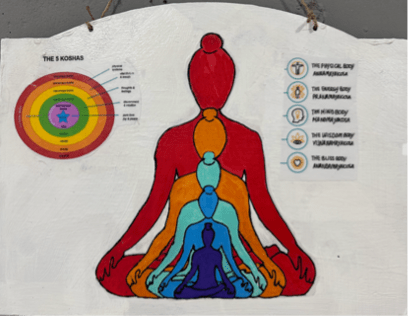
Let’s take a guided journey through each layer, pausing along the way to reflect, breathe, and connect.
Annamaya Kosha: The Physical Body
The outermost layer is the Annamaya Kosha, often referred to as the “food body.” Annamaya derives from the words anna (food) and maya (made of), signifying that the body is composed of physical matter sustained by food. It is the densest of the five koshas and the layer most familiar to us—the physical body that we see and touch.
According to the Bhagavad Gita, it is the body that allows us to engage with the material world and fulfill our physical needs.
Yoga asana (postures) help us strengthen and care for this layer. But it’s only the beginning.
Beyond our physical body exists a subtler, more energetic presence—what the yogis call the life force or prana. This leads us to the next kosha: Pranamaya Kosha.
Pranamaya Kosha – The Breath or Energy Body
Beneath the surface of what we see and touch lies a subtler layer of our being—the Pranamaya Kosha, or breath body. This sheath is composed of prana, the vital life energy that flows through and animates us. It is this energy that sustains every physical and mental function. It’s not too dissimilar to “chi,” as known in Chinese traditions.
This kosha both surrounds and penetrates the Annamaya Kosha, flowing through subtle channels known as nadis—akin to the meridians in Traditional Chinese Medicine. Ancient texts speak of nearly 72,000 nadis crisscrossing our being, creating an intricate web of energy distribution as sophisticated as our physical body.
It is said that when this energetic layer is vibrant and balanced, it manifests as vitality, clarity, and resilience. An imbalanced or blocked pranic flow, on the other hand, can lead to physical fatigue, emotional disturbances, or even illness.
Because prana is intimately tied to the breath, pranayama (breath control) becomes a key yogic tool to nourish and regulate this sheath. Practices such as deep diaphragmatic breathing, alternate nostril breathing (nadi shodhana), and kapalabhati invigorate and purify the Pranamaya Kosha, enhancing the flow of energy throughout the body.
Breath becomes the bridge between the body and the mind. As you become more aware of your breath, you tap into the present moment, calming the nervous system and centering the mind.
Manomaya Kosha: The Mental Sheath
The Manomaya Kosha is the “mental sheath,” representing the mind and emotions. It is associated with our thoughts, feelings, and mental patterns, known in Sanskrit as vrittis. This kosha encompasses the mental body—our emotional responses, internal dialogue, and perceptions of the world.
As one of the more subtle layers of our being, the Manomaya Kosha significantly influences how we interpret experiences and impacts our overall well-being. The mind shapes our interactions with the world and colors our experiences with judgment, attachment, and preference.
Cultivating mindfulness is key to mastering this sheath. By learning to observe our thoughts without attachment, we can begin to detach from mental chatter and emotional turbulence. Meditation is a powerful tool for calming the mind and finding inner stillness.
🧘♂️ Practice Tip: Let your thoughts come and go without judgment. Be the observer, not the story.
Vijnanamaya Kosha – The Wisdom Body
This kosha is the intellectual or wisdom sheath, housing our intuition, discernment, and inner knowing. It’s the layer of deep insight that enables us to distinguish truth from illusion, and ego from the true Self.
“Listen beyond your thoughts to the quiet wisdom within.”
This sheath transcends ordinary thinking. It’s where we connect with spiritual insight and our inner compass, guiding us toward Svadharma—our true calling.
This kosha is about deep understanding—not just of the world, but of our true nature.
Last night I taught a class and went through this exercise to describe what the 3rd and 4th kosha might look like.
Close your eyes and picture a bright red triangle.
Where did it come from? Your thoughts created it, but it isn’t real. I suggested it, but the image itself is imaginary.
Now ask: Who is seeing that triangle?
It’s not your thoughts—they made it. The one seeing it is the witness. That part of you is real. It watches your thoughts come and go without being them.
The red triangle will fade with the next thought, but the witness remains. It observes what arises—whether from outside influence, subconscious memory, or your own deeper wisdom.
Now, imagine that red triangle turning into a dark purple circle.
Who made that change? Who watched it happen?
This is the heart of self-awareness: You are not your thoughts.
Thoughts pass through like weather. But if you’re not aware, they shape your emotions, breath, and even your body.
The wisdom body discerns the difference between the thoughts and emotions (Manomaya Kosha) and the witness who is unaffected by the thoughts (next kosha). However, your thoughts and emotions do affect your breath and ultimately your physical body. So mind your thoughts!
Anandamaya Kosha – The Bliss Body
At the center of all the koshas lies the Anandamaya Kosha, known as the “bliss body.” This is the most subtle and innermost layer of our being—beyond the physical, energetic, mental, and wisdom layers. It represents our pure essence, a state of peace, joy, and spiritual bliss.
This kosha isn’t shaped by thoughts, emotions, or material form. Instead, it is pure being—the unchanging, eternal part of us, often touched during deep meditation, savasana, or moments of transcendence in everyday life.
It embodies Sat-Chit-Ananda—existence, consciousness, and bliss—where the ego dissolves and unity with all of creation is felt. These aren’t fleeting emotions but deep, abiding joy and contentment, experienced when we are in perfect alignment with our true self.
Practices like meditation, mindfulness, and present-moment awareness help us access this layer. In yoga, it’s the ultimate experience—being one with the divine, at peace, beyond form.
You might even say this is Your Spirit. There’s another blog I wrote just a few weeks ago about this place: https://esterinaanderson.com/2025/02/12/on-your-spirit/
Integrating the Five Koshas
Yoga is not just about stretching our bodies—it’s about integrating all parts of our being: body, breath, mind, wisdom, and spirit. As we journey inward, we realize that these layers are not separate, but interwoven—each one informing and supporting the others.
By nurturing all five koshas, we move closer to our true Self—the eternal spark of consciousness that yoga ultimately helps us remember.
Namaste,
Esterina
 esterinaanderson.com