Journey Through the Self: Exploring the Five Koshas in Yoga

“Yoga is the journey of the self, through the self, to the self.”
Bhagavad Gita

In the ancient Vedic texts, we find a beautiful framework for understanding the self beyond the physical body. Known as the Panchamaya Kosha system, this five-layered model is still embraced by yoga therapists today as a holistic map for healing and self-discovery.

Each kosha, or “sheath,” represents a different layer of our being—from the tangible to the most subtle essence of who we are. These sheaths are energetic in nature.

Since this is a conceptual idea, it’s not easily visualized. This is an artistic rendition I created, using inspiration from search engines, to give the model a visual form.
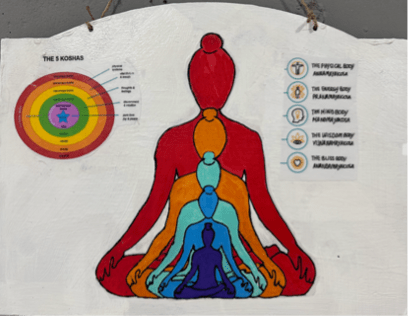
Let’s take a guided journey through each layer, pausing along the way to reflect, breathe, and connect.


Annamaya Kosha: The Physical Body

The outermost layer is the Annamaya Kosha, often referred to as the “food body.” Annamaya derives from the words anna (food) and maya (made of), signifying that the body is composed of physical matter sustained by food. It is the densest of the five koshas and the layer most familiar to us—the physical body that we see and touch.

According to the Bhagavad Gita, it is the body that allows us to engage with the material world and fulfill our physical needs.

Yoga asana (postures) help us strengthen and care for this layer. But it’s only the beginning.

Beyond our physical body exists a subtler, more energetic presence—what the yogis call the life force or prana. This leads us to the next kosha: Pranamaya Kosha.


Pranamaya Kosha – The Breath or Energy Body

Beneath the surface of what we see and touch lies a subtler layer of our being—the Pranamaya Kosha, or breath body. This sheath is composed of prana, the vital life energy that flows through and animates us. It is this energy that sustains every physical and mental function. It’s not too dissimilar to “chi,” as known in Chinese traditions.

This kosha both surrounds and penetrates the Annamaya Kosha, flowing through subtle channels known as nadis—akin to the meridians in Traditional Chinese Medicine. Ancient texts speak of nearly 72,000 nadis crisscrossing our being, creating an intricate web of energy distribution as sophisticated as our physical body.

It is said that when this energetic layer is vibrant and balanced, it manifests as vitality, clarity, and resilience. An imbalanced or blocked pranic flow, on the other hand, can lead to physical fatigue, emotional disturbances, or even illness.

Because prana is intimately tied to the breath, pranayama (breath control) becomes a key yogic tool to nourish and regulate this sheath. Practices such as deep diaphragmatic breathing, alternate nostril breathing (nadi shodhana), and kapalabhati invigorate and purify the Pranamaya Kosha, enhancing the flow of energy throughout the body.

Breath becomes the bridge between the body and the mind. As you become more aware of your breath, you tap into the present moment, calming the nervous system and centering the mind.


Manomaya Kosha: The Mental Sheath

The Manomaya Kosha is the “mental sheath,” representing the mind and emotions. It is associated with our thoughts, feelings, and mental patterns, known in Sanskrit as vrittis. This kosha encompasses the mental body—our emotional responses, internal dialogue, and perceptions of the world.

As one of the more subtle layers of our being, the Manomaya Kosha significantly influences how we interpret experiences and impacts our overall well-being. The mind shapes our interactions with the world and colors our experiences with judgment, attachment, and preference.

Cultivating mindfulness is key to mastering this sheath. By learning to observe our thoughts without attachment, we can begin to detach from mental chatter and emotional turbulence. Meditation is a powerful tool for calming the mind and finding inner stillness.

🧘‍♂️ Practice Tip: Let your thoughts come and go without judgment. Be the observer, not the story.


Vijnanamaya Kosha – The Wisdom Body

This kosha is the intellectual or wisdom sheath, housing our intuition, discernment, and inner knowing. It’s the layer of deep insight that enables us to distinguish truth from illusion, and ego from the true Self.

“Listen beyond your thoughts to the quiet wisdom within.”

This sheath transcends ordinary thinking. It’s where we connect with spiritual insight and our inner compass, guiding us toward Svadharma—our true calling.

This kosha is about deep understanding—not just of the world, but of our true nature.


Last night I taught a class and went through this exercise to describe what the 3rd and 4th kosha might look like.

Close your eyes and picture a bright red triangle.
Where did it come from? Your thoughts created it, but it isn’t real. I suggested it, but the image itself is imaginary.
Now ask: Who is seeing that triangle?
It’s not your thoughts—they made it. The one seeing it is the witness. That part of you is real. It watches your thoughts come and go without being them.

The red triangle will fade with the next thought, but the witness remains. It observes what arises—whether from outside influence, subconscious memory, or your own deeper wisdom.

Now, imagine that red triangle turning into a dark purple circle.
Who made that change? Who watched it happen?

This is the heart of self-awareness: You are not your thoughts.
Thoughts pass through like weather. But if you’re not aware, they shape your emotions, breath, and even your body.


The wisdom body discerns the difference between the thoughts and emotions (Manomaya Kosha) and the witness who is unaffected by the thoughts (next kosha). However, your thoughts and emotions do affect your breath and ultimately your physical body. So mind your thoughts!


Anandamaya Kosha – The Bliss Body

At the center of all the koshas lies the Anandamaya Kosha, known as the “bliss body.” This is the most subtle and innermost layer of our being—beyond the physical, energetic, mental, and wisdom layers. It represents our pure essence, a state of peace, joy, and spiritual bliss.

This kosha isn’t shaped by thoughts, emotions, or material form. Instead, it is pure being—the unchanging, eternal part of us, often touched during deep meditation, savasana, or moments of transcendence in everyday life.

It embodies Sat-Chit-Ananda—existence, consciousness, and bliss—where the ego dissolves and unity with all of creation is felt. These aren’t fleeting emotions but deep, abiding joy and contentment, experienced when we are in perfect alignment with our true self.

Practices like meditation, mindfulness, and present-moment awareness help us access this layer. In yoga, it’s the ultimate experience—being one with the divine, at peace, beyond form.

You might even say this is Your Spirit. There’s another blog I wrote just a few weeks ago about this place: https://esterinaanderson.com/2025/02/12/on-your-spirit/


Integrating the Five Koshas

Yoga is not just about stretching our bodies—it’s about integrating all parts of our being: body, breath, mind, wisdom, and spirit. As we journey inward, we realize that these layers are not separate, but interwoven—each one informing and supporting the others.

By nurturing all five koshas, we move closer to our true Self—the eternal spark of consciousness that yoga ultimately helps us remember.

Namaste,

Esterina

On Why I Clean Everyday

First – why do you care? Haha, but really… If you care at all, why do you? How does it affect you?

When I was 22 years old I moved to Cape Cod. I was entering the Active USCG Reserves while transitioning from a military member to a military spouse. My new home was located on a military base. It was not my first home as an adult, but it was the first home I set up alone.

This period was a transitional time in my life. Before then I went straight from high school into the military. I was married just over a year later and unexpectedly pregnant 6 months after that. My life was busy and I had not truly actively planned anything in my life until that point. As I looked around at all the boxes and pictures to hang, the disorder around me was affecting my mind. Or was it the disorder in my mind affecting my outer world?

I quickly went to work setting up home. While I opened boxes, and organized the outward disarray, the disorder in my mind started to unravel into digestible thoughts. How do I gather all the college credits I accumulated into applying for a degree? Do I quit smoking? Have another baby? What do I want to be when I grow up?

As I unpacked and moved items, then moved items again into better places I made notes – call the education office, look into the local college, schedule that physical, reach out to neighbors, ask about pediatricians, talk to spouse about a new baby while this little guy was still young so he had a playmate…

The act of outwardly organizing was helpful. I was making progress on something important, but also the monotony combined with the active thinking of where we would most easily grab a plate was just enough active/inactive brain power to keep my mind focused on thinking about the next phase of my life.

When the house was all set up and arranged just so, I missed the act of taking care of it. So I cleaned it really well. Again, the repetition and combination of active/inactive thought was helpful in  organizing my inner thoughts. As they were all I had while doing this type of work.

I learned then I very much enjoyed cleaning. All these years later I would label what I was doing as a sort of meditation. But at the time it only felt like cleaning. I started to clean everyday in various ways. There was everyday picking up (dishes, laundry, diapers, trash, wipe the table…) but also things that needed to happen often but not daily – wash floors, launder sheets, clean bathroom. I put the nondaily essentials into a schedule for myself the way I learned in my years of cooking and ended up doing meal planning and shopping… basically transferring my work skills to my home. Then I moved these things to the outside – fix fence, mow lawn, ask about the grass seeds that are supposedly free…

I met my neighbors. They were all lovely. The one who was the friendliest lived across the street and worked on the base as a cleaner for the military houses in between family transitions. I don’t remember her name but I will call her Melanie. I asked Melanie what she did when she cleaned these empty houses and she told me all about the floors and the blinds and the walls and corners, and all the checkboxes she had to complete. Surprisingly her house was quite a mess and she didn’t really enjoy cleaning. But she did comment that she saw me cleaning often.

What ???

Saw me cleaning? How?

Through your window Melanie replied…

Through my window I thought?

Now I was embarrassed. But intrigued by what she told me. I hadn’t thought about cleaning blinds or paying attention to ceiling or floor corners.

A day or two later I decided to tackle the blinds. As I was doing so Melanie waved to me from insider her home across the street. I was slightly embarrassed yet again but continued to clean the blinds as if it were a normal everyday occurrence.

The next time I saw Melanie she commented on my cleaning again. Melanie commenting on my cleaning became the standard. It embarrassed me so I often would wait until I didn’t see her mini-van in the carport to clean anywhere near my own windows or outside.

None-the-less from there I continued a lifelong habit of cleaning nearly daily and scheduling various cleaning tasks for various days of the week.

Through the years I’ve had to explain and defend my cleaning to my partners, neighbors, kids, step-kids, friends who comment with some kind of annoyance that my house is clean. I was always trying to hide it, clarify where I saw dirt or oils, negotiate with the kids to just vacuum that room – yes on this vacuum setting. It was exhausting. I loved to clean when no one was home so I didn’t have to explain it.

Which brings me to the point of this blog. Why did anyone care that I was cleaning in the first place? I didn’t really ask for help. The kids chores of table setting, dish washing, cleaning their own bathrooms on a schedule or scraping the cat litter of the cats they wanted were not chores of some Nazi clean loving freak. The cleanliness of other people’s homes doesn’t affect how much I enjoy visiting their home or their company in any way. I’m not judging those who don’t like to clean. I know I’m unusual in this particular way.

Which brings me to a bigger question. Why does anyone really care what other people do? How they take care of their home, how often they cut their lawn, their hair, their fingernails? How deep into my life do you care about what I do? Why does my lawn count and my fingernails not so much?

At what point does what I do affect truly affect anyone else? Or does what I am doing make others reflect on what they are doing? And is that really my problem? Should I be hiding my true nature in worrying about how others will look at me or themselves?  I did hide my real self for a long time worrying about what other people thought. That was not healthy.

This question grows from me into the larger scale. Why does anyone care who anyone loves or how they use their body to please a lover? How does the spices one uses in their cooking matter to you? Why does it matter how other cultures cook, pray, love, dress, and take care of one another?

Yes – there are things that affect other people in some ways. But not as many as you think. Maybe the one house on the block with the overgrown lawn can bring down the property value of the street. There are things you can have influence over – like talking to that homeowner and maybe even offering to cut their lawn because it’s a single parent short on time. But perhaps do back down and accept how things are if that person doesn’t reply the way you’d like. You cannot control other people and just because you don’t like something they do or don’t do, it doesn’t make them wrong or crazy. Why waste any mental energy on something you cannot control?

I’m not saying it’s easy to do this, I’m just offering the suggestion to ask yourself why you might care and why you are wasting your mental energy on something you can’t control. There is a locus of what you can control, influence and what you have no control over.

I clean all the time. I like it. It clears my mind. For me the house doesn’t need to be very dirty to clean it (most folks shower daily even when they aren’t that dirty). It is something in this crazy world that I feel I have control over. I like the way I feel after moving around and taking care of the animate and inanimate objects that I own like my bed, plants and pets. I like the way those objects like being taken care of by me. I like the way my surroundings look. The question I asked myself when I was 22 about the disorder of my environment affecting my mind or if it was the other way around is irrelevant to me today. Both matter and this is one of my methods to tackle both.

But why do I need to even explain that?

So I ask again and again and again… why does it matter?

You have control over the thoughts about why this or anything matters. Are you wasting your energy on something you want to waste it on? Do you have control over it? Influence? Neither?

I’m going to clean whether anyone likes it or not. I hope you collect your gnomes or pink socks or do whatever it is that you like as well as long as no one is getting hurt. Don’t worry if I like it, I love you for being you and doing what you love.

Make sure you are doing no harm and then do what you love without shame or question or worry.

Be the change you want to see. Be what you wish the world to be.

It’s all you can do.