Why BLM Matters So Much To Me

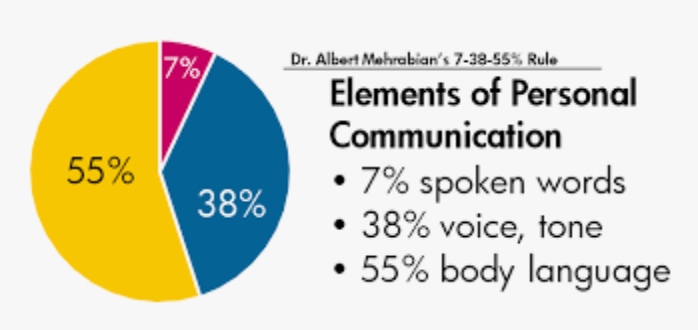
Over 90% of communication has nothing to do with the words that are spoken. Tone matters, but not as much as body language. Spoken words account for only 7% of how you interact with another person. 
Anyone who has owned a pet knows that you can tell a lot about what an animal is thinking, their mood, or their temperament without a single word.  They too know your mood at any given moment even though they do not understand a word of it. 

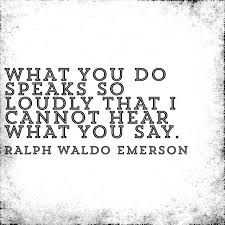
Words mean very little. The way you act and how society shaped you involuntarily speaks volumes. In fact it is so loud that often the words you say cannot be heard. 
I grew up in Brooklyn until I was 12. We lived in a predominately Italian and Hasidic Jewish neighborhood right on Coney Island Avenue. I’m the daughter of an Italian immigrant who came over in 1970 because his large family dragged him here at the age of 20. It wasn’t an easy life for my father’s family here in the United States. At that time immigrants no longer had the opportunities they did just a few decades earlier. All but my father and one of his brothers returned to Italy. My father’s reason for staying was that he met and fell in love with my mother.

My father grew up in a small town with an incredible work ethic and even stronger ambition. For his family this paid off immensely. But in the United States his work ethic and ambition went unnoticed and did little to get him ahead. He couldn’t get ahead and even learn English when he had to work so hard just to put food on the table to feed my two brothers, mom and I. 

His parents were of the traditional followed traditional, old-school Italian practices. The mother was barefoot at home taking care of the kids, while the breadwinner male provided for the family. The male raised his hands to his wife and kids when he felt he needed to in order to keep his family in line and teach them the value of putting up with crap life throws at you without bitching and complaining about all you don’t have.

Consequently, that is how I grew up. My Brooklyn neighborhood felt dangerous. There were creeps on the street everywhere. We often had various homeless people living on our front step. Our front door didn’t lock. We lived three stories up in a vacant building in a small apartment with only 3 small bedrooms where you had to walk through 2 in order to get to the 3rd. Privacy, my own things, or own room never even crossed my mind. 

I moved to Long Island in Middle School. A poor town in the middle of what seemed like nowhere compared to Brooklyn. My father knew a handful of Italian friends who moved there, so our very Italian traditions seemed normal. My mother dropped out of high school in 10th grade, was in love with my father and didn’t even want to tell her family about the dark side of living with my father. 

Growing up all I ever saw was my father working and never getting ahead, and my mother depressed at home all day in a ratty mumu.

No one helped me with my homework. No one asked how my day was or what I was learning. No one told me I was smart or pretty or really even hugged me. No one said I love you in our home. My father’s workday dominated how our evening would go. Children were an aside. You fed, bathed, and clothed them until they were 18; then they were on their own and expected to come back every Sunday night for football and dinner. 

Believe it or not I saw nothing wrong with this. I did want something more. I wanted healthcare and time off. I wanted to not depend on a man. I think everyone I know, knows my story. I joined the military, got skilled in a few trades, used the Montgomery GI Bill and then my own funds to get an MBA. I got married and had children young (19/21/23 respectively), worked 2 jobs for several years, and spent the first 10 years of my oldest’s life going to school in one form or another. 

I was proud of myself. Many people ooh and ahh and say they are proud of me for being “self-made”. White privilege didn’t benefit me. The first time I heard the term I was pissed because it seemed to disregard all I worked for. 

I was one of the happiest people I knew. Not to toot my own horn, but I was also one of the hardest working people I knew (if not the most). To say I put 110% into work, my kids and my family was to say the least. I was really happy this way. 

In 2007 after 12 years of marriage I learned about a secret my husband had been keeping that absolutely devasted me. We recovered and I was almost back to my old self, but the same issue came up again just 3 years later. This time the marriage did not last. 

Being a divorcee and remarrying someone of a different background and current societal class changed my life. I broke down. I liken it to Richard Rohr’s book called “Falling Upwards”. 

I broke down but I also became a better person. A more aware person. 

There were prominent issues from being in two different economic classes that came to a head many times where I felt myself and my children didn’t measure up to what my step-children’s lives were like back at their mothers house. The division between private school, spending a lot of money on opportunities to beef up a high school and later college education, and even what kind of school should be looked at created a large divide where myself and my children felt as if the things we strived for and were very happy with were what the lower class does.

My most enlightening moment was a few days after my current husband and I moved in with our 4 kids into an incredibly, too large for my liking house, down a beautiful cul-de-sac not far from my old reasonably sized house just a few miles away. In this area no one ever saw there neighbors so it was a welcome feeling when our neighbors right next door came out to meet us. They also had 4 kids around the same ages as ours. They were very nice until they realized we had two 11-year-olds that were not exactly the same age. We explained we were blended. It wasn’t the words they said – because the words were sweet and nice. It was the body language, the surprise and uppishness in their voices. I don’t think we ever spoke to them again.

It was at that VERY moment a flash of awareness came across my consciousness. I suddenly wanted to cry for all the black families moving to a white neighborhood or how an LGBT couple may feel buying a home in the suburbs. I became aware of the stigma of how mixed races try to explain how they are being looked at when going about their lives; or how someone who doesn’t speak English perfectly is treated. A divorcee is probably much lower on this totem pole, but it helped me to see and feel how society treats people that they feel are the non-traditional humans you see on TV. It’s why I relate to the line in the BLM rules about breaking down the notion of the traditional nuclear family.

Over the next few years before I started having clinical anxiety, I continued to get angrier and at the same time continued to climb the ranks at work. 

The contrast between my husband’s kids and family became almost unbearable. My step-kids were told constantly by their mother that my extended family is white trash and that their step-siblings were not as good as them because they went to public school. It morphed into me and my ex using my husband to put my kids through college, me using my husband for money and a host of really other rotten things. Everything I did was looked at through the lens of me being a monster. Obviously none of this was true, but because of my background and my non league education, I wasn’t one of them. 

I understand that after dozens and dozens of “digs”, it’s possible to get really angry in a situation that seems like it didn’t call for it. Similarly to how a black person might storm out of a room because of a comment no one understood could even be offensive.

One specific example is how private schools and fancy camps was one of the great divides of our blended family and one of the main reasons that created a rift between our children gelling into something new. After a lawsuit, a camp dispute that went on for months, when in the same evening the high school my children went to and then the camp my daughter was going to were put down by two separate people, I got what may have seem unrealistically angry by the second comment.

Black people have all kinds of digs in their day to day lives. Just walking into a store perhaps and seeing the elderly white woman behind the counter reach under to get closer to the panic button is a little dig that me as a white person we would never notice unless someone pointed it out to me. Perhaps I did that or something to the like too, but didn’t even notice I was discriminating or questioned why I was.

Take that example of the panic button as one part of a whole day of these digs that weren’t meant but are a part of how we accept society act it is. Then imagine a black person going out to participate in a peaceful riot to ty try to explain how what we can’t see is hurting them and in many ways holding them back (it goes far deeper than this, but it is too much to write about here).

Then imagine being in this peaceful demonstration and then getting called the “N” word and told to go back to the rubbish where you came from and off “my street”.

Can you see how the experiences this very normal black person had in their life and day may cause an otherwise very rational human being to riot and lose their mind? I’m not saying that it’s OK to riot or loot or loose your mind, but I’m saying I understand how it gets there.

I understand because it happened to me a few times. I can understand how not feeling heard and being forced to live in someone else’s perceived “better, more civilized” society would make the person who is in the perceived lesser category feel.

Riot is the voice of the unheard.
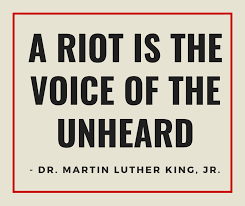
We aren’t listening.

I sincerely fear that an executive order from the president banning cultural sensitivity training and marking it as “un-American” and “divisive” is a horrific move in the wrong direction.

It leads to more “not listening” and more ignoring of what too many are trying to say. It ignores the fundamental built in narratives that if you work hard in America you can make it.

That is absolutely not true for everyone. Not everyone is granted the same opportunities due to where you are born, the color of your skin and even the gender you are attracted to.

I’m a democrat and I believe in hard work. I don’t think that conservatives hold the only claim on this. I don’t think anyone is looking for handouts, but I think they are looking for a fair chance. I know I’m smart, but without tutors, money, or even support; please don’t tell me I had the same opportunities as everyone else. And my skin is white! How can we expect for a moment that a black person in an impoverished neighborhood could compete with a good school, tutors, not having to work after school, being able to easily study because the heat and lights are on and their belly is full. Meanwhile they are being marginalized while going into a store, looking ratty when the family can only provide hand-me-downs and consequently have to waive the flag and say the pledge that there is justice for all.

How can you expect the average black kid growing up in a ghetto to possibly make it out of there through hard work and education when their school was so sub-par to one right outside the gates of the ghetto and then claim it’s socialism if we put more money toward schools? I think it’s quite Christian to take care of others and still a democracy.   

Citizens who don’t have access to healthcare cannot get help when they are sick or help with mental illness at any kind of age – let alone when you are young and can still “make it” in America. It’s not socialism to want to find a way to give people access to healthcare, the very thing that will keep them healthy and contributing to the society we hold them down in.  I never had healthcare growing up. Mostly because my father was an immigrant. Even thought he was here legally, he couldn’t get a job that provided for it. Not because he was stupid or lazy, but because he didn’t have the same inherent opportunities that are so invisible and part of what so many people think comes with life, that they can’t see them. 

Not stopping to think about what you were inherently born with and took for granted is privilege. There are all kinds of privileges like just being American, being male, or having money. And skin color. With white skin it’s very difficult to feel the sting of how society looks down on others with different skin color. Even if you don’t look down on darker skin colors, it doesn’t mean that it is not real. In fact it makes it harder to believe that it is.

There is nothing embarrassing or humiliating about learning you have privilege and that being blind to it creates an unjust society. In the same way there is nothing that should be embarrassing about being a male vs a female. Unless you are an enlightened male or were educated on the subtle societal ways males dominate our society, as a male you will not see it.

As someone with money and maybe even the luck that some risk you took to build yourself up panned out, doesn’t mean that someone else isn’t working really, really hard – perhaps even harder than you, but circumstances will never allow them to compete to get to where you are.

This is exactly how black people are being held down. I’m several steps (maybe generations) behind my husband. 43 points exactly in a privilege walk. How can anyone believe a black person isn’t behind me on this scale? I don’t need data and statistics to know they are. I know because I’m alive. I feel the 93% of non-spoken word communication I’ve been treated with and I see the 93% that black people are treated with. And guess what? It’s much worse.  

This is why it matters to me. It’s personal because as a woman and as someone who can mingle in a different social class, I have experienced how many privileged don’t know they are privileged and make judgements and comments about things that are downright just not true or just plain insulting to me.

Women are sexualized and marginalized. The upper class looks down on the lower class and believes their more expensive schools and activities are better than the middle class school and activities. They don’t realize that these types of activities is what keeps America unjust and that the privilege they creates opportunities for them that do not exist elsewhere.

Black people have historically been treated differently. Because they were they lived in lower class housing and neighborhoods. Because they had no money there are not generations of families with college degrees in competitive jobs, making even more money to put more kids in college.

The field is unlevel.

It’s unfair how society just looks the other way and then blames the lack of hard work on those who just cannot physically or mentally make it. 

I may not have understood this as a white woman who in many ways has been marginalized. It wasn’t until I was 40 years ago and immersed myself in some things where I realized what I took for granted – the good of being white, and the bad, such as the role I was playing being a women; were things that I was blind to and when along with because it was just such an integral part of society that I didn’t see it.

I learned from extreme measures. The book I referenced above “Falling Upwards” talks about how it often takes extreme measures and extreme discomfort to learn about seeing another side. It’s a blessing to fall because the world makes a lot more sense to me. I can understand and see the injustices all around me. It’s not a Christian, Hindu, Buddhist, Jewish or any religious type of teaching life. Unless you stop to think about it, what we teach in American schools and homes as “success” is actually greed and looking out for #1. It’s the complete opposite of love.

Now at this moment in history we are being told that trying to understand where someone with a different background of the already made American dream and line “With justice for All” is un-American and creates a divide.

Not acknowledging there is a divide and ignoring what the a very large majority of a country’s people are saying is a divide.

My father will now be 70 years old this year. He will never retire. He is an alcoholic with tons of medical issues and terrible senior healthcare. My mother died at the age of 49 from lung cancer. Yes, she smoked earlier in life; but please don’t tell me that treating her during her life for depression and helping her find a way out of an abusive home and the stress that it caused would have done nothing for her. If nothing else, her quality of life and subsequently that quality of life for my brothers and I would have made a world of difference. 

The social issues we face are real. It’s the single most divisive element in this election. But I don’t understand how anyone can be against helping other members of society be brought up to simple standards of living with dignity. There are cases of lazy people, but they are not most people. 

Most people, given fair opportunities will take it. But those opportunities have to be there and visible. Without them there is no hope. You can’t blame someone for not working 80 hours a week knowing it won’t ever get them out of the ghetto. There are some where it can, I agree. Some of those individuals take advantage of it, and others squander it. But I do know that for the majority (like my father) – no amount of hours would have made a difference. I’m not advocating for giving money to lazy people, I’m advocating for creating opportunities for lower socio-economic classes.

That is why living wages are important. 

Black people are in this category of the lower socio-economic rung more so than any other sector of our society. They are in these rungs because of the history of our country. You want them to wave a flag and be proud of living here? Not try to peacefully protest and explain this in some way? 

We can’t have a conversation about fixing anything if these issues and the whole BLM issue are not acknowledged. BLM came up now for a reason. It’s not just because of police brutality. Police brutality was what made people get up and onto the streets, but it’s not the only reason. Privilege is so entwined into our society that unless you are living on the fringes you cannot see it.

Not seeing white privilege at work or how the lack of attention to these social issues doesn’t mean they aren’t real. Telling your own story of the hard work you did or the hard work your parents/grandparents did does not make anyone else’ struggles today null and void. It seems to be a valid excuse to turn your head. Helping others doesn’t turn our country into a socialist country, it turns our citizens into evolved human beings who can look past themselves for the benefit of others, which will in turn truly be beneficial for the society and county at large. It can be an even more thriving democracy when all our citizens are working and healthy enough to contribute and be proud to be an American. Right now it thrives for only some but not all. It’s not Justice for All.

What you do, how you act, what you post, how you treat people is what people perceive when they are communicating with you. I’d go the mat to say that most people are not knowingly racist, sexist, arrogant or pretentious on purpose. Knowing that, know you might be one of those people and not know it either. But those who aren’t know – because it’s being communicated so loudly, they can’t hear what you are saying. Stop and think about what you really think, what you really feel and what you really support. Is it justice for all? Or is it keeping you and you only safe and sound? 

This may sound disjointed, but the point is that I know I couldn’t see this message only a few years ago. I would have said society is fair. But I now know it’s not. Until we all acknowledge that we aren’t equal, the inequity will continue to grow.

I don’t think we want to do that to ourselves, our neighbors, our children or our country. But it’s happening.

Please. Wake. Up.  

If you enjoyed my writing, consider leaving a comment, sharing with others, or following my blog

About this site
On Facts vs Beliefs

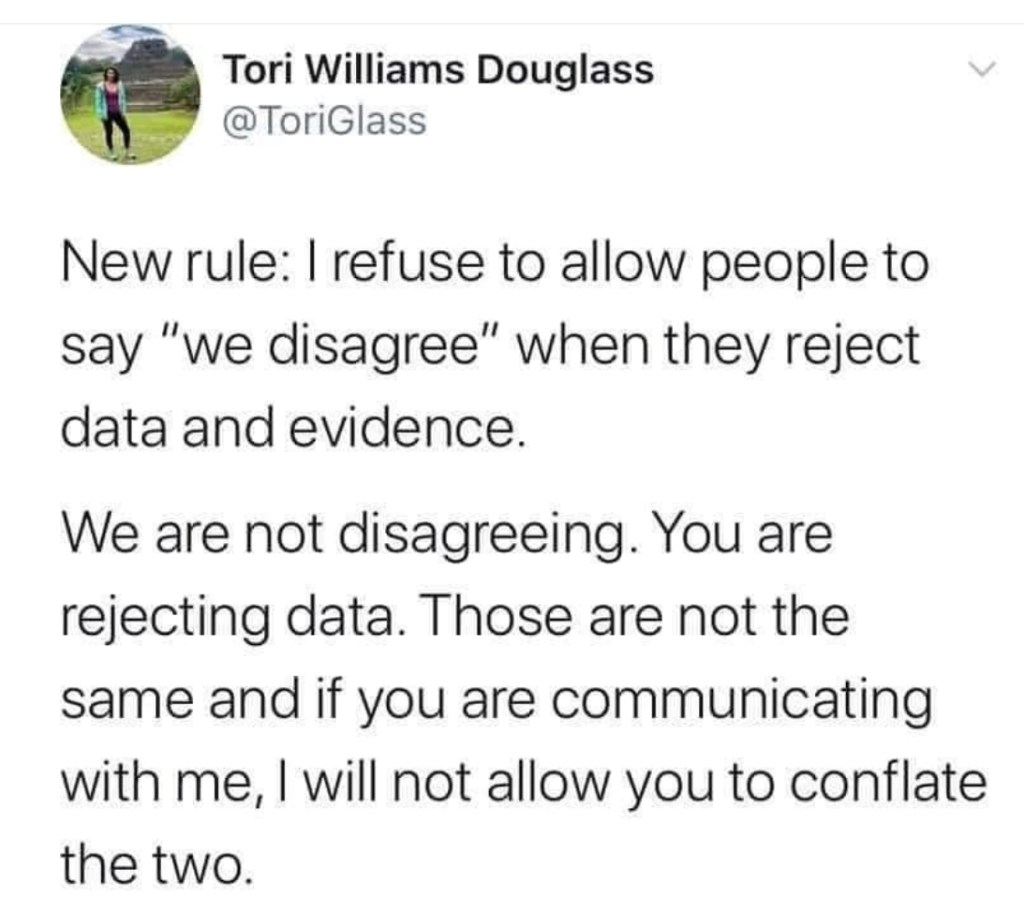
As a current data analyst, and a data analyst as a major role in most of the professional positions I have held in the past 13 years; I am quite accustomed to people questioning data. 

Most of the time compiled data is unquestionably passed along and used for managerial decision making. Sometimes after someone looks at it, new parameters need to be put in because either more information is needed or there was a miscommunication about what was wanted. And on occasion I may have made an error in inputs or pivoted an incorrect field. It happens. To avoid a circumstance of error, my co-workers and I usually do a second review of one another’s work to ensure that we pulled and compiled an analysis correctly. 

Once it’s sent out, we often answer questions about parameters, assumptions, categories, etc. No one has ever accused us of being biased. If something seems wrong or the requestor doesn’t like what the data shows, there are other people who can run the same thing. When the same results are shown over and over by different groups whether or not it’s within my local organization or around the country – it ends up being facts that don’t have a “belief” on whether or not one agrees with them. 

On some rare occasion a manager or physician will find one or two lone people who will run data to support what they need. Or they unknowingly asked someone who doesn’t do it often enough to know what to put in, and they just happen to get results that support a new position, that supports a clinic is more full than it really is, or some other result the individual wishes to be true. 

However, there are measures in place to ensure that when other results overwhelmingly outweigh a small number of results; what the vast majority has found is what is used. This is also true in clinical research which I’m also very familiar for obtaining data for as a side job. 

Peer review is a common practice in professional papers, journals, and research. In my first job at the VA before any data analysis, the physician I worked for was a peer reviewer for several medical journals in her field around the world. The process is blind – meaning, you have no idea who wrote the paper or pulled the data in the paper. And the writer has no idea who reviewed it. The reviewer makes suggestions to the editor and writer about whether or not the paper has validity, if more information is needed, etc. It’s a brilliant process that has worked for decades and lead to serious advances in all areas of life. 

That is what I have found disturbing about COVID. COVID isn’t the first thing that is indisputable but ends up becoming a “belief”. But it does seem now like things questioned in the past are now forums for long angry discussions, some become political points, and others are ripping apart family and friends. I really don’t understand this. 

The facts and data shows- 

  • COVID isn’t made up
  • COVID numbers aren’t made up
  • Climate Change is a real thing
  • Racism is real
  • Sexism is real 

At some point – where the bell curve flattens (around 98% or so; or arguably even before) it’s time to believe the majority. When something is new – such as the world is flat, I really understand that it can be hard to believe. But when 98% of the studies show the world is indeed round, it’s kind of time to flip the flat earth viewpoint. 

No actual data or studies show most of the poo that is tossed around about political candidates or parties. Some clown (or brilliant jokester) either in the US or a foreign country is probably laughing in their garage about Americans eating up whatever nonsense they drummed up hook, line and sinker. These are rinky dink memes and articles and unvalidated data. Even articles and opinion columns in well respected news media are not backed by any studies or data. We would hope they stay neutral (but they clearly don’t); so our only real hope for good information is from the professionals who do this for a living. 

You can have an opinion, but when it conflicts with overwhelming data – I have to side with the person who posted this on social media. 

Beliefs are not facts. And that is a fact. 

Namaste 

If you enjoyed my writing, consider leaving a comment, sharing with others, or following my blog

About this site

Anxiety and Missing Medication Doses. A Missed Effexor Dose.

I woke up from my husband’s alarm this morning. It’s Saturday, and what most people would consider a day to sleep in. But for us almost every week for a different reason, for the past 9 years- there is some reason to get up.

6am today.

The beeping jarred me awake from a very vivid dream that I try to hold onto for a moment or two- trying to make sense of what it meant.

At some point just moments later, I realize that I feel EXHAUSTED. I mean exhausted, in case the uppercase didn’t relay this feeling well enough. Next I notice an almost unbearable throbbing of my head. My nose is stuffed. My mind is racing for no good reason. So badly that my heart and breath (with stuffiness) matches the anxiety.

But there is a reason for anxiety. We are moving and had just spent a week in the new house meeting with contractors, getting quotes, installing ductless air… working for work… working around the house… managing upcoming renters and our mostly adult children. A week of some big changes too. Devin, the youngest of our brood of 4 passed his road test on Thursday. Days of carting kids are just suddenly over.

I went through this week like any other. Feeling like I’m going through the motions to get to the next step. Feeling like I’m barely hanging on and can hardly make it another day at this pace. Telling myself and my husband that we cannot keep going on like this. That the work we are doing has to be for some great reason so in the near future we can finally rest.

Massive changes taking place around me hardly phase me. If I went back to every week in the past 9 years- nearly every one of them would show at least one or two mega great changes and things to celebrate or mourn. It’s constant. This week was really like no other. So why am I anxious today? It’s no secret I struggle with anxiety disorder and PTSD. But it’s felt very under control for about a year now with a few relapses. Why now?

I think back to yesterday when at some point around 2 or 3pm in the afternoon I felt unbelievably restless. Then it turned to feeling trapped. Next I’m frantically texting my husband about how I feel. This alone is an old familiar feeling. I hadn’t done this in about a year either. I’ve had relapses of panic and/or PTSD episodes, but this one is different. It feels a little more uncontrolled.

We’ve had workers in our house since Tuesday around the work day clock. They were supposed to be done Wednesday. Then they said Thursday. Thursday when I arrived home at noon they were still there. 7:30pm and wanting to eat dinner with no where quiet to sit… they are still there. Thursday evening they say they will need to come back for a half day Friday (yesterday). I am ready to go back to our home on Cheshire. We have renters coming today (Saturday) and I haven’t been home in a week. We are also going to Long Island. I’m starting to feel overwhelmed again. Like I have no time for myself. There is so much to do. I’m sick of eating take out, I want to cook but need to shop first. The house in Cheshire is on the market and I can’t even think about what it might look like after my quite messy 22 year old came home for the month of Aug. I can’t bear to look at my broken fingernails with dirt underneath due to the copious amounts of yard work- and there is more to do in Cheshire. My body is sore from what feels like non stop physical labor from cleaning, fixing, working. I have bruises, bug bites and cuts everywhere. I need to unpack my clothes and loads of food in Cheshire only to pack an overnight bag… then unpack again Sunday.

As the hours tick by and the workers are still there- relaying they are ‘almost done’ every 1-2 hours. I become increasingly more agitated. At 4pm they announce they are in fact done and start to clean up.

I drive home in commuter traffic with a car packed to the gills with air conditioners, food, photo albums, clean and dirty clothes, frozen items defrosting rapidly in the nearly 90 degree heat, amongst a myriad of other things. My car is constantly packed with stuff to cart from house to house or to drop off here or there. My anxiety starts to go over the roof.

Somewhere on Route 10 about 20 minutes away from home while moving at a snails pace I start to cry. Really really cry. And it feels good. It’s a release of all the toxicity I feel has been building up that I just pushed away and dealt with.

Long story short I get home and feel fine, but the night is filled with mixed emotions ranging from sadness to anger to despair to PTSD related thoughts. I’m crying, then laughing.

What is wrong with me?

IS there anything wrong with me?

Wouldn’t most others hit a limit of feeling like it’s too much as well?

To add other weird fuel, I have 4 known trigger dates that I’ve identified in my PTSD treatment. Trigger dates are times to rest and realize your body recognizes similarities in the atmosphere (light falling certain ways, temperatures, smells, etc). One should rest because our lower brain only feels these things without rational thought and goes into fight or flight mode in an attempt to protect itself. If we don’t consciously pick up on this with the higher brain, the lower brain shuts the higher one down at a certain point to divert all energy to fight or flight. This used to happen to me a lot. With and without dates, brought on by other known triggers. The only thing is you don’t know when those other triggers will strike. At least with dates there is an ability to prepare and take it easy.

Three out of four of my most prominent annual trigger dates take place on & around July 9th through on & around August 9th.

I’m not taking it easy or treating this time of year with any special care. In fact I’m feeling busier than usual and barreling ahead like someone is chasing me.

As I move around in bed my body hurts in every single which way. Mind, belly, headache, muscle pain, sinuses, heart, third eye.

I mentally go through the morning and imagine going downstairs for coffee and to take my daily dose of Effexor. That is when I horrifically realize that I never did take my medicine yesterday morning. Pieces of the puzzle start to fall into place. My emotional breakdown and complete instability last night. The way I feel today. The feeling of being trapped yesterday. It makes sense.

More often than not if I forget my pills by 10am I have a dizzying headache and feel crazy nausea. I take them as soon as I remember and I’m fine within a few hours. No head ache yesterday. No head ache = no physical reminder something was amiss. Only hours later when my old mood symptoms returned did anything feel off.

So is it the chicken or the egg??? Anxiety from missed dose or missed dose due to anxiety.

Both??

Twice this week when going into work I forgot my pills. One day my husband delivered them and the next I had some in my car. Perhaps I’m anxious, my thoughts are jumbled and I can’t remember?

Is this anxiety or is what we are going through something that would make anyone anxious? 9 years of non stop activity and life momentous life changes taking place back to back (divorce, kids driving & going through all firsts of puberty, graduations, college starts, new jobs, house moves, new schools)

Is it my trigger dates?

Do societal expectations to do it all, hurry faster, give and experience as much as you can cause anxiety? Would my PTSD kick in less if I weren’t so busy and experienced the same levels of increasing anxiety that society in general seems to feel? I know I’m not the only one. Stress and anxiety seem to be a quiet epidemic virally rolling through our nation like a barely detectable tsunami before it strikes.

Does it matter to me where it’s coming from?

This morning I cried some more. I cried because even though I know how sick I get when I miss a dose, I didn’t realize how much the Effexor was keeping the anxiety at bay. Like I said I’ve had relapses. But yesterday’s was something different all together. It was like I never started a single pill and I was right back to where I was before I began dealing with this issue. It feels like a complete and absolute loss of thought and emotional control. The lower brain did take over. It sensed some kind of danger and shut the rest down. It’s terrifying. But I do have to admit the crying jags feel really good! They actually hurt physically in my heart, throat and head- but it is like there is a release of pressure in those areas and it is coming out. Am I not allowing emotion to pass through by taking pills?

The struggle is real. The pills really work. The issues are complex and are both personal and societal.

There is no point to this blog other than to just wonder, chicken or egg? To share with others how missing a dose feels because an hour ago I wanted very badly to read someone else’s experience. To see how long it was before they felt better once they took their dose. To see if anyone else wonders if their life experiences would affect anyone or if there is something truly wrong with the wiring in their brain. 9 years of running around and with delayed onset PTSD creeping in slowly through that time. Would an occasional breakdown be expected?

I used to be so afraid of the thought of having a mental illness. So afraid I didn’t even want to find out. It’s stigmatized.

Once I couldn’t take it any longer and started meds, I was afraid of anyone I know finding out.

Now I just want to shout from the rooftops that it is ok, you will be ok. We all struggle. As soon as we stop pretending we are struggling & that all is hunky dory- it miraculously becomes easier.

Why is that? Because we let the emotions pass rather than holding them down & hiding them? Does the medication prevent real healing then? Or is it a bandaid?

I don’t know. All I do know is that I’m starting to feel a little better about 2.5 hours after my dose this morning. I haven’t left the couch yet so I can’t speak to the level of feeling better other than I’m not suffering through stillness any longer.

Writing about it and seeing my fleeting thoughts in front of me helps.

If it helps anyone else too either now or in the future, then all the more beautiful.

Esterina

If you enjoyed my writing, consider leaving a comment, sharing with others, or following my blog

https://esterinaanderson.com

Sunday Mornings

Sunday mornings always had a feel to me of a new dawning. No matter where I’ve been on a Sunday morning, I have felt a certain vibe in the air that the day is even fresher than the Saturday and weekday mornings before it.


In cities coffee shops are just opening, few cars are in movement on the streets, and most stores are closed. There is a certain quiet in the air. Softer movements. A slower vibe.


In suburban and rural towns, the atmosphere also has a peaceful quality. The strip mall lots and main streets are mostly empty except perhaps for a convenience store, gas station or breakfast shop.


Sunday morning is not quite as exciting to me as Saturday morning. Saturday morning is about chores, shopping, making plans for the evening. Sunday for me is more about taking time to wake up; enjoying my cup of coffee longer, mentally and physically getting ready for the week ahead, and having a whole day ahead of me to do so.


This cloudy, albeit beautiful morning is so very typical at this time in my life. I am up before anyone else at the moment. I came downstairs to the main kitchen/living area and it looks like (what we like to say) a bomb. But it is a bomb that I love. This scene is a snapshot in time; my life at almost 43; my family; where I happen to be in the world.


On Sunday morning my house often has blankets strewn about the couches, the floor and perhaps even a kitchen chair. Yesterday’s paper is usually lying about in a neat heap still waiting to be read. The cats are milling and meowing like crazy for their morning meal of a little wet food. The counters and coffee table will often have mostly empty popcorn or snack bowls. A cold tea bag sitting in an empty Starbucks mug from one of the cities we have visited. More often than not there is an espresso cup somewhere with a small circle of the dried, dark remnants sitting at the bottom. An open, unfinished bottle of wine sits on the counter with an accompanying wine glass or two in either the sink with an amount too small to finish lying in the lowest nook of the glass, or haphazardly rinsed and left in the dish drain to dry. It’s not difficult to see what we did before bed, be it a puzzle, a card game, or just some movies, since the TV remotes or pieces of whatever we were doing are mostly left where we had them when everyone retired for bed.


I will either be up alone or with the hubby. The first order of business is to start the coffee. Then we quiet the little milling lions who get increasingly vocal by the second until they receive their ever-so-desired wet, stinky cat food. Either alone or splitting up the tasks, we will start to load the dishwasher, open the blinds, fold the blankets and put the house back in order.


Today I’m alone. I woke up before Daren, excited to begin a new day and continue to work on a painting that I am in the midst of completing. I cleaned up the house and then sat on the living room floor with two pillows beneath me facing the East to do some morning breathing and meditation. It’s a cloudy, dreary and gray morning; but beautiful none-the-less. The sun is still making its way up and about and brightening the day, even though we can’t see it.


I couldn’t help but take a picture of the scene I was looking at. Every morning it looks different. Even in its drab form, this morning was picturesque to me. I stepped outside to get a closer shot and the air felt SO fresh and cool, I didn’t want to go back in. But I did – simply to get a chair and two blankets to take my morning practices outside.

It feels like Sunday. Even in February, birds are singing. I can’t see the town or even much of our neighborhood from the back porch, but none-the-less it has the Sunday morning vibe of serenity that I enjoy so much.


Nothing exciting, but I am feeling intense gratitude and oneness with the world at the moment. A snapshot in time. It’s just a beautiful and precious Sunday morning.


The page has turned. The week, day & month are fresh. We write the story, whether we do so intentionally or not. Be mindful of your thoughts.


Namaste.

If you enjoyed my writing, consider leaving a comment, sharing with others, or following my blog

https://esterinaanderson.com

On the Fluctuating Gunas (The What???)

Today I woke up anxious. Physically I had a slight tightness in my chest. My heart felt like it was a little heavy, but the worst was my breath. I couldn’t help but sigh every few moments. Obviously releasing some kind of tension. I felt slightly lost. Not sure where my life is going. Not but an hour later I was laughing and feeling like wherever my life is going it doesn’t matter and I’ll get there as I need to.

These are the “Gunas”. Fluctuations that are normal in the universe. They are everywhere. In the weather, in our moods. It’s a universal law. What goes up must come down. What swings one way will swing the other.

The Gunas are a term I learned in yoga teacher training and were often discussed. It’s now a part of my regular vocabulary and thought process. We don’t stay in one mood forever. Nothing stays in its state forever. We are supposed to feel good and bad. It should be expected that good things as well as bad things will happen. Fighting it is what leads to suffering. In Buddhism a key tenant is that any attachment causes suffering. Even attachment to feeling one way (like happy), being attached to an outcome you want, or any objects/feelings/desires/etc. The Hindu tradition (yoga’s roots) describes the same concept but in a different way.

From Yogapedia: https://www.yogapedia.com

A guna is an attribute of nature, according to Hindu philosophy. In Hinduism, there are three gunas that have always existed in the world in both all living and non-living things:

• Tamas (darkness, destructive, death)

• Rajas (energy, passion, birth)

• Sattva (goodness, purity, light)

Here in our Western world we are not taught to think in this way. We seem to feel that if something goes wrong or we don’t feel well (mentally, physically or spiritually), that something is wrong with us. Imagine we were taught that both elation and depression are normal and to be expected? Neither will stay. Both are an experience of being alive. The more we attach to any experience (the good or the bad ones), the more we will ‘suffer’. Suffering really meaning anything from disappointment to despair.

I’m signed up for daily emails from Richard Rohr. He is a Franciscan priest that wrote many books on spirituality. I recently finished “Falling Upward” which was amazing! Much of it was about how we need to fall in order to learn and grow. How opposite things are complementary and part of life. I will paste a quote from the Tuesday mediation.

“If we are going to talk about light, then we must also talk about darkness, because they only have meaning in relation to one another. All things on earth are a mixture of darkness and light, and it is not good to pretend that they are totally separate!”

Understanding the Gunas is one of the many ways I am learning to accept life as it is. When I remember them when I’m feeling down I almost embrace it as the full experience of life. Not always, but more & more often.

They have helped me- and if you have read this and are willing to try, perhaps that can help you or a loved one too!

Peace & Namste


If you enjoyed my writing, consider leaving a comment, sharing with others, or following my blog

https://esterinaanderson.com

On New Pathways


images.jpeg

I don’t know if it’s because I turned 40 this year. Or because I started yoga teacher training. Or because I started taking Lexapro. Or a combination of those and other things, but I’m a person going through a transition. I’m sort of on a new path.

One of the many new things in my life that I’ve been taking advantage of is the new trail that was recently built between Jarvis and West Main Street in Cheshire. It’s not officially connected to Southington yet, but it’s walk able and no one tells you to get off. It’s not connected to Cornwall Street either, which would make it possible to not get off the trail all the way from Southington to New Haven, but the small road that connects West Main and Cornwall (Willow) is safe and short enough that it’s no problem at all to do the whole route without getting too far off the path.

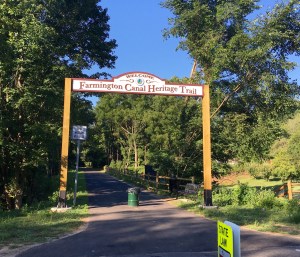
It’s a new pathway. I ran on it for the first time about a month & a half ago. It was the same day I put on a Fitbit. Daren got one at the conference I joined him at in Vancouver. He had it on his dresser for a few weeks until I asked him if he was going to use it. He said no and that it would be ok if I did. I put it on that morning and ran the 1.25 miles up to the new trail. I didn’t know what I would soon be embarking on. As soon as I stepped off my usual route from Lancaster onto Jarvis, I felt a little scared and excited. I’d never really been off my usual path (A.K.A. rut), and the excitement of being on new territory without a car just felt sort of freeing. I turned the corner and really didn’t know how long it would take me to get to the trail. I knew it by car, but being on foot was so much different. It turned out to not be that far at my jogging pace. I looked down at Map MyRun on my iPhone and saw that I had already run 1.25 miles when I hit the entrance of the trail. It was kind of exciting to see it live in person. I mean I drove past it every day, but to be standing in front of it, in the bright morning sunlight; it felt a bit magical. I stopped to take a picture of the new sign. I thought when I left that morning I might start walking once I got to the trail; but I wasn’t tired just yet, and felt the strong desire to keep running.

img_8589
Where the new portion of the trail starts on Jarvis

The path is flat compared to the hills in my neighborhood that I’m accustomed to. At times those hills kick my butt and I need to stop and walk; and other times I can just run on the balls of my feet and lift my legs little higher to somehow to run seamlessly up them. The flatness felt novel and good. It felt like I could run forever.

img_8590
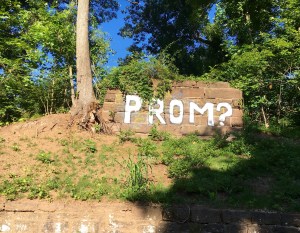
Cheshire’s new prom pose spot?

I ran a little further into the trail and saw the Prom? sign that I’m now very familiar with graffitied into the mountain. Where did that come from? Is it the Cheshire prom pose place? Did some romantic high school boy do that for a girl while the trail was being built? Who knows… but it’s kind of nice. It is right across from a bench. I stopped to take another picture. I felt the warm morning sunlight on my skin and just wanted to soak it in. I ran further while breathing slow. It’s an old trick that also sometimes works for me and other times does not. This particular day it worked. The slow breathing, warm sun and shadowy trees created the perfect jogging conditions for me. I continued down this new path not really having an idea of how far I’d run or how far it even was until West Main Street. I just knew I wanted to keep going. Running waters, green muck, many benches, beautiful trees… It was all breath taking. I felt so alive. And before long when I heard the sound of cars in the near distance I knew I was getting close to the end; and almost without warning – there it was. I had to stop and just look at the familiar site of West Main Street. I had never seen it from the side of the road and vulnerably out in person without the armor of a car. A person without that protection is just exposed to the elements; but at the same time, so close to them. I could smell the greenery, touch nature, feel the heat, smell that green muck. It was beautiful. I took a picture at West Main and turned around, now having a baseline of how long it might take to get home.

img_8597
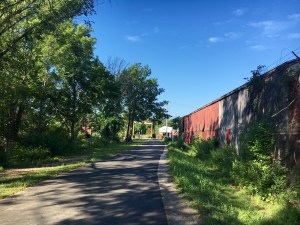
Where the new trail starts on West Main right next to the Lumber Factory

Again, I thought I’d get tired and walk. To my surprise on the flatness of the path I never did get too tired to keep running. I took many more pictures and reveled in how it felt to be outside in a new territory. I loved it. When I got back to Jarvis and had to run up the hill, I continued to push myself just up to the next mailbox before I decided I would walk. Then it was going to be the next mailbox, then the next one… and before I knew it I was at the top of the hill and didn’t have to stop! As soon as I rounded the corner onto Lancaster, I was back to my very familiar territory. I felt a little new. I had left the familiar path for a new one and was able to come back with new eyes. I ran down Brigadoon and turned onto Dundee when my Fitbit buzzed around my wrist. I knew I hit 10,000 steps already for the day. I also knew from my Map MyRun experience that is about 5 miles. At that point I knew my round trip would be about 5 1/2 miles. I got home to check and it had been 5.55. I was so excited. I had never run that far in my life. It wasn’t that hard! And it was so much fun.

Over the past few weeks I went out onto the new trail as much as I could. I took Koji for a walk 2 days after my first venture out the other way toward Southington. That part isn’t officially opened yet, but Daren had run on it a few times and assured me that many others were using it. It wasn’t quite as finished, but it was just as paved and pretty. I started to combine the new route with my old one to get up to 9 miles without running anywhere dangerous.

One Sunday after yoga training last month, I don’t know what inspired me; but I got on my bike and decided to bike to and then down the path alone. I hadn’t biked alone since I was a teenager heading to a friend’s house. Biking was equally riveting and exciting. The cool thing is that I was able to move so much faster. I was at the path in no time, and then at the end of the trail at West Main before I could imagine. I didn’t want to just turn around and go home so quickly, so I decided to actually go off the path and see if I could find my way to the entrance that is on Cornwall Avenue where it connects to New Haven on my own… without a map app (who could imagine such a thing?). It was easier than I thought it even might be. I knew that a street parallel to Mountain and Route 10 must eventually hit Cornwall. And it did, like fast! Before long, I was on the very familiar trail from Cornwall to Higgins. Once I got on it, it felt so much older, but older in a good way. It had history and spirit that I could just feel in the air. It was different from the newness of the portion that connects Jarvis to West Main. The trees were more grown in, the road a little more broken in, and nature just in fuller bloom; as if the habitat was more comfortable with it’s surroundings. I biked all the way down to Brooksvale Park in Hamden that day, crossing many familiar roads that Daren and I biked over the years. I stopped at the park and checked Map MyRun. I had only gone 6.7 miles but it was so far from my house. I realized how this path could get me to where I’d like to in an alternative way sans a motor vehichle. It felt so good to do this on my own too, without the comfort of another human and without having to rely on technology to find my way around. I felt so independent. My round trip that day was 13.4 miles. Two weeks ago I actually biked 29 alone and all on the trail.

img_8806

This new path has opened up my world in so many ways. It helped me to realize how strong I am, either on foot or on the bike. It’s given me the power to go places without a car, which is something I have been aching to do for quite some time. It’s connected my part of town to other parts of Cheshire and neighboring towns so much more quickly. It’s connected me to nature. It’s connected me to myself.

While biking on the path a few days ago while coming back from a yoga class in Southington; I couldn’t help but marvel at the coincidence of this new path with so many new changes in my life, and compare it to the same process of creating new neural pathways in your brain. On the Cheshire-Southington portion that is still being worked on, the workers had their trucks out and were building the brick areas around the concrete stanchions that stop cars from being able to get onto the path. I have been watching this portion of the path being built and change day by day. Like me. I’m changing day by day, just a little at a time. I’m building new neural pathways. Each day, one change at a time I’m creating new routes, improving them and making them a little deeper so they eventually will be the automatic default reaction instead of the old patterns and ruts. Just like the path.

As above, so below. Pathways are pretty amazing, whether in our minds or in the physical realm. I couldn’t help but think about history and when the Romans started building roads. It opened people’s worlds. It promoted trade. Suddenly there was less constraint and more possibilities. Roads, highways and paths do get old though. Sometimes either the path wears out or the place it leads to is not a place you want to go any longer. It happens in our brains too. It’s a lot of work to create a new route to somewhere else. It’s often scary too, because there are so many unknowns both in the construction of it and the destination (especially if you aren’t familiar with the destination). Who wants to do that work when every inch is unknown and the default old route just feels so darned comfortable and familiar? It’s work, whether mental or physical. It’s scary and painful. There does need to be some level of destruction to create something new and beautiful. But once you step out of that rut and into the unknown, it’s exciting too. It feels a little dangerous and your level of alertness is also much higher. But that level of alertness also helps you to stop and appreciate what is around in a way that you don’t normally see your world because that world feels familiar and safe, so we get lost in our thoughts and don’t even pay attention to what is around us.

When you do revisit old familiar ways, thoughts, patterns, or pathways after being on a new one; there is often a level of appreciation and/or awareness of what is no longer serving you and what needs to be let go. A combination of what is good from the old and an exploration of the new is what creates new possibilities and the ability for us to grow individually in our minds, in our lives, physically to a new place with a better way to get to a possibly better destination; or as a society just as the Romans started.

New pathways both mentally and physically makes life more exciting and helps us to grow by changing patterns in our brains so we can experience life in a better way. That sounds good to me! Thank you Cheshire rails to trails projects. It’s just one of many physical things that is changing in my physical and mental world these days and I want to honor it by sharing it’s beauty with the world. Love, Peace & Namaste.

img_8797

If you enjoyed my writing, consider leaving a comment, sharing with others, or following my blog

https://esterinaanderson.com

On a Disjointed Life

105928270_4db43f009f_o


This blog is mostly in response to one my husband Daren wrote a few weeks back https://darenamd.wordpress.com/2016/07/23/on-the-value-of-rituals/

We did chat that day in the coffee shop, and I’ve been thinking about this for a few weeks now. One of the reasons rituals are so awesome is because it traces something back to it’s roots and honors something in it’s entirety. Well, there is nothing alone in its entirety. Anyone who is Facebook friends with me (IF they paid any attention to my page) would know that for the past 7+ years the main quote sitting on my profile is: When we try to pick out anything by itself, we find it hitched to everything else in the universe. – John Muir

I love that quote. I’ve used it in many conversations and presentations in a variety of formats. We can trace everything almost continuously including ourselves back to the stars. We and everything around us is made of star stuff (thank you kindly Carl Sagan for coining that term in my head forever). If we do actually think about this & how we are all nothing but star stuff; it’s easy to see nothing at all or just outright chaos. But if we ignore everything else and only focus on one piece of the universal pie we miss understanding and appreciating the beauty of the tie in. And feel very much alone.

Our human brains need to draw natural lines to understand something so it’s not all chaos or nothing at all. We also need to stop those lines in a place that we as humans can understand something and make sense of it. What I would argue is happening in the world today is that those lines we draw around something to make sense of it are becoming smaller and smaller.

Take for instance a shoemaker 150 years ago. He had a little shop in the heart of a town. People who lived in that town acquired their shoes there. The shoemaker knew his customers well. Everyone had a role in the town’s functioning and everyone supported everyone else to keep that town running through trade, bartering or monetary exchange. They were all they had and likely felt a sense of community and oneness. Mr. Shoemaker made the shoes from start to finish. He knew where the material came from, how they were put together. He literally created every stitch and hammered every sole. When he walked through town and saw others, he saw his creations on their feet. He felt connected to the product he made and the people who benefited from it. He appreciated the art of his work, which helped him to inherently understand and appreciate the products and services of his fellow townsfolk. Making shoes was a ritual and the universal lines were drawn around the whole shoe and the tie into the community and other humans.

At some point in history, machines and the assembly line were developed and broke up shoe making and nearly every other previous manual whole process that we could as humans possibly get our hands on. The universal lines broke down even smaller. Instead of making shoes; one stood on a line and mechanically made just a sole, or hammered in the same piece of stinking shoe over and over. The pride and ritual of the shoe in it’s entirely was lost. It became harder to connect with the final product. Supply chains were built up and one would no longer see the product they created on the feet of habitants of their town. In fact today, no one really knows any longer where things were created or how they were put together. People started working outside of their towns and traveling alone to jobs on long commutes to do things they don’t feel a part of. While our world is becoming more and more connected, humans are becoming more and more disjointed from the origin of their being; and their own worlds are becoming smaller and smaller.

I love Daren’s example of the record player. It was a ritual to play a song or album. The anticipation of hearing a song would build up as you went through the process of getting all set up. Manually making that happen while we wished it were faster felt very satisfying. Now that I have every song I have ever heard or could want to hear in my life at my fingertips, I just don’t enjoy music like I used to. Daren’s example of the coffee making process is simply beautiful. Making a cup of coffee in the morning was a means to true enjoyment. Manual effort was put in. The waiting made it all the more special. Do we really enjoy the k-cup, drive through, or 7/11 versions of coffee in disposable containers as much? As we gulp them down without thought? …several times a day for most.

Our on the go life style has started to suck the pleasure out of life. We aren’t connected to the things we do, the food we put into our body, or the people we run into during the day. We see ourselves as separate, and not part of the whole. Unless you own your own business, most of us who work have little to no connection to the mission of our jobs. We feel like a part in a machine with no connection to the outcome or even our own humanness. I march through the VA facility where I work and see the patients hobbling down the main corridor as road blocks to the next place I’m heading and already late to. Every so often when the bathroom on my floor is being cleaned and I need to walk down to the floor below, I see patients in the waiting room and checking in. It’s only then I remember that I even work in a hospital. That is sad and a symptom of something gone terribly, terribly wrong.

I wasn’t around back in the shoemaker days, but based on my experience with record players (and cassettes and CDs), and when my mom ground the beans at the end of the line at A&P and then percolated the coffee; I much more enjoyed the older, more manual versions of these and many, many other products and services. We don’t have time to do things in a way that are truly enjoyable any longer. How uncool is that? Why are we trying to do more and more faster and faster? It necessitates a quicker, faster, and smaller means to an end. It’s harder to appreciate the whole when you and everything you take part of is such a small cog in a larger wheel. What’s the rush? What are we accomplishing? Are we happier as a human race? I’m not. Am I alone in this feeling? Even if I am, I want to step out & slow down. I want to know the bigger whole. I’m a bit tired of the disjointed feeling of my being. I miss manual processes and rituals. I want off the treadmill. Anyone care to join me?


cog

If you enjoyed my writing, consider leaving a comment, sharing with others, or following my blog

https://esterinaanderson.com