Journey Through the Self: Exploring the Five Koshas in Yoga

“Yoga is the journey of the self, through the self, to the self.”
Bhagavad Gita

In the ancient Vedic texts, we find a beautiful framework for understanding the self beyond the physical body. Known as the Panchamaya Kosha system, this five-layered model is still embraced by yoga therapists today as a holistic map for healing and self-discovery.

Each kosha, or “sheath,” represents a different layer of our being—from the tangible to the most subtle essence of who we are. These sheaths are energetic in nature.

Since this is a conceptual idea, it’s not easily visualized. This is an artistic rendition I created, using inspiration from search engines, to give the model a visual form.
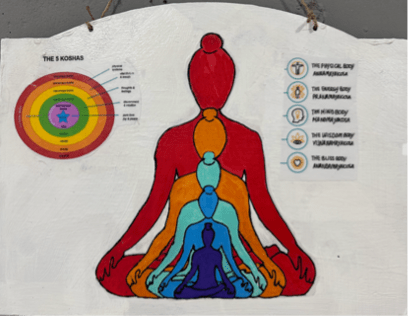
Let’s take a guided journey through each layer, pausing along the way to reflect, breathe, and connect.


Annamaya Kosha: The Physical Body

The outermost layer is the Annamaya Kosha, often referred to as the “food body.” Annamaya derives from the words anna (food) and maya (made of), signifying that the body is composed of physical matter sustained by food. It is the densest of the five koshas and the layer most familiar to us—the physical body that we see and touch.

According to the Bhagavad Gita, it is the body that allows us to engage with the material world and fulfill our physical needs.

Yoga asana (postures) help us strengthen and care for this layer. But it’s only the beginning.

Beyond our physical body exists a subtler, more energetic presence—what the yogis call the life force or prana. This leads us to the next kosha: Pranamaya Kosha.


Pranamaya Kosha – The Breath or Energy Body

Beneath the surface of what we see and touch lies a subtler layer of our being—the Pranamaya Kosha, or breath body. This sheath is composed of prana, the vital life energy that flows through and animates us. It is this energy that sustains every physical and mental function. It’s not too dissimilar to “chi,” as known in Chinese traditions.

This kosha both surrounds and penetrates the Annamaya Kosha, flowing through subtle channels known as nadis—akin to the meridians in Traditional Chinese Medicine. Ancient texts speak of nearly 72,000 nadis crisscrossing our being, creating an intricate web of energy distribution as sophisticated as our physical body.

It is said that when this energetic layer is vibrant and balanced, it manifests as vitality, clarity, and resilience. An imbalanced or blocked pranic flow, on the other hand, can lead to physical fatigue, emotional disturbances, or even illness.

Because prana is intimately tied to the breath, pranayama (breath control) becomes a key yogic tool to nourish and regulate this sheath. Practices such as deep diaphragmatic breathing, alternate nostril breathing (nadi shodhana), and kapalabhati invigorate and purify the Pranamaya Kosha, enhancing the flow of energy throughout the body.

Breath becomes the bridge between the body and the mind. As you become more aware of your breath, you tap into the present moment, calming the nervous system and centering the mind.


Manomaya Kosha: The Mental Sheath

The Manomaya Kosha is the “mental sheath,” representing the mind and emotions. It is associated with our thoughts, feelings, and mental patterns, known in Sanskrit as vrittis. This kosha encompasses the mental body—our emotional responses, internal dialogue, and perceptions of the world.

As one of the more subtle layers of our being, the Manomaya Kosha significantly influences how we interpret experiences and impacts our overall well-being. The mind shapes our interactions with the world and colors our experiences with judgment, attachment, and preference.

Cultivating mindfulness is key to mastering this sheath. By learning to observe our thoughts without attachment, we can begin to detach from mental chatter and emotional turbulence. Meditation is a powerful tool for calming the mind and finding inner stillness.

🧘‍♂️ Practice Tip: Let your thoughts come and go without judgment. Be the observer, not the story.


Vijnanamaya Kosha – The Wisdom Body

This kosha is the intellectual or wisdom sheath, housing our intuition, discernment, and inner knowing. It’s the layer of deep insight that enables us to distinguish truth from illusion, and ego from the true Self.

“Listen beyond your thoughts to the quiet wisdom within.”

This sheath transcends ordinary thinking. It’s where we connect with spiritual insight and our inner compass, guiding us toward Svadharma—our true calling.

This kosha is about deep understanding—not just of the world, but of our true nature.


Last night I taught a class and went through this exercise to describe what the 3rd and 4th kosha might look like.

Close your eyes and picture a bright red triangle.
Where did it come from? Your thoughts created it, but it isn’t real. I suggested it, but the image itself is imaginary.
Now ask: Who is seeing that triangle?
It’s not your thoughts—they made it. The one seeing it is the witness. That part of you is real. It watches your thoughts come and go without being them.

The red triangle will fade with the next thought, but the witness remains. It observes what arises—whether from outside influence, subconscious memory, or your own deeper wisdom.

Now, imagine that red triangle turning into a dark purple circle.
Who made that change? Who watched it happen?

This is the heart of self-awareness: You are not your thoughts.
Thoughts pass through like weather. But if you’re not aware, they shape your emotions, breath, and even your body.


The wisdom body discerns the difference between the thoughts and emotions (Manomaya Kosha) and the witness who is unaffected by the thoughts (next kosha). However, your thoughts and emotions do affect your breath and ultimately your physical body. So mind your thoughts!


Anandamaya Kosha – The Bliss Body

At the center of all the koshas lies the Anandamaya Kosha, known as the “bliss body.” This is the most subtle and innermost layer of our being—beyond the physical, energetic, mental, and wisdom layers. It represents our pure essence, a state of peace, joy, and spiritual bliss.

This kosha isn’t shaped by thoughts, emotions, or material form. Instead, it is pure being—the unchanging, eternal part of us, often touched during deep meditation, savasana, or moments of transcendence in everyday life.

It embodies Sat-Chit-Ananda—existence, consciousness, and bliss—where the ego dissolves and unity with all of creation is felt. These aren’t fleeting emotions but deep, abiding joy and contentment, experienced when we are in perfect alignment with our true self.

Practices like meditation, mindfulness, and present-moment awareness help us access this layer. In yoga, it’s the ultimate experience—being one with the divine, at peace, beyond form.

You might even say this is Your Spirit. There’s another blog I wrote just a few weeks ago about this place: https://esterinaanderson.com/2025/02/12/on-your-spirit/


Integrating the Five Koshas

Yoga is not just about stretching our bodies—it’s about integrating all parts of our being: body, breath, mind, wisdom, and spirit. As we journey inward, we realize that these layers are not separate, but interwoven—each one informing and supporting the others.

By nurturing all five koshas, we move closer to our true Self—the eternal spark of consciousness that yoga ultimately helps us remember.

Namaste,

Esterina

On Gratitude and Self-Care

Yesterday morning I woke up with that slightly confused feeling of not knowing momentarily where you are or who you are.

It took me a second to adjust. When I did, and I opened my eyes I saw the most beautiful sunrise coming up in my line of vision. I gently touched my husband’s back to wake him up so he could see this gorgeous spectacle outside the window in front of us as well.

We laid there a few minutes in complete silence watching the sun change the colors of the sky so very slowly. It was almost like an artist changing the canvas by mixing the colors they already had on there and making adjustments.

Daren and I have been on a road trip for nearly two weeks and changed locations quite a  bit. It was the first morning in this new place and this view was quite a lovely surprise.

We made our way downstairs to the coffee maker, not knowing how the coffee would turn out. We bumbled around the kitchen and sought to find the things we needed, things we we brought and items in the rental home. We weaved past one another like a well practiced symphony opening and closing cabinets, making do with the things we could find.

Another kitchen, another adjustment. The coffee and breakfast were ok. When it was time to clean up, the previously beautiful sun was at eye level and shining right into the main part of the house and kitchen sink. It was too bright to even see what I was doing. I actually went to find my hand bag to dig out my sunglasses to reach the sponge into the corners of the oddly square shaped pot I made oatmeal in to clean out the parts that were mushy and stuck in this weird pan. The previous evening when we arrived I had felt the opposite, like it was entirely too dark to see anything, no matter how many lights I put on. Both times what I perceived was the wrong level of light – either too much or too little, I felt mildly irritated.

We decided to throw on our shoes to take the dog for a walk and check out the area. I think both Daren and I were a bit disoriented. I went upstairs about 5 times and kept forgetting the same thing. I couldn’t remember where I put my hair tie. Daren couldn’t find his sunglasses. And the sunglasses were direly needed. He came out to walk with us without them.

Suddenly I was really irritated. The sun, the adjustment… the packing and unpacking.

I remembered a conversation I had with a coworker right before I left on vacation almost two weeks ago. She herself just came back from a 2 week vacation and said she thought two weeks was too long to be away. I waved off the thought. I love taking two weeks off and have done it numerous times.

But yesterday morning I knew exactly what she meant. Each of the lovely places (and one which was not lovely) we stayed at was a goldilocks experience in comparison to home where everything is just right. The bed, the height of TV, the shower pressure, the stove… yeah everything.

I missed being home.

My husband and I walked the 3.8 mile route we chose before leaving the house in near silence. I’m not sure we had stopped talking the entire trip, as we somehow have an endless reservoir of things to chat about, but I didn’t want to talk yesterday. I wasn’t feeling it.

I didn’t even know what I was really feeling other than I felt like I had had enough of vacationing. I really just wanted to be home. In my own kitchen, with our coffee maker, and our cats, and bed and shower… and all the creature comforts.

The silence helped me to just feel my emotions and I wondered why I felt like I had had enough.

What is wrong with me? Too much vacation? Is that possible??

I have been practicing how to notice my feelings for over a decade now and I’ve become much more competent after lots and lots and lots of trying to discern what is irking me and/or to come back to a good emotional place.

Yesterday on this walk as we strolled past the billionth cute General Store on this trip, I giggled to myself thinking about how Daren who never complains about anything said something to the effect of “How many lighthouses can we keep going to look at and walk around on their rocks?”. It wasn’t a question as much as an acknowledgement that we needed some time to do nothing and not see all there is to possibly see and cram in.

The lightness and humor I found in what he said was helped me to become grateful that we could do this. I was suddenly annoyed with myself for having been irritated. There are wars going on. People are living in fear. There is poverty. Who am I to feel annoyed by the sunlight in a well-stocked kitchen? Woe is poor me for too much packing and unpacking of our things we are lucky to have.

Then my guilt crept in. I don’t know how common it is, but I feel guilty often about not constantly doing something productive or helpful to the world. In some small way (no, if I’m honest with myself large way), I feel guilty for being able to do nothing except enjoy life for a little while.

So I asked myself why that is, which I actually didn’t have to think about – I knew the answer to it and it had to do with the gratefulness I had suddenly felt that I am on a beautiful walk in a Tuesday morning.

There is so much suffering and pain, hurt and meanness, coldness, depression, poverty… how can I just go about life and take pictures of beautiful things? Sleep in? Make new meals in new places? Dine out and try new foods? My dog has a better life than a lot of people. I have trouble reconciling this!

I try to do my part for the world and to make a difference in other peoples’ lives. But for some reason, I do not think it’s enough.

Is that my problem or is that A problem? I’m not sure.

So we kept walking and I kept thinking.

In the yoga classes I teach, I often highlight the importance of self-care. The importance of filling your own cup.

In the past two weeks I cannot tell you how often I thought or commented to my husband how much nature charges my soul. I’ve referenced video games – particularly the Legend of Zelda. Games where the character is low on “life” and goes to ponds and into the mountains to re-charge. They sit there and you can see on the screen the hearts or whatever symbol of the character’s strength build back up.

I’m not going to lie – I haven’t played video games in a serious way since the late 80’s/early 90’s so I cannot even be sure that is something that is done anymore. But it speaks to the importance of getting away from life; particularly in nature and “recharging”.

I began to reconcile my guilt with the thought of filling my cup. I remembered before I left how much I desperately felt I needed it. I also reconciled this guilt with learning about new things and trying new foods and thinking about new ways to help myself and others be the best version of ourselves in this crazy world. To be a part of helping to make it less crazy. Like the idea of video game characters even realizing they need to refuel before they can keep going out there on their adventures and slaying the “bad” things that threaten us all.

On the way back from walk we passed a house with “free” things in the front which I noticed on the way out, and I grabbed two wooden hanging art things that I envisioned painting onto them some of the photos I had taken. It made me excited to go back to our rental and chose some photos to work with, then to go back home and to paint these wooden treasures.

By the time we got back to the rental, Daren, Koji the dog and myself were winded and thirsty. Daren sat outside to cool off. Koji went to take a long drink, and I grabbed my laptop and sat on the couch to capture some of my ideas. Minutes later I was fantasizing about our next vacation. I thought maybe we can take a long weekend to take a drive and then work remotely from a different place. I started looking at rental places in Upstate NY.

What is wrong with me??? I’m wanting to go home, but I’m already planning our next trip? I am guilty about having so much free, unproductive time, and now planning more.

I almost don’t understand myself, but I think I do. I love so many things. I love life. I also really really like my everyday life at home. When you like your job and family (most of the time); when you love your house, neighborhood, town, friends, hobbies, groups, etc.,  going home from vacation is awesome.

So why do I take vacations? Well – I love to travel too. I really love seeing new places. Imagining what it would be like to live in the dwellings in the locations where we visit. I love visiting new sites, hiking new woods, going to new grocery stores and getting outside to exercise in different places. I love it all. It helps me to miss and appreciate my everyday life too. As we pass homes for sale and I’m compelled to look them up – I am reminded that I love where I am. And most importantly, it recharges me.

I am in complete gratitude for everything around me. It is gratitude that helps put me back into perspective when I fall out of it. How dare I be grumpy about the not so perfect coffee maker? And how dare I feel guilty about doing things I love? I am grateful for that guilt. It helps me to remember that I’m lucky and that I should help others in any possible way that I can do so. Am I perfect at this? No – but I keep doing things and keep trying. If we all did our part to help the world be a better place, it would be a better place. The more I see of it, the more I love and want to protect it and the creatures in it.

I feel so lucky and blessed to love my life and to want to come home from a vacation to get back to it. My life at home is as full as my life on vacation. I remember long ago reading a passage on the importance of making every moment of your life fulfilling, so much so that the desire to retire or vacation while pleasant, is not what you are living for.

Not everyone loves the life they are living. I am very lucky to have that feeling. It’s not to be taken for granted for a single moment.

I am fully aware that this state can change at any moment and that it would be as normal and expected as never having been comfortable and in love with the things and people (and pets) around me.

So for now, for the moment I am thankful for the experience I am having in life. I will try to not feel guilty about it and to do my part to keep making the world a better place. And I will be thankful that time off brings me back to this very perspective of gratitude again and again.

Namaste

Pictured below are the two pieces of free things I picked up and hope to transform into something even more beautiful and meaningful.

Sufi Breathing Techniques

Sufi Breathing

Relaxation Technique

The following series of Elemental Purification Breaths come to us through one of the lineages of Sufi teachings. This is a perfect focusing and centering practice to begin your day, and takes only the time of 25 breaths. It can be used as a short and simple meditation practice in itself, or as a warm-up breathing relaxation technique to focus the mind for another meditation practice you may choose to do.

  1. (Bhu Mudra) Begin by breathing naturally in and out through your nostrils for five full breath cycles. This first series of five breaths is focused on purifying your¬self with the element of earth. As you inhale, imagine that you draw the energy and magnetism of the earth up into you. It circulates through your subtle energy systems and replenishes and renews the vitality and strength of Your body.

As you exhale, imagine that the magnetic field of the earth draws all the heavy, gross elements or energies within you down into the ground to be purified and released. With each breath, you feel revitalized, lighter, less dense, and clearer to the free flow of breath, life, energy.

  • (Jala Mudra) Then with a second series of five breaths, imagine purifying yourself with the energy of water. Inhaling through your nose and exhaling through your mouth, envision a waterfall of pure, clear energy pouring down into you from the heavens above, flowing through you, and dissolving, purifyinganything within you that might block the flow of life-energy moving through you. With each breath, you are washed clean and clear, as this stream of energy and light flows through you.
  • (Surya Mudra) With the next series of five breaths, purify yourself with the element of fire.Inhaling through your mouth and exhaling through your nostrils, let the breath flow focus at your solar plexus as you inhale, and then rise up and radiate as light from your heart-center, shining out between your shoulder blades, and like a fountain of light up through the crown of your head. Inhaling fire, exhaling light, envision and affirm that this circulation of energy is a purifying fgire gathering any remaining impurities or congestion and burning them into radiance and light in the fires of your heart.
  • (Vayu mudra) With the next cycle of breaths, imagine purifying yourself with the air element. Inhaling and exhaling through your mouth, imagine the air element sweeping through you like the wind blowing through the spaces of your whole body, purifying any sense of density or obstruction that may remain.
  • (Akasha Mudra) Finally, breathing very gently through your nostrils, envision yourself being purified by the most subtle element – the “ether” element of the ancients, or the most subtle energies that infuse space, or the quantum field of infinite potentials. Let this most subtle breath dissolve any remaining sense of solidity or density and let your heart and mind open to be clear and vast like the infinite sky.