Nothing feels different, but everything feels different.
Chapter 2 is what I am calling this.
I sit across the breakfast table from my husband, but my personal laptop is in place of my work one. There still feels like there are a million things to do. But honestly, not a single one of them really needs to be done.
Was it always like this? Meaning, did anything really ever need to get done?
My heart is beating and I’m racing against the clock—stuff to do… I have to remind myself that there is nothing to actually really do. Today, there will be no sound of bings and chimes to notify me of new emails, Teams messages, or upcoming meetings.
Each of those bings is accompanied (was accompanied—gosh, this will take getting used to) by a spike in alertness and heart rate. At this time of the morning (6:15—YES, Six Flipping Fifteen), my heart rate and anxiety were probably elevated a handful of times.
Whoa, writing that out sounds so unhealthy. It is unhealthy. But I’ve been doing this for years.
Even when I was physically going into the office, I’d wake up around 5 a.m., and just thinking about the day ahead would spike my anxiety. Sometimes in a productive way, but often in a storm of worry about how to plan the day to squeeze the most out of it—for both home and work.
The drive in would be filled with thoughts, worry, plans, more plans. And once I had two kids—then suddenly four—that planning hit a whole new level: kazillion mode.
Things have been quieter in recent years with the kids out of the house and me working remotely. But the anxious habit stuck around. And so did the bings, dings, and mounting pressure of the average workday.
Not that long ago in a land not faraway
I remember back in 2002, my boss gave me access to her email because she found it overwhelming—she got up to 50 emails a day. I was floored. Fifty! I was getting maybe 10, mostly forwarded from her.
Now that number sounds almost quaint. If you get only 50 work emails a day in this era, you’re lucky. Managing email has become its own professional skill.
Most of it? Nonsense. But stressful nonetheless.
I felt like I had to walk into each day in full armor, machete in hand, clearing the overgrown weeds before they even had a chance to stop growing. 90% of emails went straight to Trash. Of those, maybe 10% were actually important—but wading through the digital clutter? A waste. So I created workarounds, tasks, and filters.
OK—seriously, I’ve digressed. But wow. It’s all so absurd.
Getting Anyone’s Attention
You can’t count on someone seeing your email. Depending on how someone organizes their inbox (and I’ve seen some truly wild systems), they may never even notice your message.
Urgent? Tag it with an @? Add the exclamation point? All overused. All part of the noise.
So we escalate: Teams. Work phone. Personal phone. Desk phone. And all of it—every single one of those tools—comes with a sound, a vibration, a ding that makes your chest tighten and your focus scatter.
But Now…
I closed the door. I shut the laptop. I walked away.
That’s why I’m sitting here this morning, coffee in hand, at a different computer.
And now I ask myself: How long will this feeling of impending doom last? (Not actual doom, of course—nothing I ever did was life-or-death. But that tight-chested feeling… it’s real.)
How long until I can simply be present?
I Want to Be Present
I want to be present in my life. I only get one. And I’ve spent 49 years rushing through it.
I’m safe now. I don’t need to stress myself out daily. If I live to be 100, I’m only halfway through. How lucky is that?
I feel so grateful. So blessed. And I don’t want to recreate the stressful life I just stepped away from.
It’s funny—I only found out a week ago that yesterday would be my last day of work. I didn’t dare dream about what’s next, out of fear I’d jinx it.
And now? The urge to plan the “what’s next” is already kicking in. But… I don’t have to figure that out right now, do I?
There’s no rush.
I have the rest of my life—whether that’s a few hours or another 50 years.
As I sit here on the Metro North Railroad next to my husband on this very sunny, very windy Sunday, late April morning, I’m filled with wanderlust and a sense of possibility. As we speed by I notice trees, mountains, houses, cars, waterways, docks… so many ways of living and modes of travel.
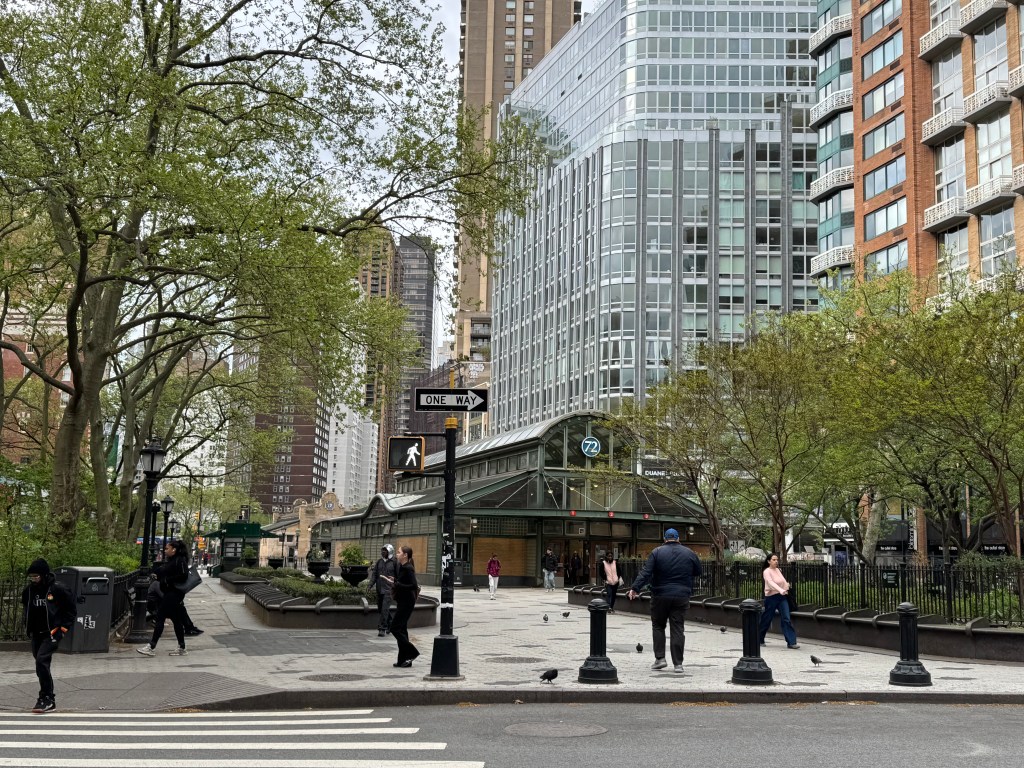
The subway this morning, leaving New York City, back home to Connecticut
My heart aches to experience it all. I sit and watch, feeling stuck where I am; on a moving train that is going too fast. I am unable to really see, experience or touch any of it. Destination known.
I marvel at how at any stop I could really get off. How I could take another train to another destination and experience something new. I could…. Why don’t I? Why haven’t I?
I am a government employee.
A Fork in the Road.
That is the title now infamous email sent to government employees on January 28th. It quite possibly could open doors, new roads, endless possibilities. However, the doors and possibilities are soured by the ruthless ways civil servants have been discussed in the past few months.
I am government employee with a possibility of taking early retirement. I am 49 and was not planning to retire for a while. But the possibility cannot stop lingering on my mind. I want to see the world! I want to get out from under the grind, off the crazy train. The past few years, but particularly the past few months have dampened the passion of flames I once had for work. It was long burning down, but the new administration has left but the smallest of sparks still attempting to burn.
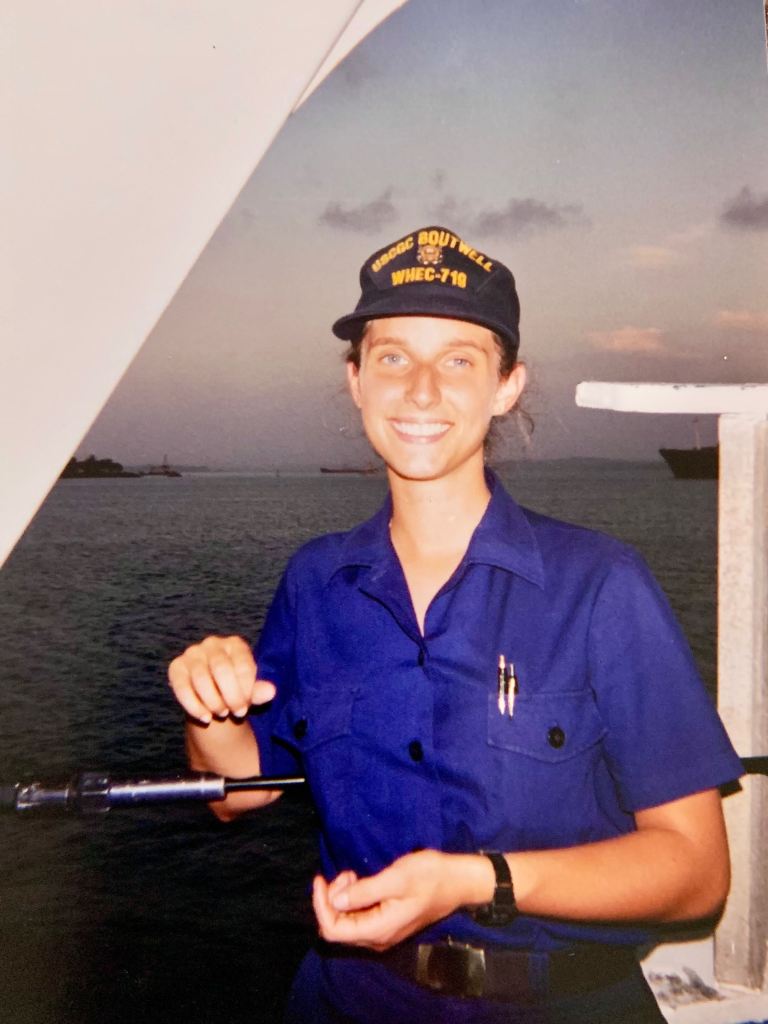
I have given my entire adult life to the United States government. At 18 I went into the Coast Guard. At 22, I continued into the active reserve pool and became a weekend warrior while raising two babies. At 26, I became a civil servant where I have worked ever since.
I’ve been on a train, on the path set out by many. Get an education, get a job, start a family, get the bigger house….
In the past 31 years with very little help from the supposedly educational funds and benefits that tempted me into the military in the first place I obtained a Professional Secretarial Certification, a Bachelors in Business Administration, an MBA, and a certification Healthcare Analytics.
There were countless other trainings I took through work or on my own. Regardless of where I took these trainings, I immediately gave everything I learned back to the government through my work. Up to and including teaching yoga.
I chose the government because like many undiscussed Americans, particularly second generation Americans, I grew up not have basic securities met. We always had food, though food security was something my parents often struggled with. There were enough clothes and enough help to feel ok. We did not have healthcare and my parents did not have jobs with paid vacation or sick time. Retirement is still out of the question for my 74 year old father. My mother passed away at 49, in part to smoking; but more in part to not having access to healthcare.
I chose the military for the benefits. Paid education, vacation days, and healthcare. The military also seemed as if it were fair and just, that there were rules that had to be followed and consequences for breaking those rules. My home seemed to be a place where there were no consequences and no rights for women or children. As a teenager with looming uncertainty of my future, the military recruiters at the tables stationed around my high school looked healthy, happy and secure in themselves. I wanted that for myself too.
I still don’t know if recruiters purposely mislead or they themselves do not know, but many of the things I was told were only partial truths. Healthcare is not for life unless you are destitute once you separate from the armed forces. The Montogomery GI Bill hardly paid for a semester let alone an education. I was not able to apply for specialty school right out of bootcamp as an E-3, a benefit I personally took advantage of because I had spent 3 years in junior ROTC. The immediate bump from E-2 to E-3 wasn’t a huge benefit, but the one that likely made what was a tough decision at the time for me. A decision that ended up being a very good one for my life.
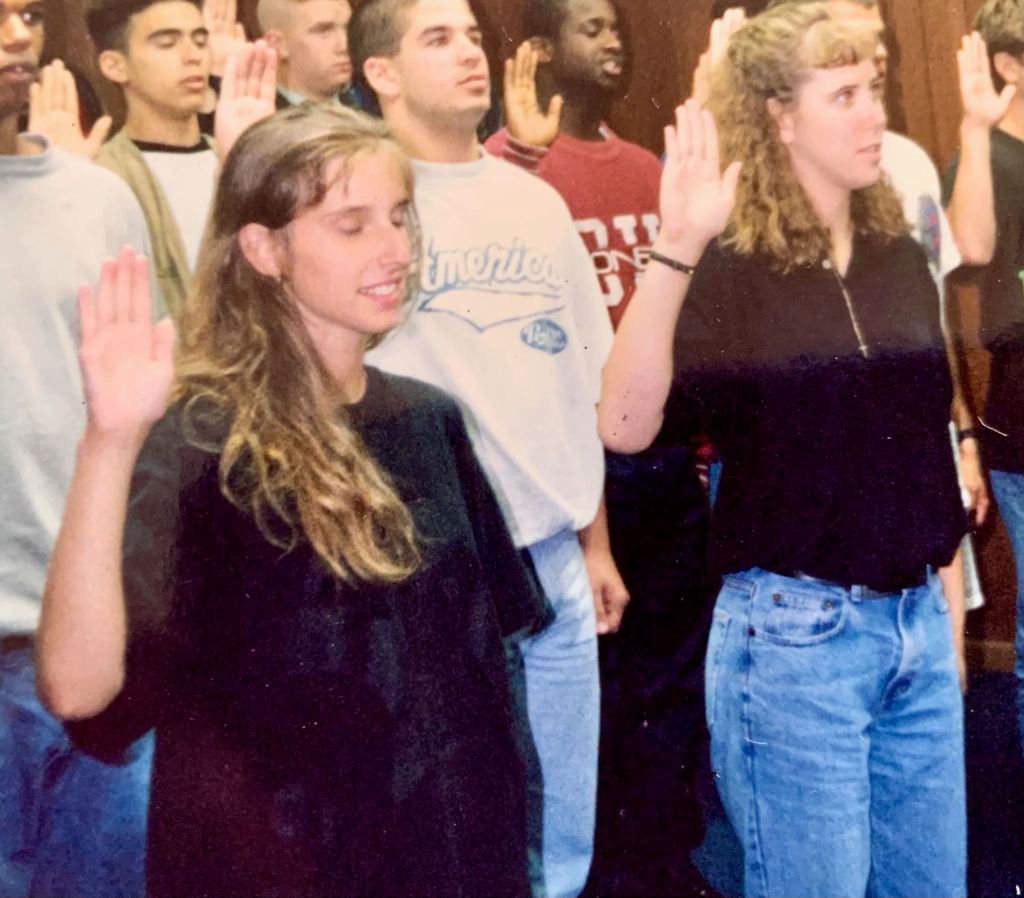
Swearing into the United States Military at MEMPS in Brooklyn NY August 9, 1994
From that time, and into my career, and until this very day; there were spouted benefits. Benefits that lured me in, but were not what they seemed to be. Benefits that few who are the gatekeepers to obtaining these benefits even seem to know about.
My earliest experience was the lack of knowledge at my first duty station on being an E-3. Then seemingly gregarious barriers to putting my name on a wait list for specialty school. I did everything I was supposed to as quickly and efficiently as I could. It seemed to surprise people that I had the oomph to push through the barriers and keep pressing until I got the answers I was seeking. It seemed unnecessarily difficult, but that was only the start of many years ahead of pretty much the same.
I met and married my first husband who was also in the military at the age of 19. We had no plans of having children anytime soon, but I did know about the benefit to females of taking two years off to raise a child and coming back to finish any required time that was owed to the government.
When my husband and I were re-located and co-located from the west to east coast, the new dispensary that I was assigned did not carry the birth control pill I had been on for years. I was prescribed a new pill and immediately experienced unwanted side effects. When I went to the dispensary to discuss these issues; they took some bloodwork to ensure I was not pregnant, prescribed a new type of pill, and asked me to not take any pills until my next cycle.
My newlywed husband and I were careful, but obviously not careful enough because I never did start that next cycle. I was unintentionally pregnant at 20 years old. My new duty station (which was for the first time in my career on land [opposed to on ship]) helped me to apply for the two year program to raise a child. The administrators and I could not foresee my request being denied because I owed 2 exactly two years and my husband was also a service member.
The request was denied without an explanation. We were flabbergasted. The men and their wives at my at my station were so supportive and helped me and my husband with taking care of our newborn child. I will forever be grateful for the rallying and support provided.
October 1996, pregnant with my first born
My baby Thomas at just over a year old with his daddy
Two years later my owed time was up and I had the option to reenlist. For the majority of non-Air station based jobs, most Coast Guard members were required to be stationed on a ship alternating with land stations. Unless they specifically wanted to be on ship duty or if circumstances called, folks were allowed to be stationed on land for back to back tours.
The military does married couples the honor of trying to station couples together or close by. My husband’s tour was also up. His job required him to be at an Air station which were far and few between. Air stations at the time also required a 1 in every 3 or 1 in every 4 evening overnight obligation. My job as a cook was one of the few jobs in the Coast Guard that did not require overnight stays at all. It was the only way we were able to get by raising our son until that point. That and the help from the members of my station.
Service members have some input on where they would like to go by filling out what was referred to as a “Dream Sheet”. We filled out our dreams sheets and requested to go anywhere in the world as long as I could be stationed at a land station nearby an Air station so I could be home every evening with our son. It should not have come as a surprise when this reasonable request was denied. Yet it was a surprise and felt like a blow.
The Commanding and Executive Officers who were fond of my hard work, impressed that I finished a secretarial certificate and was taking college classes, and who were already upset from the denial for the maternity leave I asked for were also infuriated. The Commanding Officer (unprompted) wrote a letter asking for my request to be reconsidered because he felt I was just the kind of person that the Coast Guard should want to keep. He received a response back saying that it was my turn to go on a boat and if I didn’t like it, I did not have to re-enlist.
I did not reenlist.
I enlisted into the Active Reserves for four years instead. My husband stayed in and I became a military spouse. We had another baby and I finished my bachelor degree.
Four years later in 2002, both my husband and I had completed all required obligations to the military. It was not long after 9/11 and we decided to take a plunge into the civilian world.
Finding work in your twenties hot out of the military with little other work experience and family obligations is not easy. I was interested in federal employment because of the benefits and pension.
I applied to dozens of government and private sector positions. It took about 6 months to find a temporary grant funded government position.
During my first few years as a civil servant I applied for the programs and leadership trainings that were available, but I was denied participation because I was not a permanent employee. I went back to school (out of pocket) while working full time and raising 2 children for an MBA.
I used the information I was learning in school and my personal drive constantly to make my job, my role, and in turn my organization a better place. In 2007 I finished my Masters degree and landed a full time permanent position. About 5 minutes later I was asked to teach and mentor students in the programs I had never taken and had been denied access to. I was not snarly or punishing because I paid for and took my own initiative to learn what they denied me access to. I excitedly obliged because I wanted to provide my organization with the passion and knowledge I myself wanted to share.
MBA graduation in 2007
I cannot believe that was 18 years ago. Since then I’ve learned even more. In my journey as a government employee I’ve changed as a human, but maintained exceptional performance reviews for every single rating period for 31 years without fail. I have given the government every piece of knowledge I learned, and for many many years, many more hours than I was ever paid for.
I have since been divorced and remarried. My children have grown and left the nest. I’ve taken many other trainings at work and outside of work. I trudged a personal journey of experiencing C-PTSD from childhood which involved drinking, recovery and a lot of therapy.
Very typical office set up I had (back in the days I had an office that is)
At my ‘hands down’ favorite position I held in Primary Care
Screenshot
Group of lady work friends I had for many years
I’ve been on the path. I was not planning to retire now. I have more to give. But do I want to give it to the government anymore???
My heart has not been in it a while. And the current administration seems to admonish and mock employees like myself.
Until this very day I am dealing with “benefits” unknown to those who are the gatekeepers. My latest escapade involves healthcare. I have been paying for health insurance for a family through the Federal Employee Health Benefits (FEHB) since 2002. A few years ago while I was undergoing intensive outpatient therapy I was part-time and we used my husband’s insurance because the employee share for part-timers is unaffordable. We switched back to my insurance over 4 years ago, but the government has a stipulation that upon retirement in order to keep the FEHB for life, you have to have paid FEHB for the 5 consecutive years prior to retirement.
This is what stopped me from Taking the Fork in the Road back in January. Healthcare. One of the very reasons I entered into the federal workforce 31 years ago. The lack of which (healthcare) I attribute to my mom passing at 49 years old. The very age I happen to be at the moment.
The only time I did not pay for healthcare was for the short period of time I shortened my work hours to deal with mental health issues.
Most veterans have mental health issues. Most individuals enter the military because the benefits outweigh the personal risks. Most individuals who join at a young age do not have many other options. Those lack of options, lack, limit = mental health issues that if not already experiencing, will likely show up later in life when the dust has settled. Like it did for me.
Back in January when the Fork in the Road email was sent, I read all over the place in OPM guidance and other government sources that under VERA authority (when early retirement is being offered) the Office of Personnel Management (OPM) waives this 5 year healthcare payment requirement. I asked about it at the time. No one has ever heard of it. Of course they haven’t. I’ve been down this sad road before. Benefits that are there but unknown or in some way inaccessible.
My Department is offering VERA again due to impending RIFs (Reduction in Force) and this time it specifically states that OPM is waiving the 5-year requirement.
Why am I still here? What do I have to gain?
I think I want to get off the train. I watch the world literally and proverbially whizzing by. A world I long to see and experience.
I am not one of these mystery civil servants you hear on the news. One of these lazy people who is just taking from the population and needs their job to be cut with a sledge hammer. I gave the government more than I gained from it. I know my job can be involuntary cut in a few weeks. If I get to keep a job at all, there is no guarantee it will be at my salary level or that I enjoy.
Yes, there is waste in the government. There is waste in all organizations. The fairness I had been seeking when entering the federal workforce is not on everyone’s side. As employees under the rule of the law, we are mostly indistinguishable from one another. All kind of being lumped in with the bath water that our administration wants to throw out.
As I reflect on my journey, I realize that my experiences have shaped me into the person I am today. The highs and lows, the challenges and triumphs, have all contributed to my growth and resilience. While the uncertainty of early retirement looms, I am filled with hope and possibility. I am ready to embrace change and explore new horizons. My dedication to public service has been unwavering, and I am proud of the contributions I have made. As I contemplate the next chapter of my life, I am reminded that there is so much more of me to give. The world is full of opportunities, and I am eager to seize them.
“Yoga is the journey of the self, through the self, to the self.” – Bhagavad Gita
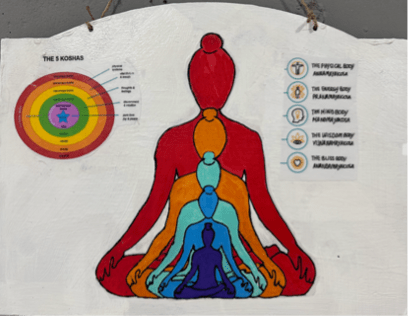
In the ancient Vedic texts, we find a beautiful framework for understanding the self beyond the physical body. Known as the Panchamaya Kosha system, this five-layered model is still embraced by yoga therapists today as a holistic map for healing and self-discovery.
Each kosha, or “sheath,” represents a different layer of our being—from the tangible to the most subtle essence of who we are. These sheaths are energetic in nature.
Since this is a conceptual idea, it’s not easily visualized. This is an artistic rendition I created, using inspiration from search engines, to give the model a visual form.
Let’s take a guided journey through each layer, pausing along the way to reflect, breathe, and connect.
Annamaya Kosha: The Physical Body
The outermost layer is the Annamaya Kosha, often referred to as the “food body.” Annamaya derives from the words anna (food) and maya (made of), signifying that the body is composed of physical matter sustained by food. It is the densest of the five koshas and the layer most familiar to us—the physical body that we see and touch.
According to the Bhagavad Gita, it is the body that allows us to engage with the material world and fulfill our physical needs.
Yoga asana (postures) help us strengthen and care for this layer. But it’s only the beginning.
Beyond our physical body exists a subtler, more energetic presence—what the yogis call the life force or prana. This leads us to the next kosha: Pranamaya Kosha.
Pranamaya Kosha – The Breath or Energy Body
Beneath the surface of what we see and touch lies a subtler layer of our being—the Pranamaya Kosha, or breath body. This sheath is composed of prana, the vital life energy that flows through and animates us. It is this energy that sustains every physical and mental function. It’s not too dissimilar to “chi,” as known in Chinese traditions.
This kosha both surrounds and penetrates the Annamaya Kosha, flowing through subtle channels known as nadis—akin to the meridians in Traditional Chinese Medicine. Ancient texts speak of nearly 72,000 nadis crisscrossing our being, creating an intricate web of energy distribution as sophisticated as our physical body.
It is said that when this energetic layer is vibrant and balanced, it manifests as vitality, clarity, and resilience. An imbalanced or blocked pranic flow, on the other hand, can lead to physical fatigue, emotional disturbances, or even illness.
Because prana is intimately tied to the breath, pranayama (breath control) becomes a key yogic tool to nourish and regulate this sheath. Practices such as deep diaphragmatic breathing, alternate nostril breathing (nadi shodhana), and kapalabhati invigorate and purify the Pranamaya Kosha, enhancing the flow of energy throughout the body.
Breath becomes the bridge between the body and the mind. As you become more aware of your breath, you tap into the present moment, calming the nervous system and centering the mind.
Manomaya Kosha: The Mental Sheath
The Manomaya Kosha is the “mental sheath,” representing the mind and emotions. It is associated with our thoughts, feelings, and mental patterns, known in Sanskrit as vrittis. This kosha encompasses the mental body—our emotional responses, internal dialogue, and perceptions of the world.
As one of the more subtle layers of our being, the Manomaya Kosha significantly influences how we interpret experiences and impacts our overall well-being. The mind shapes our interactions with the world and colors our experiences with judgment, attachment, and preference.
Cultivating mindfulness is key to mastering this sheath. By learning to observe our thoughts without attachment, we can begin to detach from mental chatter and emotional turbulence. Meditation is a powerful tool for calming the mind and finding inner stillness.
🧘♂️ Practice Tip: Let your thoughts come and go without judgment. Be the observer, not the story.
Vijnanamaya Kosha – The Wisdom Body
This kosha is the intellectual or wisdom sheath, housing our intuition, discernment, and inner knowing. It’s the layer of deep insight that enables us to distinguish truth from illusion, and ego from the true Self.
“Listen beyond your thoughts to the quiet wisdom within.”
This sheath transcends ordinary thinking. It’s where we connect with spiritual insight and our inner compass, guiding us toward Svadharma—our true calling.
This kosha is about deep understanding—not just of the world, but of our true nature.
Last night I taught a class and went through this exercise to describe what the 3rd and 4th kosha might look like.
Close your eyes and picture a bright red triangle. Where did it come from? Your thoughts created it, but it isn’t real. I suggested it, but the image itself is imaginary. Now ask: Who is seeing that triangle? It’s not your thoughts—they made it. The one seeing it is the witness. That part of you is real. It watches your thoughts come and go without being them.
The red triangle will fade with the next thought, but the witness remains. It observes what arises—whether from outside influence, subconscious memory, or your own deeper wisdom.
Now, imagine that red triangle turning into a dark purple circle. Who made that change? Who watched it happen?
This is the heart of self-awareness: You are not your thoughts. Thoughts pass through like weather. But if you’re not aware, they shape your emotions, breath, and even your body.
The wisdom body discerns the difference between the thoughts and emotions (Manomaya Kosha) and the witness who is unaffected by the thoughts (next kosha). However, your thoughts and emotions do affect your breath and ultimately your physical body. So mind your thoughts!
Anandamaya Kosha – The Bliss Body
At the center of all the koshas lies the Anandamaya Kosha, known as the “bliss body.” This is the most subtle and innermost layer of our being—beyond the physical, energetic, mental, and wisdom layers. It represents our pure essence, a state of peace, joy, and spiritual bliss.
This kosha isn’t shaped by thoughts, emotions, or material form. Instead, it is pure being—the unchanging, eternal part of us, often touched during deep meditation, savasana, or moments of transcendence in everyday life.
It embodies Sat-Chit-Ananda—existence, consciousness, and bliss—where the ego dissolves and unity with all of creation is felt. These aren’t fleeting emotions but deep, abiding joy and contentment, experienced when we are in perfect alignment with our true self.
Practices like meditation, mindfulness, and present-moment awareness help us access this layer. In yoga, it’s the ultimate experience—being one with the divine, at peace, beyond form.
Yoga is not just about stretching our bodies—it’s about integrating all parts of our being: body, breath, mind, wisdom, and spirit. As we journey inward, we realize that these layers are not separate, but interwoven—each one informing and supporting the others.
By nurturing all five koshas, we move closer to our true Self—the eternal spark of consciousness that yoga ultimately helps us remember.
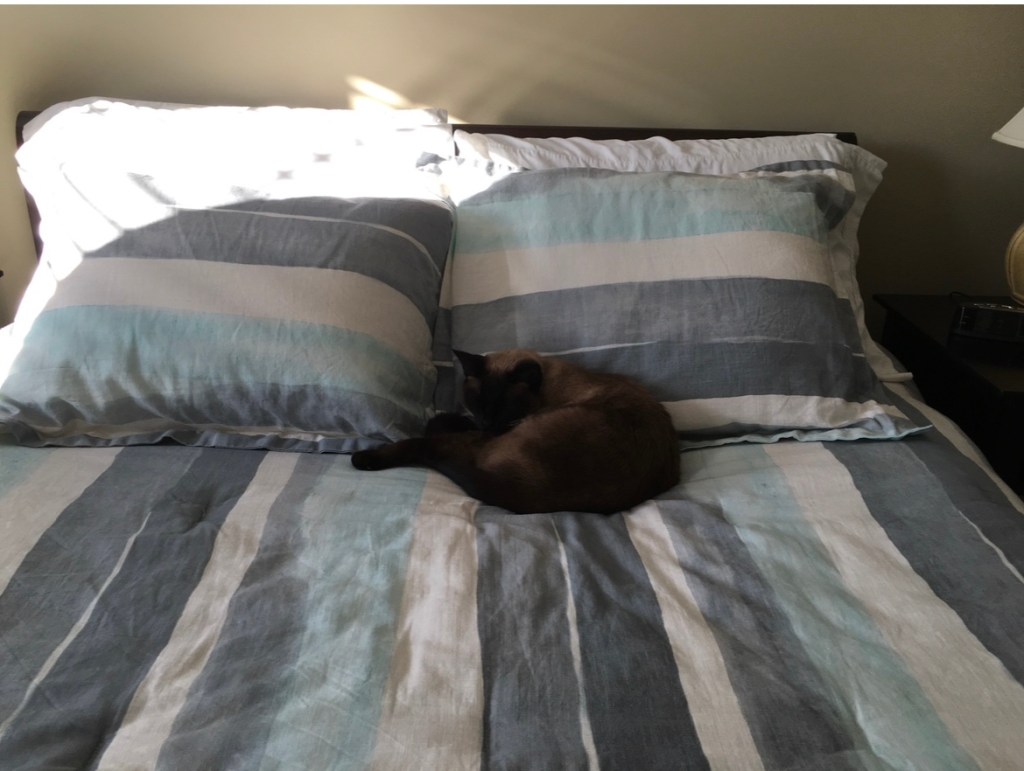
I am told a good life starts in the morning with making your bed.
Do you make your bed?
I’ve heard all reasons of why folks do or don’t make their bed. It is a personal decision. But research shows that people who make their bed are more successful, productive and happier.
I make my bed. I feel energetically better when I do. The room appears neater and I don’t feel schlepy when I crawl back in it at night.
I have also heard people say “why bother?”, it’s only going to get messy again.
There is truth to that. But your body will also get dirty after you shower. Most of us don’t skip showers for that reason.
A lot of people tell me they don’t do yoga or meditate because they aren’t flexible or their minds don’t work that way or they aren’t flexible enough. A funny line in the yoga world is:
“Saying you don’t do yoga because you aren’t flexible is like saying you are too dirty to take a shower”.
Taking it a step closer would be to say that you are too out of shape to exercise.
I hate to break it to you – we are all the same. Our bodies and minds need maintenance and when we don’t maintain them we have a monkey mind and we get out of shape. It’s really that simple. Yes there are exceptions but almost all of them can be overcome.
We can skip cleaning our spaces and making our beds (or weeding our gardens- literally and metaphorically)- but while we are at it, why not skip that shower too? And why bother to exercise? Won’t we become atrophic again when we stop?
To live is to maintain. To live well is to maintain everything about our lives. Our health, our habits, our homes, our finances, our pets… and even our minds. They can all go to pot if we skip the maintenance and loose sight of their health.
Yes- this takes up a lot of the day, but it’s worth the clean and cleared space because what you see around you directly affects what you feel inside you. You can feel it in your energy if you quiet your mind and get in touch with it.
So make your bed and see if anything changes around you.
Namaste
“If you want to change the world, start off by making your bed. This is perhaps the most famous line from Making your bed to perfection each morning is a reminder that if you do the little things right, it makes the big things possible.”









 esterinaanderson.com